

Twenty-five years after her parents’ wedding, Caterina Santi married in Montalcino. Her husband was Jacopo Biondi, a physician. Their marriage joined a third surname to the Tamanti and Santi, and four years later it produced the son who would carry all three family inheritances into the history of wine. It is also the marriage where the published record went wrong, and the civil register sets it right.
The marriage of 22 January 1844
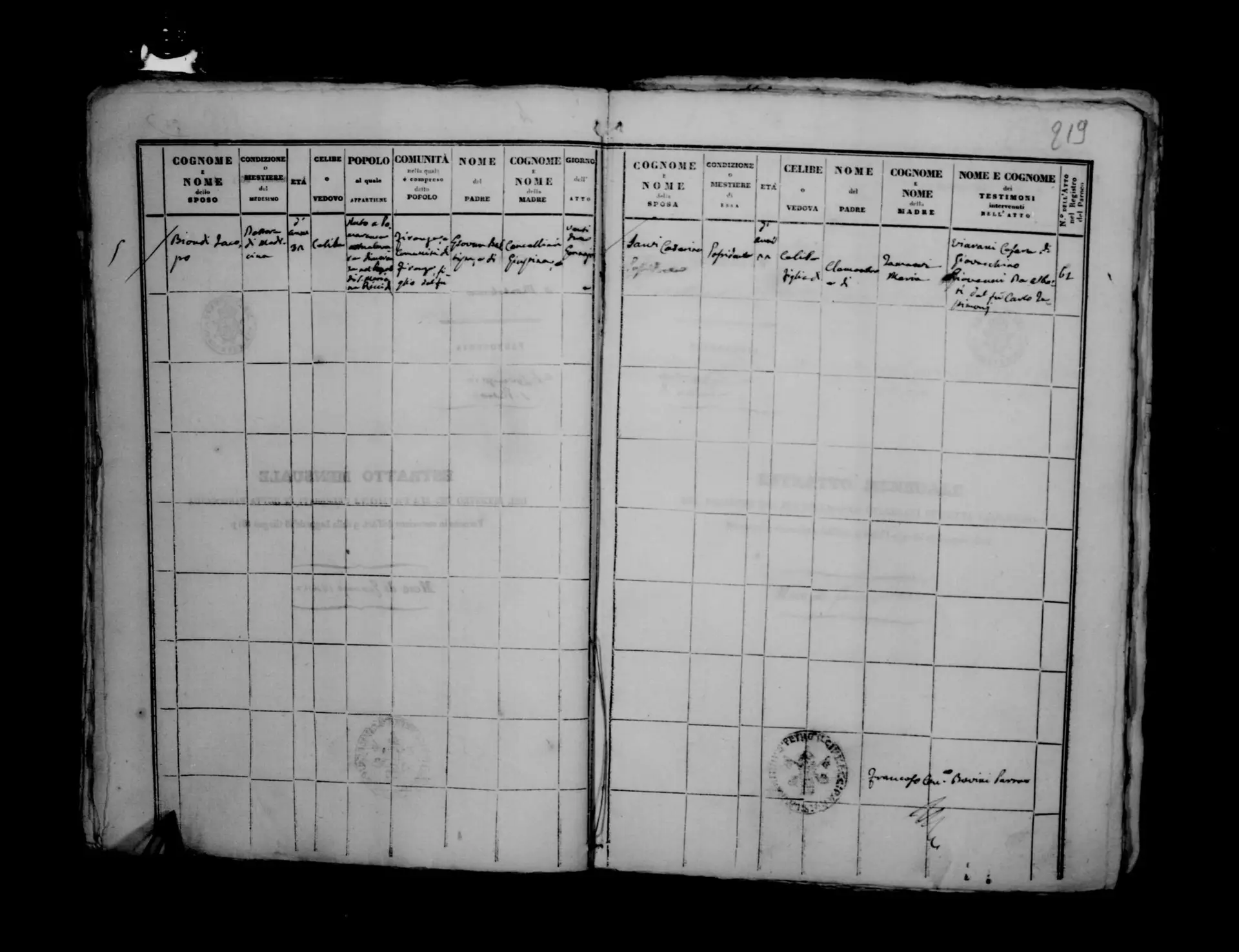
The marriage entry of 22 January 1844 (original on Antenati) records the marriage of Jacopo Biondi and Caterina Santi. Its key detail for this history is the bride’s parentage: Caterina is named as the daughter of Clemente Santi and Maria Tamanti. That makes this entry an independent second witness to the 1819 union, written a generation later.
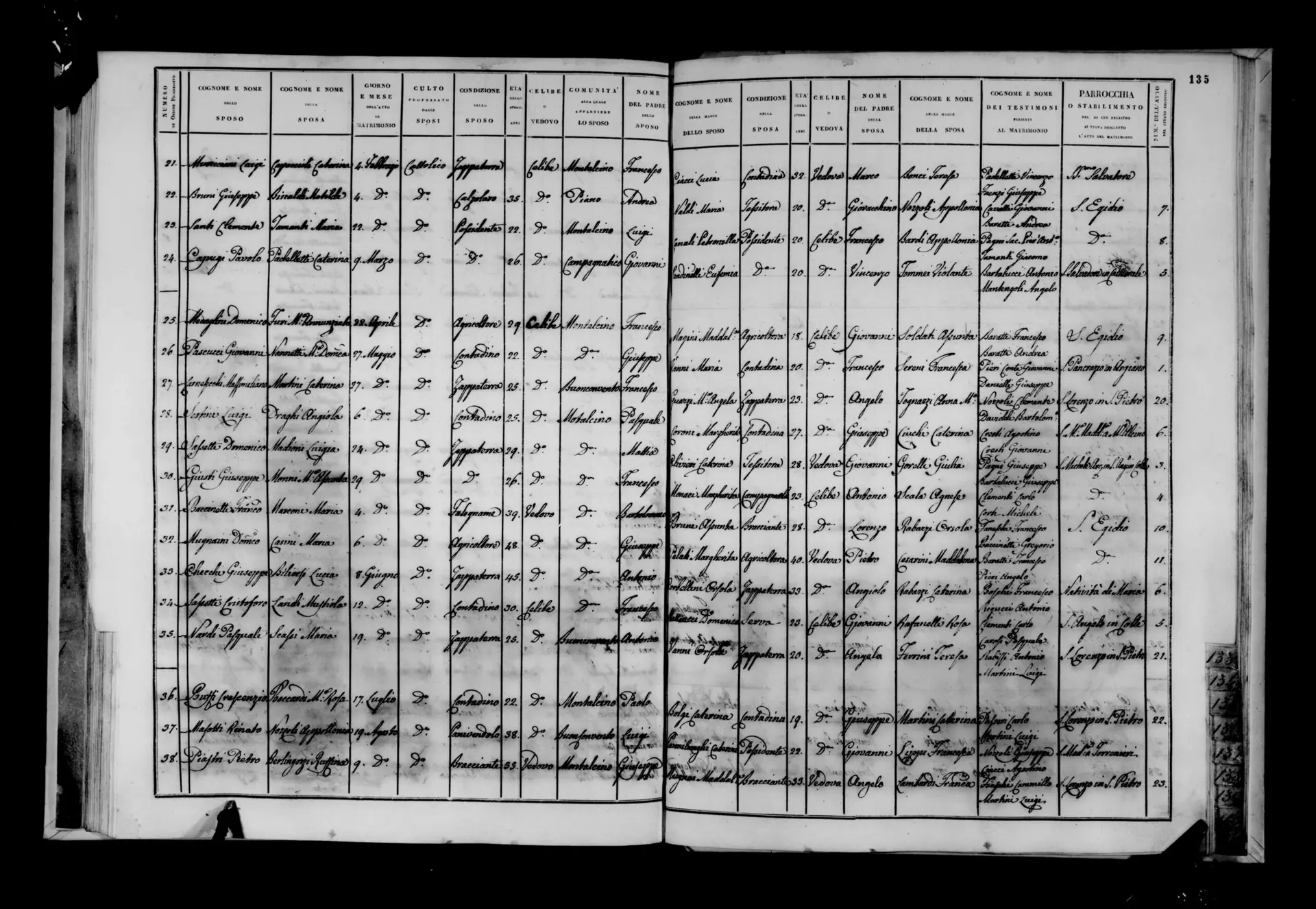
Read together, the two acts form a chain that needs no family tradition to hold it up. In 1819, Maria Tamanti, daughter of Francesco Tamanti and Appollonia Bardi, marries Clemente Santi (marriage act of 12 February 1819). In 1844, Caterina, daughter of Clemente Santi and Maria Tamanti, marries Jacopo Biondi. The Tamanti link to the Biondi family runs through these two documents.
Caterina’s own birth record has not yet been located, so her age at marriage is unknown. Her sister Paolina, born in December 1819, has not been found in the death registers through 1823. Later family history describes Caterina as Clemente’s surviving daughter (Cinelli Colombini, Brunello, ritratti a memoria, 2021, pp. 74–75).
Correcting Carle’s reversed surnames
Lucia Carle’s La patria locale (1996) is the standard published study of Montalcino’s families and the main published source for the Tamanti genealogy. On this point, though, it is wrong. Both her family tree and her text give the marriages as Maria Tamanti with “dr. Clemente Biondi” and her daughter Caterina with “dr. Jacopo Santi” (Carle, La patria locale, 1996, pp. 292, 296).
The civil registers say the reverse, and they say it twice:
- 1819: Clemente Santi marries Maria Tamanti (act 8, S. Egidio).
- 1844: Jacopo Biondi marries Caterina Santi (entry of 22 January 1844).
The difference is more than a slip of the pen. In Carle’s version the Biondi name enters the family first, through Maria’s husband, and “Santi” arrives a generation later. In the records, the Santi come first: Maria marries into the Santi, and her daughter carries the Santi name into a Biondi household. That order explains the famous name that followed. Caterina’s son Ferruccio was legally a Biondi, and in later life he added his mother’s surname, Santi, to his father’s. Carle’s reversed surnames make that combined name hard to explain. The corrected ones make it follow naturally.
The published Biondi-Santi family history by Boldrini, Bruchi and Cappelli (This Is My Land, 2010, pp. 18–19) and two working family trees compiled for this research agree with the civil records. This history follows the registers throughout.
Gaetano Tamanti and the will of 1847
Caterina’s uncle Gaetano Tamanti, her mother’s brother, belongs in this chapter too. In the Leopoldine cadastre of about 1820 he owned the Chiusa house and its fields, the core of what is now the Le Chiuse estate. In 1840 he was still proprietor of the podere Chiusa. That year he asked the bishop’s permission to build a family burial chapel there (Brandi, Studi e Trascrizioni).
Carle adds that Gaetano never married, and that he made a will in 1847 and petitioned the Grand Duke about it. On the same page she notes that the Biondi Santi family came from the marriage of his niece Caterina (Carle, La patria locale, 1996, p. 296). Carle’s source for the will is a private Tamanti family archive. The will has not been seen for this history, and the storybook on which these pages are based does not discuss it. Its terms, its heirs, and whether it touched the Chiusa land are all unknown. For now, it is a lead to follow up, not evidence that Le Chiuse passed from Gaetano to Caterina.
From this marriage, Ferruccio
Four years after the wedding, in 1848, Caterina gave birth to a son, Ferruccio. He grew up in a household where land, pharmacy, agronomy and wine were bound together. According to Stefano Cinelli Colombini, it was through Caterina that Ferruccio later inherited the Fattoria del Greppo, Le Chiuse and lands at Pienza (Cinelli Colombini, Brunello, ritratti a memoria, 2021, pp. 74–75). The deeds and cadastral transfers that would confirm each of those inheritances have not yet been traced. Continue to Ferruccio Biondi Santi and Brunello.
Sources on this page
- Marriage of Jacopo Biondi and Caterina Santi, 22 January 1844, Montalcino, Stato civile della Restaurazione. Local scan; Portale Antenati.
- Marriage of Clemente Santi and Maria Tamanti, 12 February 1819, Montalcino, S. Egidio, act 8. Local scan; Portale Antenati.
- Lucia Carle, La patria locale. L’identità dei Montalcinesi dal XVI al XX secolo (Regione Toscana / Marsilio, 1996), pp. 292, 296.
- Maurizio Boldrini, Bruno Bruchi and Andrea Cappelli, This Is My Land: Franco Biondi Santi, Montalcino and Brunello (Protagon Editori, 2010), pp. 18–19.
- Stefano Cinelli Colombini, Brunello, ritratti a memoria, 2nd ed. (Fattoria dei Barbi, 2021), pp. 74–75.
- Don Antonio Brandi, Studi e Trascrizioni (online compilation), 1840 Cappella della Chiusa record.