

Antonio Tamanti was born into Napoleonic Tuscany and died a few years before Montalcino became part of the Kingdom of Italy. In his lifetime the town’s old landed families were drawn into talk of roads, railways and farm improvement. Antonio is the man through whom the family line continues. He is also the clearest example of how the Tamanti combined a professional title, land in the countryside and a house in town.
A birth in 1810
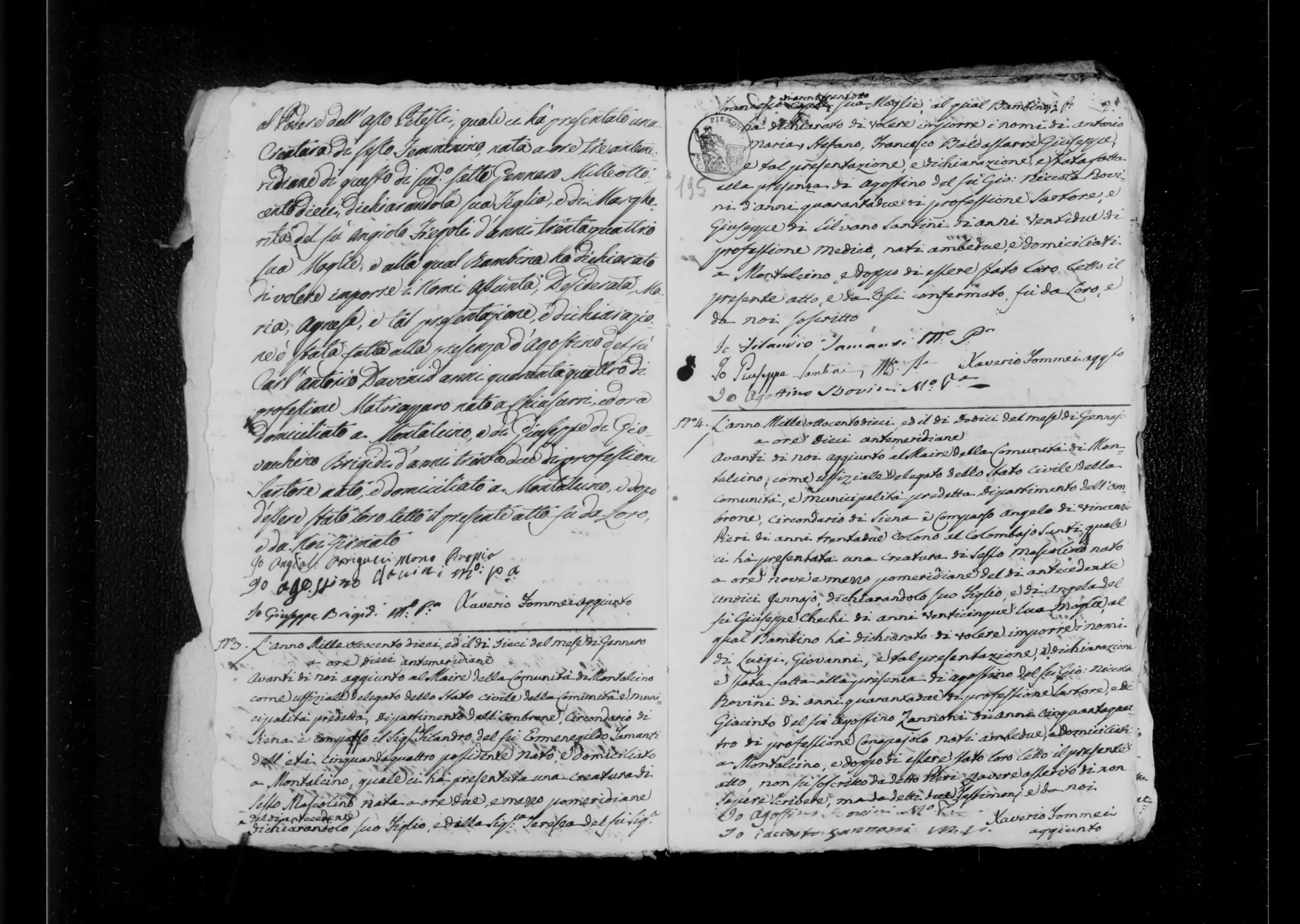
On 10 January 1810 the civil register recorded the birth of Antonio Tamanti, son of Filandro and Teresa (birth act, Nati reg. 61, act 3; original on Antenati). Carle’s genealogy calls him “dr. Antonio” and gives his dates as 1810–1854 (Carle, La patria locale, 1996, p. 298).
Land in the country, a house in town
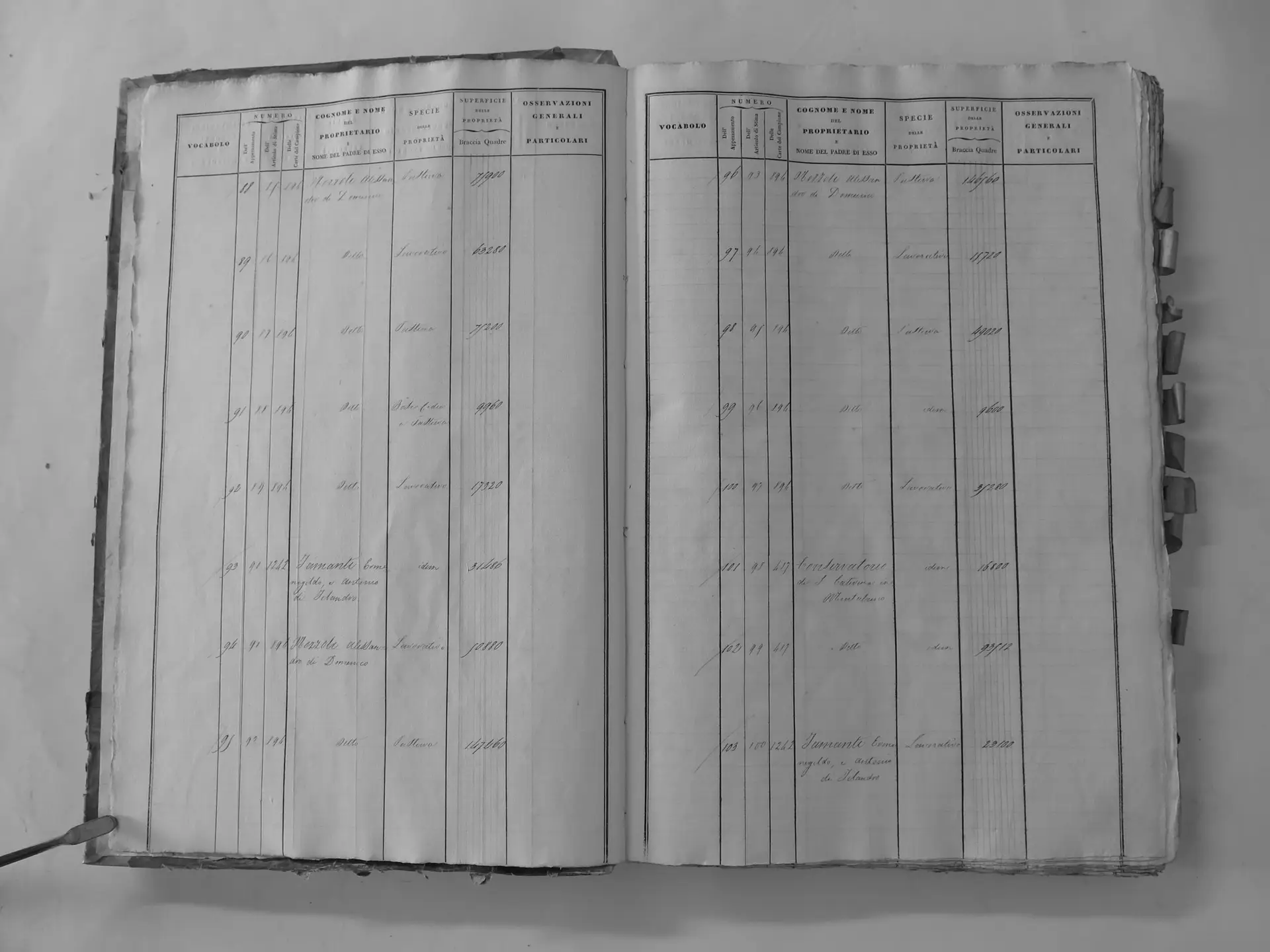
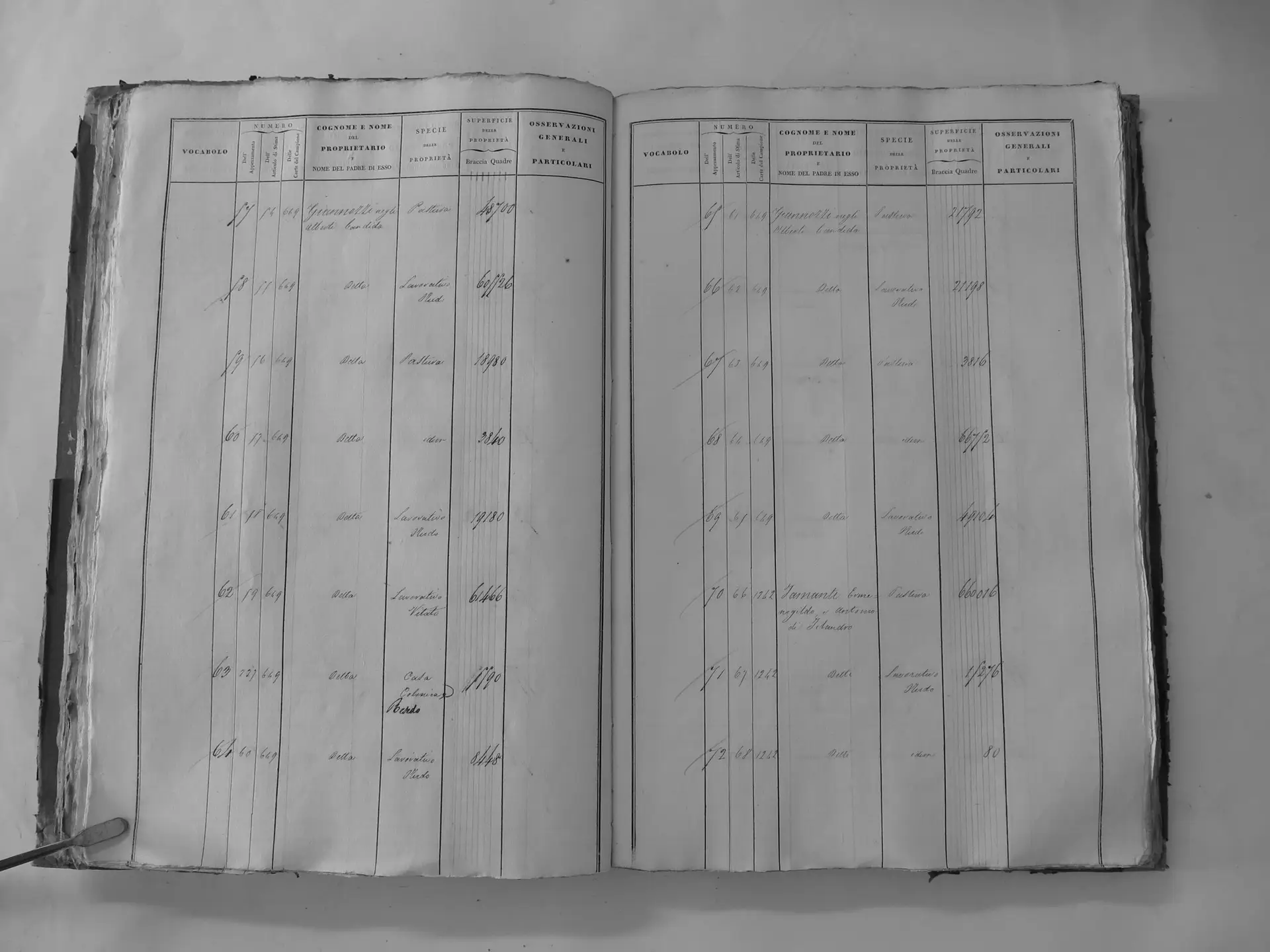
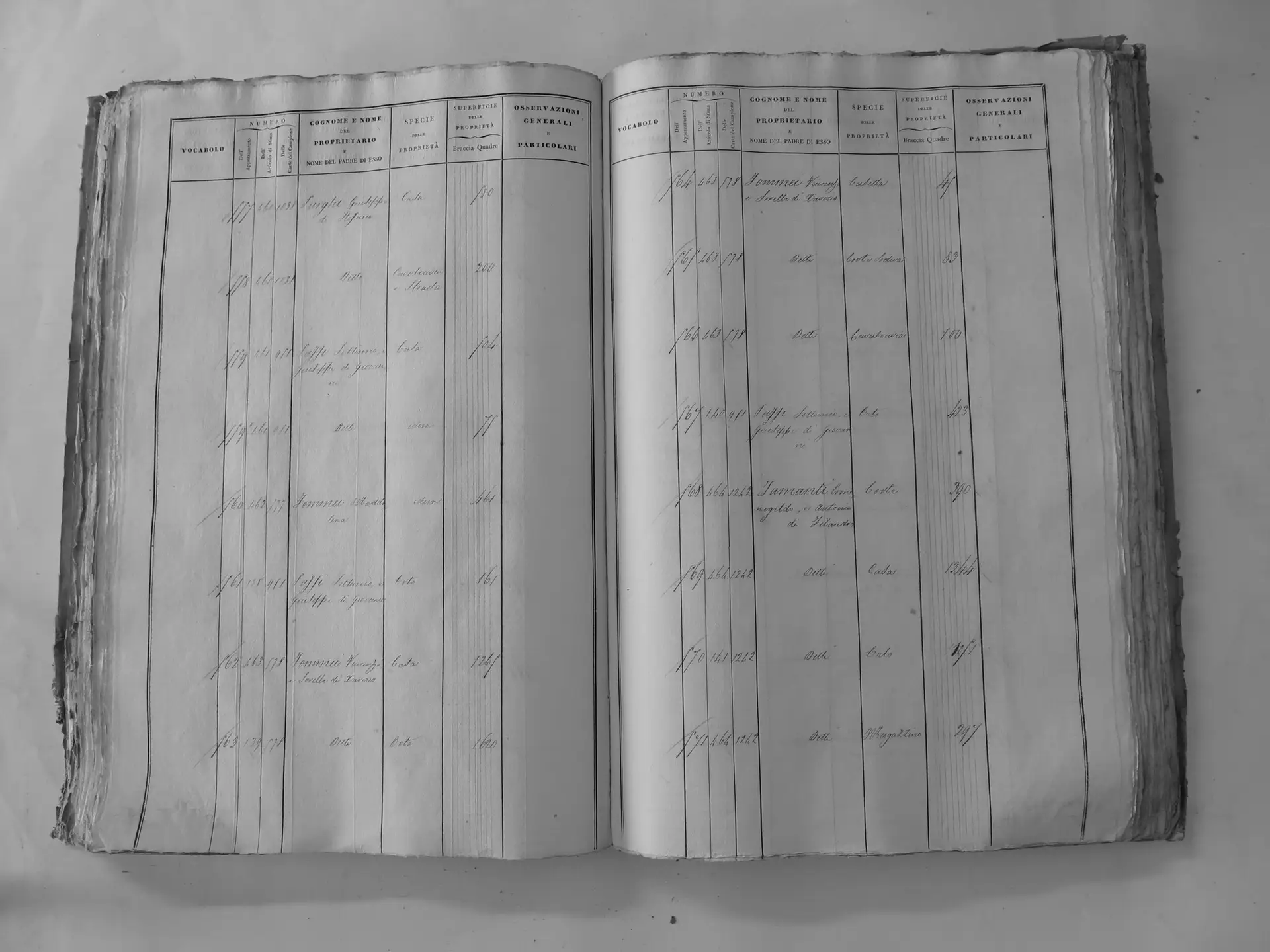
Antonio was still a boy when the cadastre of about 1820 recorded him and his brother Ermenegildo as joint owners of Il Casato. This was a working estate of 98 parcels at Sparampaglia, with fields, vines, woods and a farmhouse with a stable. The brothers also held land in section A of the cadastre and at Osservanza (Tavole indicative, Tomo I p. 9; Sparampaglia ledger, Tomo II p. 82). Around 1835 the same brothers were registered as owners of the town complex known as Casa Tamanti: a courtyard, a house of about 457 m², a garden and a storehouse on parcels 568–571 (Tavole indicative, Tomo III p. 164, as identified by the local historian Luisa Scrivani). The owner identifies parcel 569 with the footprint of today’s palazzo.
Gonfaloniere, census and railway
According to Carle, Antonio was Gonfaloniere of Montalcino, head of the town council, from 1835 (Carle, 1996, p. 298). The 1841 census, as reconstructed by Luisa Scrivani, lists “Tamanti Antonio, 31, proprietario” in the parish of Sant’Egidio. In the same year Ermenegildo, 37, is listed as a proprietor in San Lorenzo in San Pietro (Scrivani, Era il 1841 a Montalcino, pp. 107, 112, 132). Name, age and status all match Dr Antonio. Because the entry gives no address or title, the identification is high-confidence rather than proven.
Antonio had taken his doctorate in civil and criminal law at Pisa, and a Siena court judgment already calls him “Dottor Antonio” in December 1832. He held liberal views. In August 1844 “Antonio Tamanti di Montalcino” was one of eight promoters, and the only one from Montalcino, who appealed to the people of Siena to pay for the engineer Giuseppe Pianigiani’s survey of a railway from Siena to the Leopolda line at Empoli. The 4,000 lire needed were raised “in pochissimi giorni”. The Grand Duke allowed the studies on 3 September 1844, the promoters launched a company with ten million Tuscan lire of capital on 23 December, and a motu proprio of Leopold II dated 5 June 1845 and published on 9 June, which opens by naming the eight promoters, gave them the right to build and run the Strada Ferrata Centrale Toscana for a hundred years (an older printed account gives 5 April; the decree itself, reproduced in a parliamentary dossier of 1861, settles the date). Antonio signed the company’s statutes and on 14 June 1845 was elected a substitute member of its first board, but stood down in favour of Augusto de’ Gori Pannilini. That year, 1845, he was also gonfaloniere of Montalcino. In 1839 he had bought from the Brunacci guardians the farms of the Madonna del Piano, with the San Pietro mill, and the Capanna, with the woods of the Macchie del Battellolio, for 3,759 scudi (deed of 6 December 1839, notary Mario Costanti). In the printed lists the other promoters carry their titles of count, marquis or cavaliere; Antonio is simply “Antonio Tamanti, di Montalcino”. In 1845–47 he also served as Regio Economo, administering the revenues of Montalcino’s vacant bishopric, and in February 1849 “Dott. Antonio Tamanti” spoke at a special session of the town’s democratic Circolo. His full story, including his lost court case over the bishop’s livestock, is on his family leader page.
The railways promised to carry people and farm produce well beyond the hill towns. Within the same few decades the Santi and Biondi Santi branch of the family was beginning to make wine intended for long ageing.
The marriage of April 1847
At about 37 Antonio married. A monthly return from the parish of San Lorenzo in San Pietro for April 1847 names him as the son of Filandro and Teresa, of the parish of Sant’Egidio. It names his bride as Fidalma Muzzarelli, daughter of Leopoldo (marriage entry, April 1847, no. 22; original on Antenati; parish cover sheet).
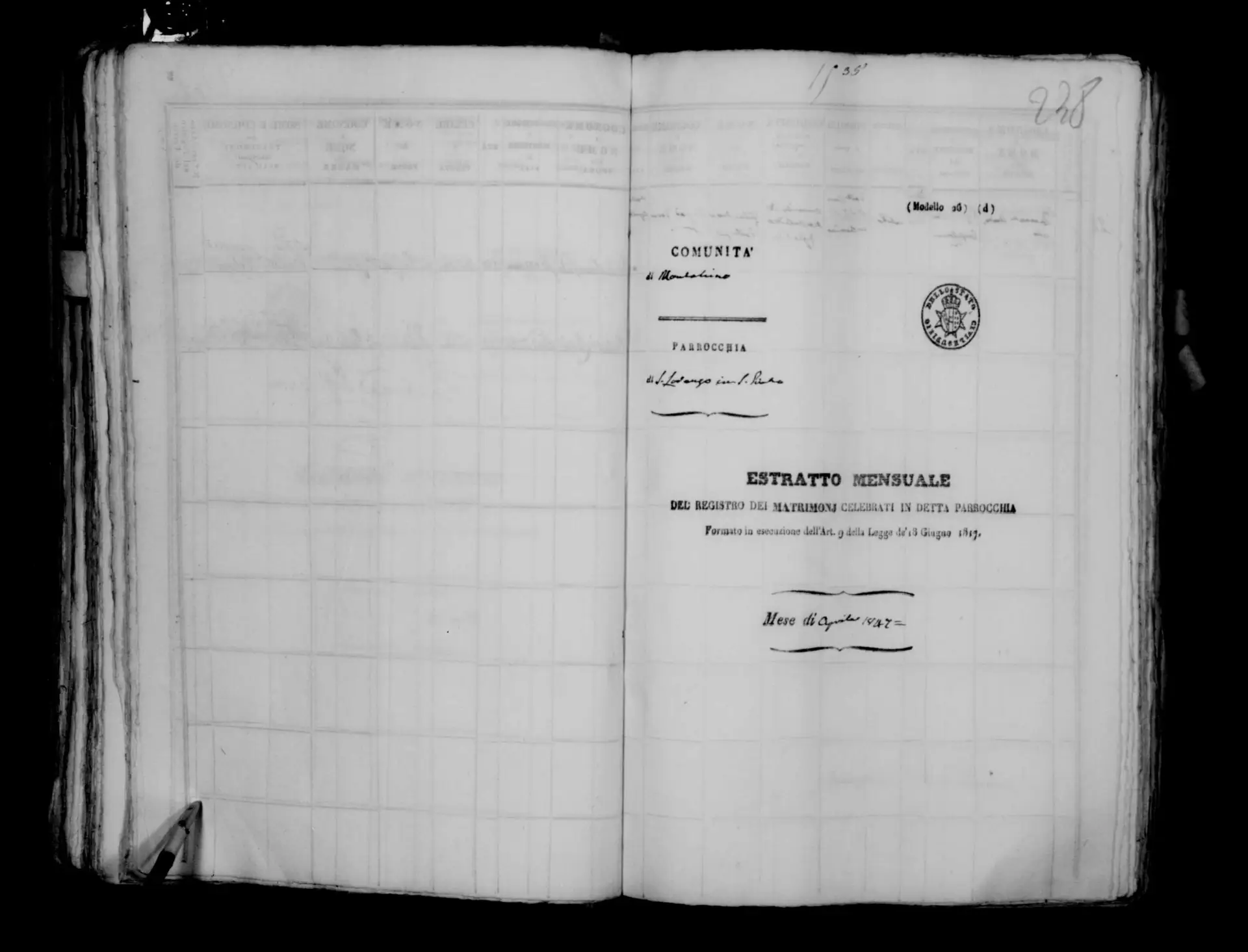

An earlier reading of this entry gave the bride’s name as “Giuditta”. That was a misreading: Carle names her as Fidalma Muzzarelli (Carle, 1996, p. 298), Antonio’s death act of 26 September 1854 calls him the husband of Fidalma Muzzarelli, and her own death act settles the rest. Fidalma, daughter of the late Leopoldo Muzzarelli and Palmira Pieri, was born in Montalcino, not Fano as a literal reading of Carle suggests. She outlived her husband by more than fifty years and died in the family house, Corso Vittorio Emanuele 17, on 15 December 1906, aged 89. She lived to be godmother to her granddaughter Luisa in 1884 and to see her granddaughter and namesake Fidalma married in 1901. The exact wedding day still needs the full parish act.
Giacomo’s marriage, 1848
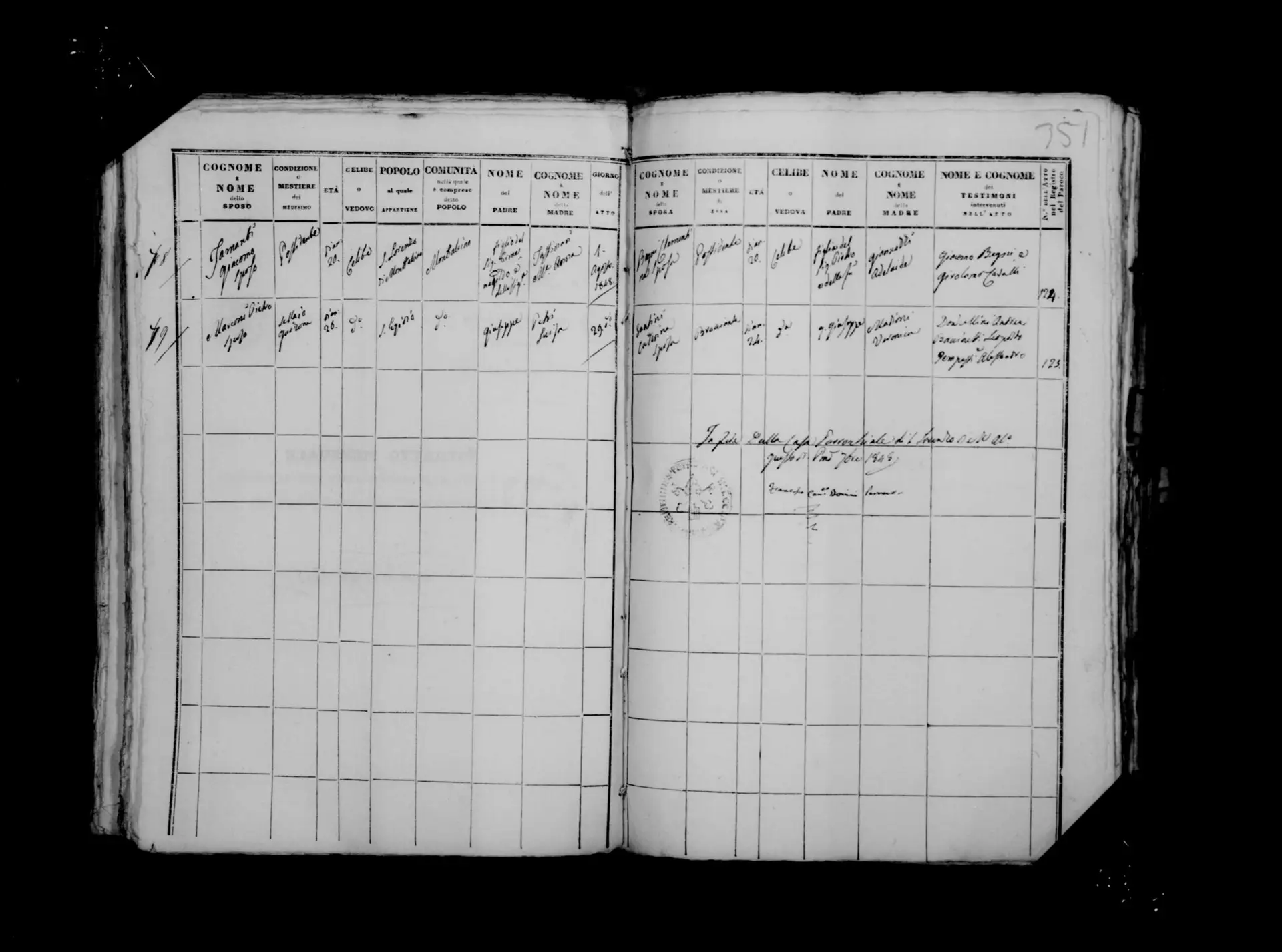
On 1 August 1848 Giacomo Tamanti, son of Ermenegildo, married Clementina Bagni (marriage entry of 1 August 1848; original on Antenati). This Giacomo was Antonio’s nephew, born about 1828. He was probably named after his great-uncle, the Giacomo who died in 1819. The storybook reads his mother’s name as M. Rosa Tassinari, but the reading is uncertain. An archive inventory lists a dossier on the betrothal and dowry of Ermenegildo Tamanti and Marianna Tassinari (Gabinetto Vieusseux, Tassinari-Colnaghi-Malvani inventory, TCM.Ta.II.4). Whether Marianna and Maria Rosa are the same woman is not yet established.
Ermenegildo’s Etruscan urn
Antonio’s elder brother Ermenegildo (1804–1872) owned an antiquity. The Corpus Inscriptionum Etruscarum, the great nineteenth-century collection of Etruscan inscriptions, records under no. 213 a small limestone ossuary, a burial urn for ashes, with an incised inscription. It had been found at San Quirico d’Orcia “in praedio qui dicitur dei Cancelli ad torrentem la Tuoma”, on the farm called dei Cancelli by the Tuoma stream, and was kept “olim Montalcini apud Ermenegildum Tamanti”, formerly at Montalcino in the house of Ermenegildo Tamanti. The scholar Ariodante Fabretti had seen it himself: his Corpus Inscriptionum Italicarum of 1867 (no. 440 quater a) describes the limestone “arcula”, 32 to 33 centimetres wide and 27.5 high, as “servatur Montalcini apud Ermenegildum Tamanti”, kept at Montalcino in Ermenegildo’s house, and prints its two-word inscription, read today as title pupae, the name of the person whose ashes it held. Fabretti thanks “il dottor Clemente Santi da Montalcino”, husband of Ermenegildo’s cousin Maria, among the correspondents who sent him paper impressions of inscriptions, and the very next entry in his book, an urn from Lucignanello, was sent by Clemente in November 1865; Clemente was very probably the channel through which the Tamanti urn reached the scholar. By the time the Corpus was compiled, around 1890, Ermenegildo was dead, and the editor could not find out where the urn had gone: “nunc Tamantio mortuo ubi sit, non comperi”. Whether Ermenegildo collected antiquities or simply came by an object found on someone’s land, and what became of the urn when his estate was divided, are still open questions.
The later 1800s
Antonio died on 26 September 1854, aged forty-four, only seven years after his marriage. The line continues through his only son, born on 6 November 1852 and registered as Francesco Carlo Alberto Federigo. He took the name Antonio at confirmation and is called Antonio in most later acts. He married Maria Giuliani at Lucca on 15 November 1873, farmed the family estates, served as councillor and assessore of Montalcino, and died in the family house on 23 December 1932 (family leader pages: Francesco Antonio, Maria Giuliani). Montalcino joined the Kingdom of Italy in 1860.
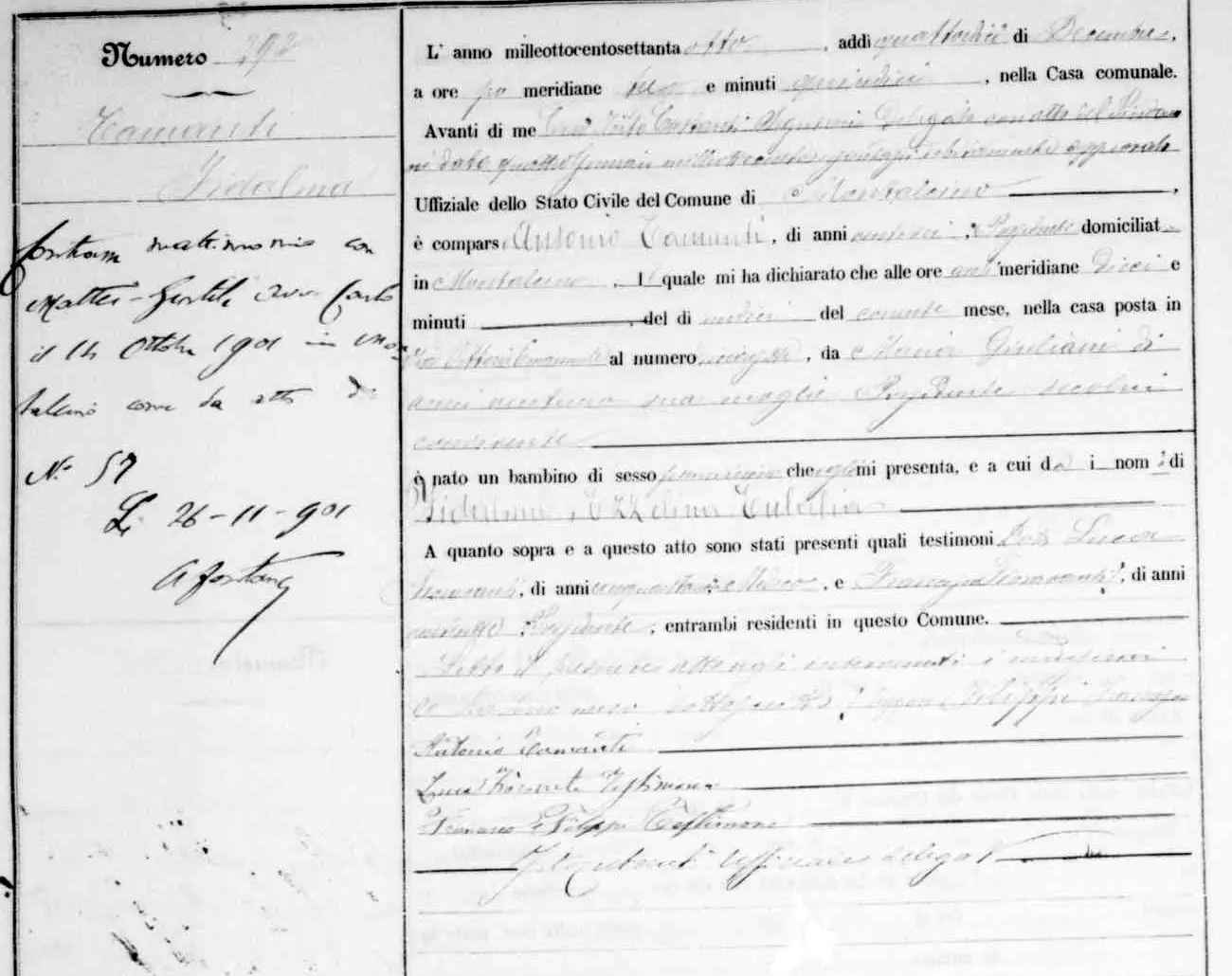
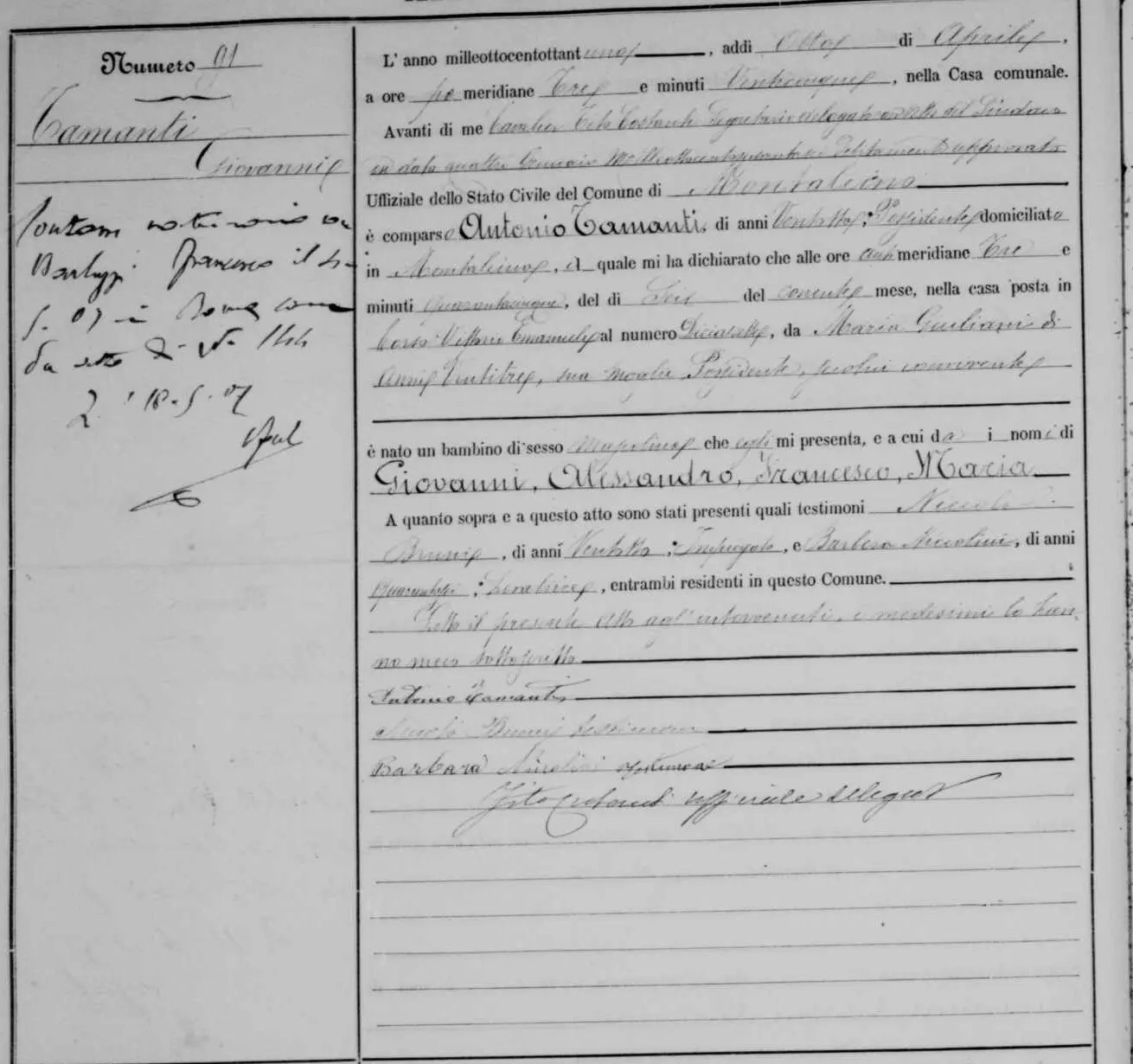
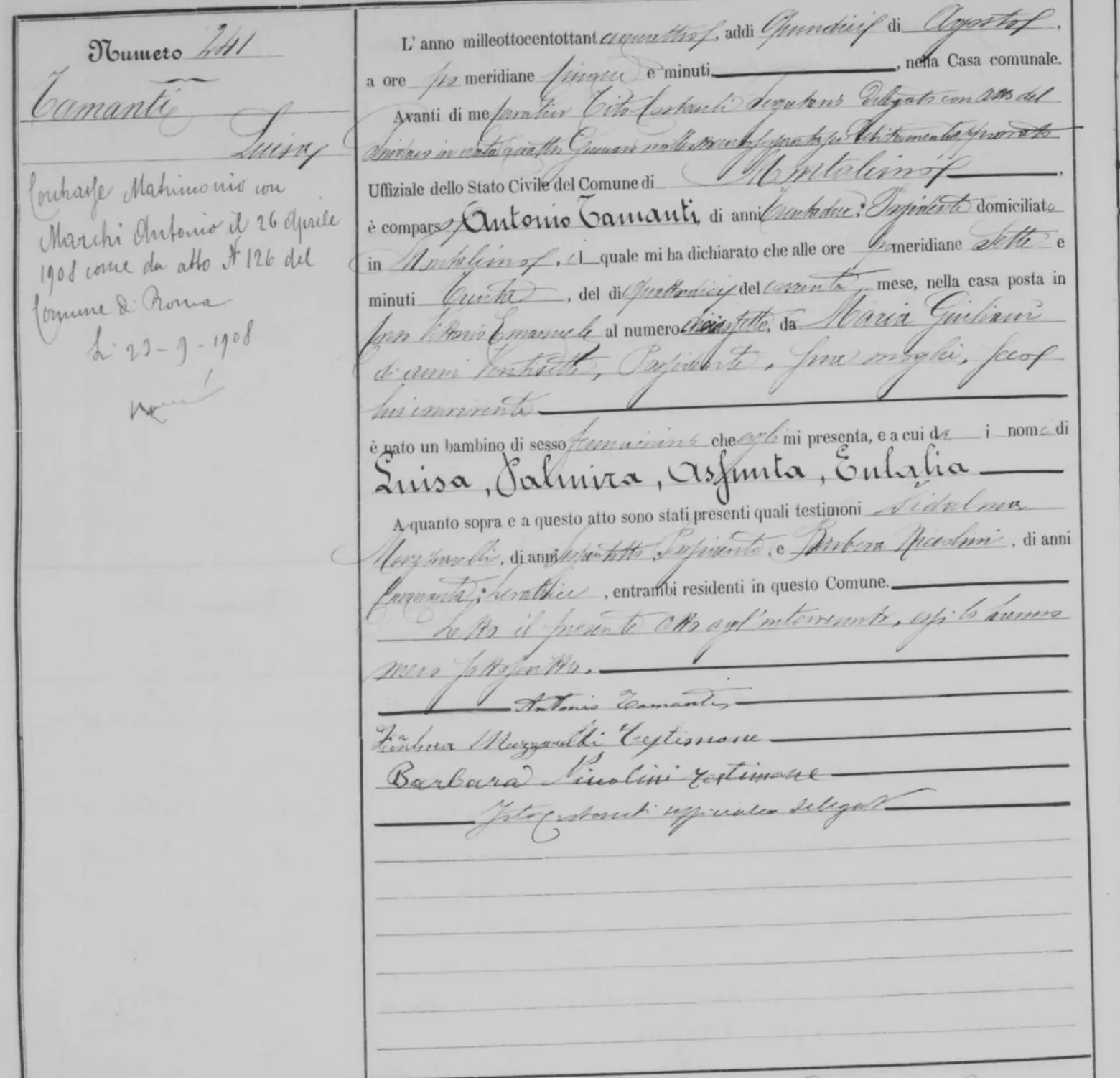
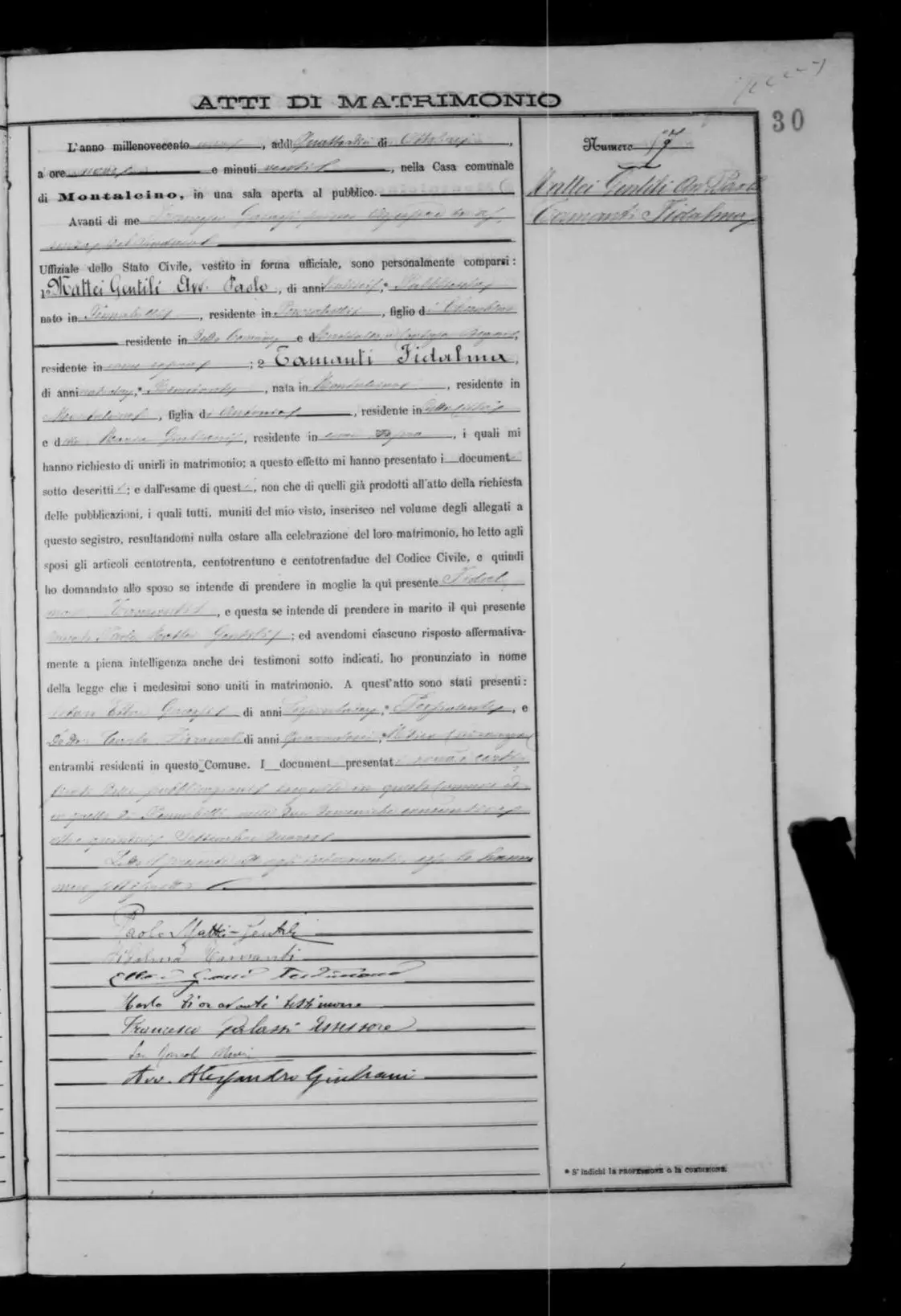
Three Tamanti births of these years are held in the civil registers: Fidalma Tamanti in 1878 (act 292), Giovanni Tamanti in 1881 (act 91) and Luisa Tamanti in 1884 (act 241). Giovanni’s parents were Francesco Antonio Tamanti and Maria Giuliani, and he was the officer who fell at Col di Lana in 1916. Fidalma married Paolo Mattei Gentili in Montalcino on 14 October 1901 and moved with him to Rome, where they raised eight children. That marriage record calls her father Antonio, “the landowner” (marriage act, 1901, act 57; Severini, “Mattei Gentili, Paolo”, Dizionario Biografico degli Italiani, vol. 72, 2008). That Antonio is Francesco Antonio: the parish baptisms of all four surviving children, Giuseppe (1876), Fidalma (1878), Giovanni (1881) and Luisa (1884), call their father “Antonio (Francesco) Tamanti”, son of the late Dr Antonio, and their mother Maria Giuliani. Luisa married Prof. Avv. Antonio Marchi (1873–1935), professor of Roman law, rector of the University of Macerata and later vice-president of the Siena provincial council, in Rome in April 1908. Luisa was already living in Rome: the civil marriage was celebrated on the Campidoglio on 26 April 1908, and the register (Rome, Matrimoni 1908, act 126) enters her as ‘residente in Roma’, while the bridegroom signed ‘Prof. Antonio Marchi’. He remained tied to Montalcino by his marriage and died there on 10 May 1935.
Avv. Giuseppe Tamanti, Assessore
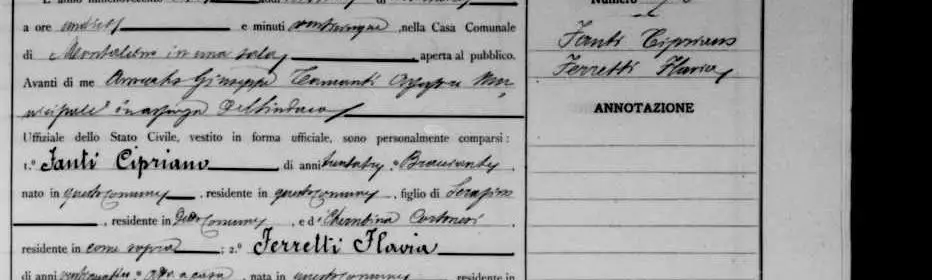
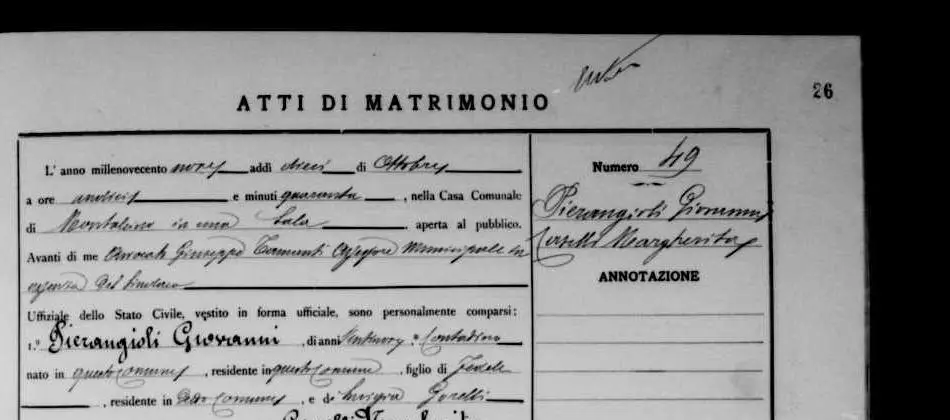
A new generation took on civic office. In 1908 and 1909 the lawyer Giuseppe Tamanti signed civil acts as Assessore, a member of the town’s governing council (1908, act 72; 1909, act 49). The family tree records a Giuseppe Tamanti, born in 1876, son of Francesco Antonio and Maria Giuliani. He married Agnese Calcagni. Their daughter Cecilia married Alessandro Feliziani, and her children still own part of the palazzo. The lawyer and the Giuseppe of 1876 are the same man: Montalcino’s newspaper Il Progresso calls Avv. Giuseppe the “zio” of Giovanni’s son Gianni, and follows his public life for a quarter of a century. He co-founded the paper Libertas and the Unione Popolare, became vice sindaco in 1907, led the Misericordia and the Congregazione di carità, was appointed justice of the peace in 1928 and was president of the Accademia degli Astrusi in 1933. His story is on his family leader page.
Sources on this page
- Lucia Carle, La patria locale (Regione Toscana / Marsilio, 1996), p. 298
- Birth of Antonio Tamanti, 10 January 1810, Nati reg. 61, act 3 (Antenati)
- Tavole indicative, Tomo I p. 9; Tomo II p. 82 (Sparampaglia); Tomo III p. 164 (Città di Montalcino)
- Luisa Scrivani, correspondence of 28 August 2026 (Casa Tamanti parcels 568–571), and Era il 1841 a Montalcino, pp. 107, 112, 132
- Marriage of Dr Antonio Tamanti and Fidalma Muzzarelli, April 1847, S. Lorenzo in S. Pietro, no. 22 and cover sheet (Antenati)
- Marriage of Giacomo Tamanti and Clementina Bagni, 1 August 1848 (Antenati)
- Gabinetto Vieusseux, Tassinari-Colnaghi-Malvani inventory, TCM.Ta.II.4, item 5
- Birth of Fidalma Tamanti, 1878, act 292; Birth of Giovanni Tamanti, 1881, act 91; Birth of Luisa Tamanti, 1884, act 241
- Marriage of Mattei Gentili and Fidalma Tamanti, 1901, act 57
- Marco Severini, “Mattei Gentili, Paolo”, Dizionario Biografico degli Italiani, vol. 72 (Treccani, 2008)
- Archivio di Stato di Roma, Stato civile italiano, Roma, Matrimoni 1908, Parte I, Serie B, act 126 (Luisa Palmira Tamanti and Antonio Teofilo Marchi, 26 April 1908, Campidoglio), via Portale Antenati; Il Popolo Romano, 1908, ‘Matrimoni del 26 aprile’; Il Progresso, 1908, no. 8; G. Nicolosi, La Provincia di Siena in età liberale (Antonio Marchi)
- Avv. Giuseppe Tamanti as Assessore, 1908, act 72; 1909, act 49
- Montalcino death acts: Dr Antonio Tamanti, 26 September 1854, act 85; Fidalma Muzzarelli, 15 December 1906, act 119
- Sant’Egidio parish baptism registers and birth index (1852, 1876, 1878, 1881, 1884), photographed by Valentina Pieri, 1 October 2026
- Railway promoters’ appeal of August 1844; motu proprio of 5 June 1845 (Camera dei Deputati, railway convention dossier, 26 June 1861, scan pp. 17–20); company statutes and first board, Gazzetta di Firenze, June 1845
- Gazzetta di Firenze, 1847, “Avviso per purgazione d’ipoteche” (Brunacci sales of 29 November and 6 December 1839); Almanacco toscano, 1845, p. 466
- A. Fabretti, Corpus Inscriptionum Italicarum (Turin, 1867), nos. 440 quat. a–b and preface (Internet Archive)
- Il Progresso (Montalcino), 1894–1933, via the Comune di Montalcino’s Archivio della Memoria; Ilio Raffaelli, Montalcino (1892–1914)
- Owner’s Ancestry.com family-tree export (GEDCOM), 20 August 2026
- Corpus Inscriptionum Etruscarum, vol. I, no. 213, after A. Fabretti, Corpus Inscriptionum Italicarum, no. 440 quater a, pl. XXVIII (Istituto Nazionale di Studi Etruschi, PDF)