Il Casato and Fattoria dei Barbi are two neighbouring stories. Il Casato is the old Tamanti estate that reached the Colombini family through Giuliana Tamanti. Fattoria dei Barbi is the Colombini family’s winery, which Giovanni Colombini and his daughter Francesca built into one of the best-known names in Brunello. Today the two are run by Giuliana’s grandchildren: Fattoria del Casato by Donatella Cinelli Colombini, and Fattoria dei Barbi by Stefano Cinelli Colombini.
Il Casato in 1820: ninety-eight parcels
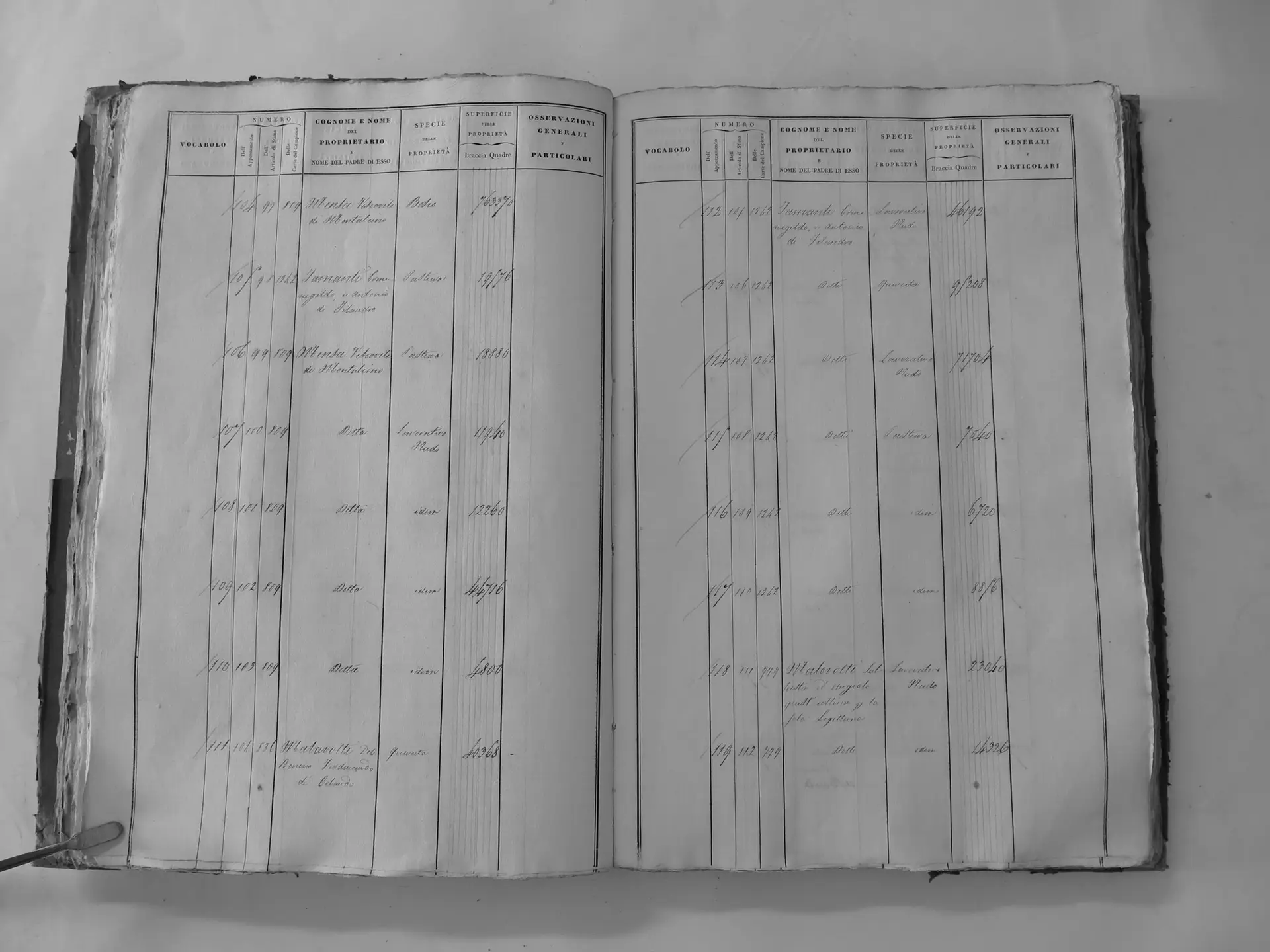
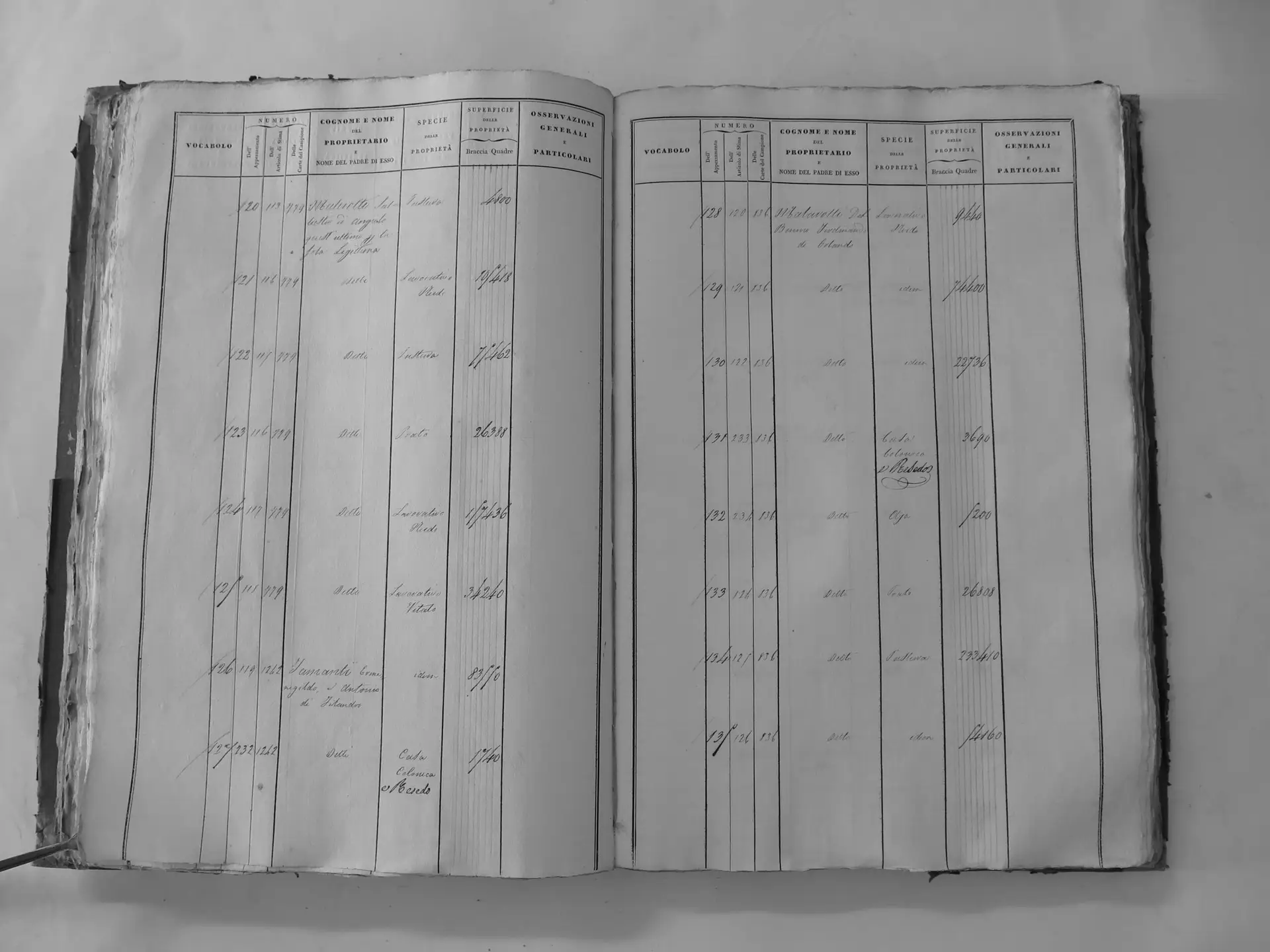
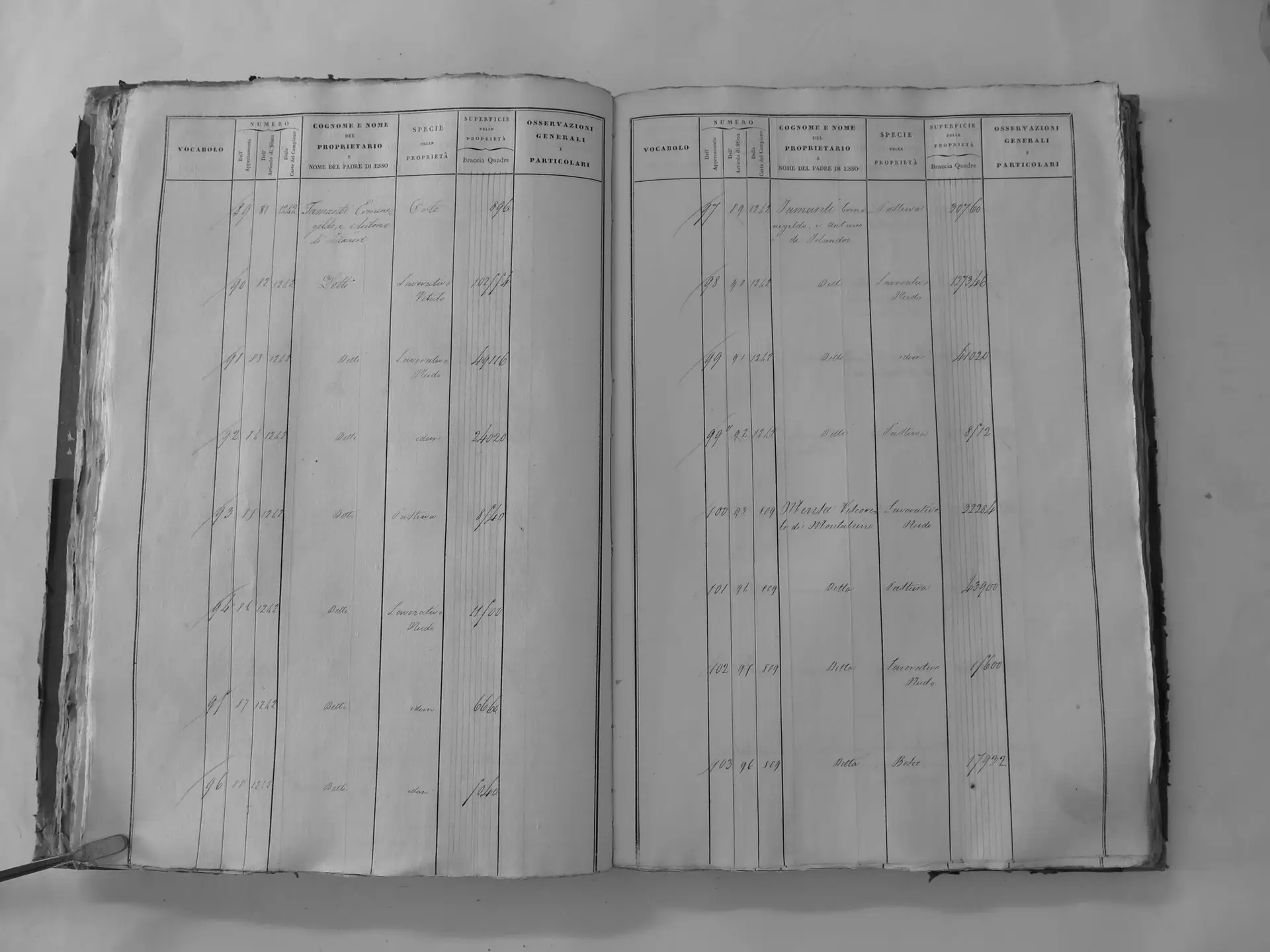
The Tuscan land survey of the early nineteenth century divided the Montalcino countryside into lettered sections. For each section it drew a map of numbered parcels and compiled an owner table, the Tavola indicativa, recording who owned each parcel and what it was used for. In the Sparampaglia section, the owner table names “Ermenegildo e Antonio Tamanti di Filandro,” the brothers Ermenegildo and Dr Antonio. It then carries their ownership down page after page, either by repeating their names or with the register’s “Detto” (“the same”). (See the Tavole indicative, Tomo II, p. 82, p. 83, p. 84 and following.)
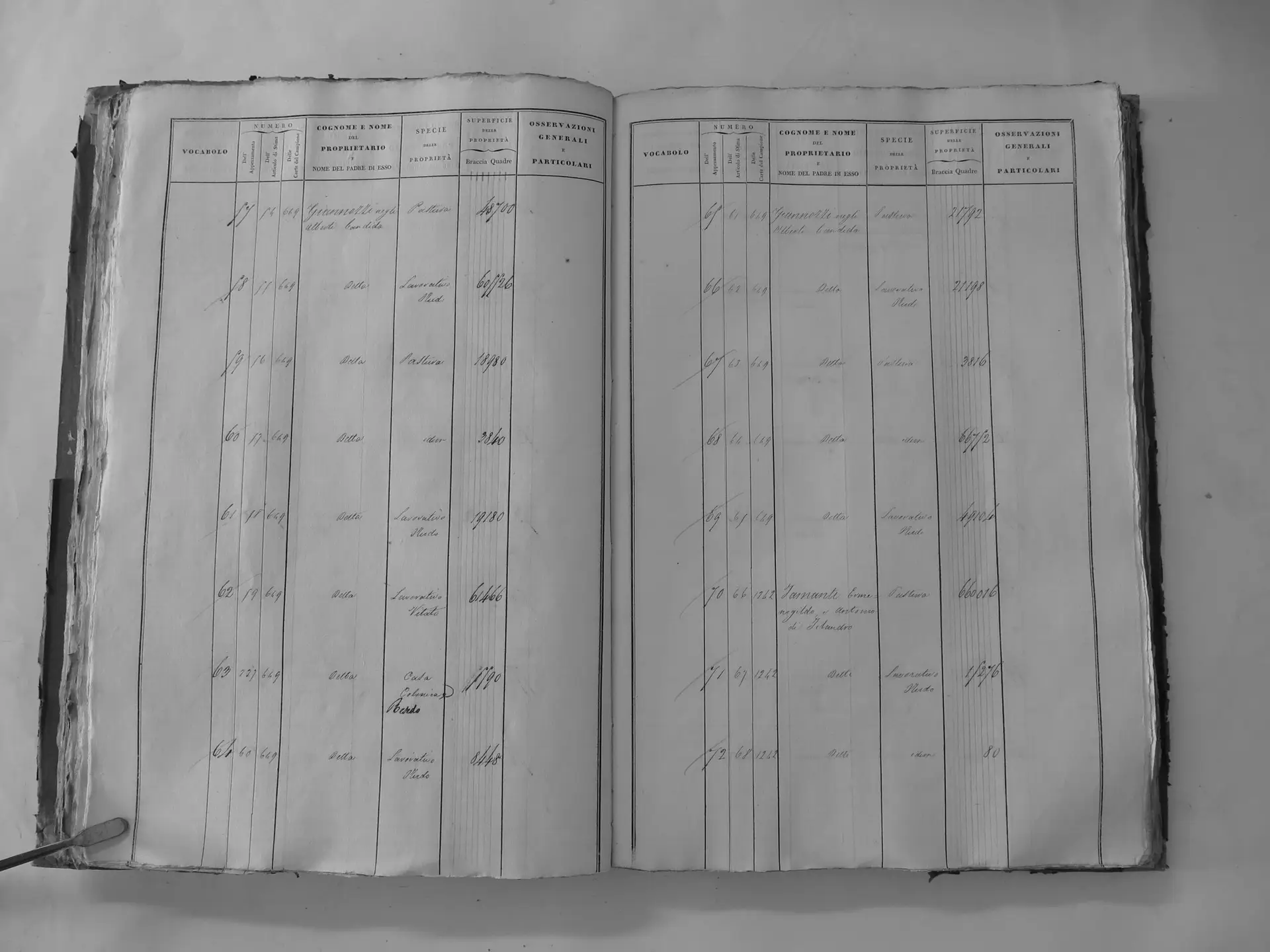
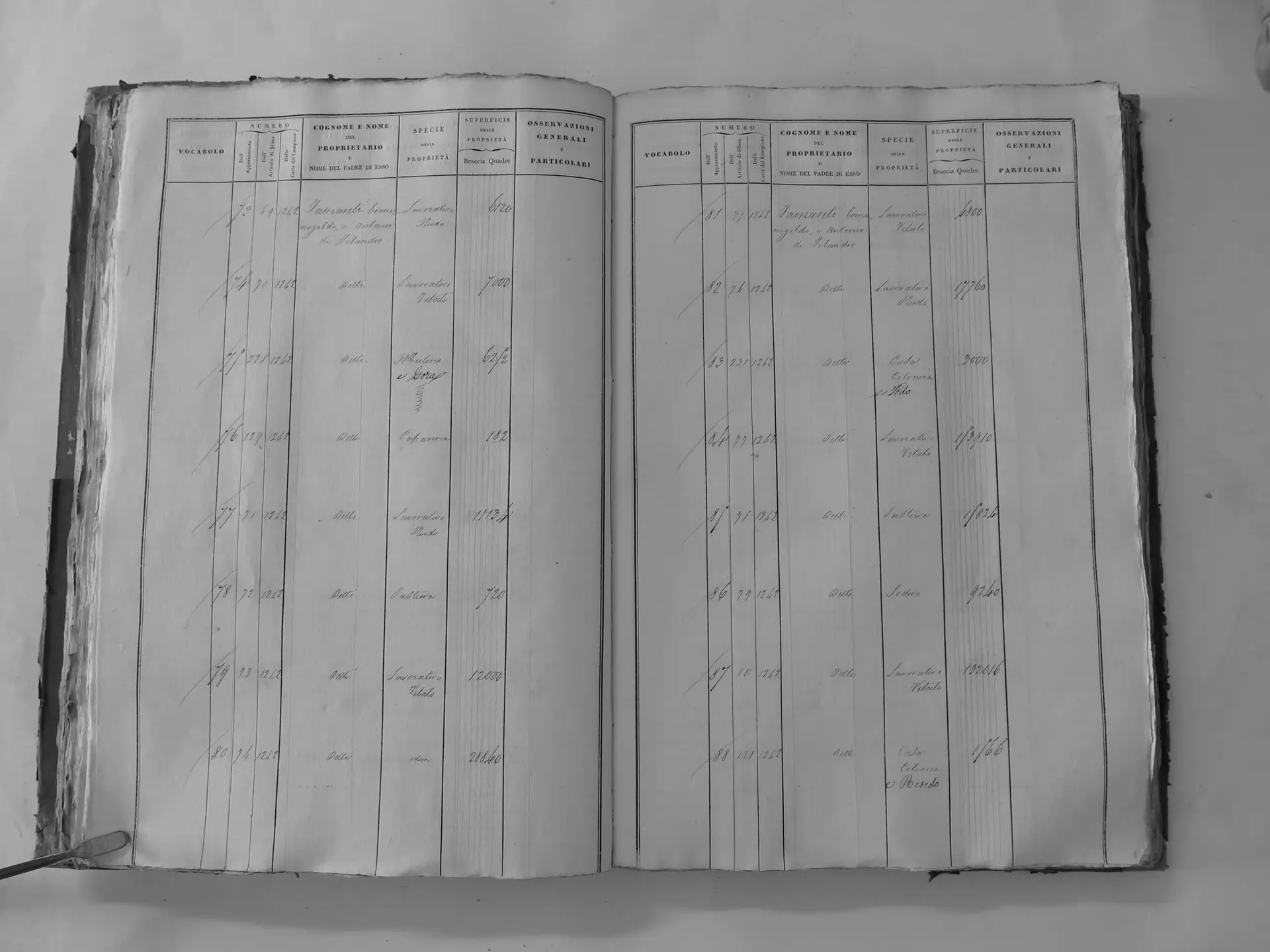
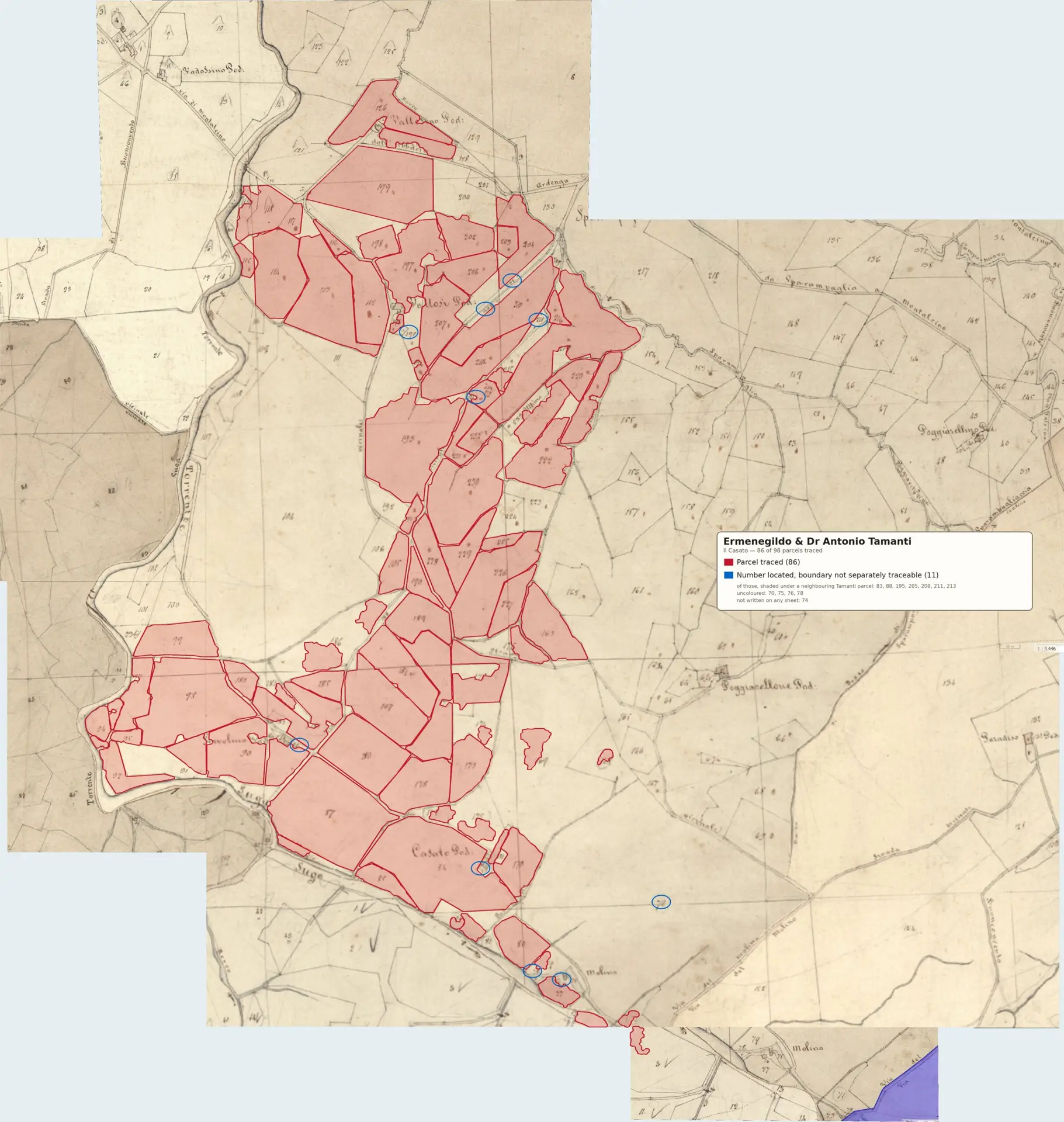
The owner’s parcel-by-parcel reconstruction gives the brothers 98 parcels at Il Casato, in the blocks 70–99, 105, 112–117, 126–127, 163, 168–191, 193–199, 202–208, 210–216, 219–222 and 225–233. These are not a few scattered fields. They are the footprint of a substantial rural estate.
Parcel 83: the farmhouse and stable
The most important single entry is parcel 83, which the owner table classifies as Casa Colonica e Stalla, a farmhouse and stable. It was the working centre of the estate, where a farming family would have lived and kept the animals. Stefano Cinelli Colombini has called Casato “the centerpiece of the Tamanti lands.” That is family testimony, but it no longer stands alone, because the survey independently places Filandro’s sons at a large estate built around a farmhouse and stable.
What grew there
Sample entries show a mixed farm, not a vineyard in the modern sense. Parcel 70 is seminativo (arable), 73 is vigneto (vineyard), 105 is bosco (woodland), 112 is vineyard again, and 183 and 233 are woods. In the old sharecropping system of Tuscany, a farmhouse like this was surrounded by grain fields, vines, woods and other productive land. Vines were one crop among several.
Two brothers, town and country
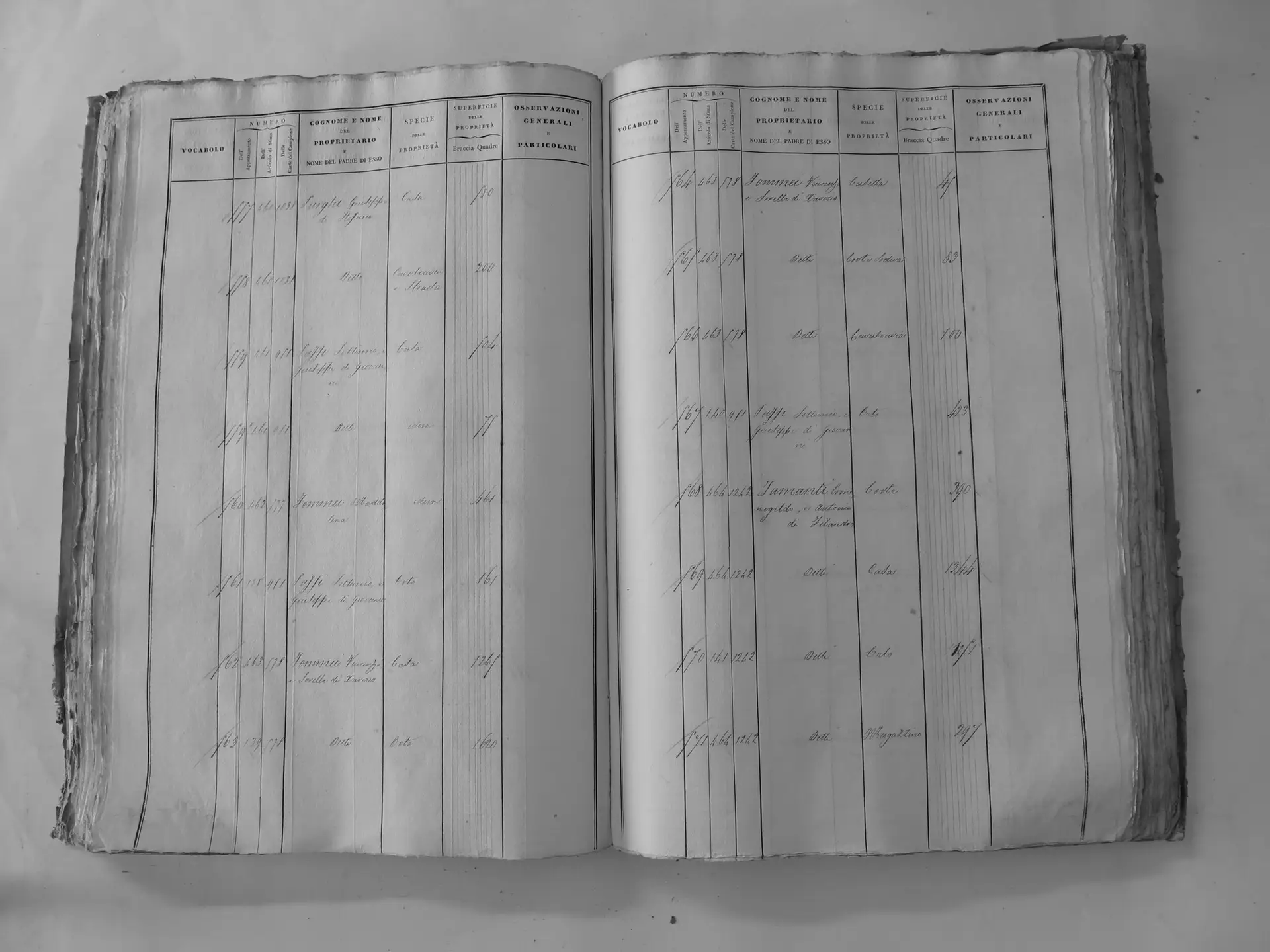
Ermenegildo and Antonio are named elsewhere too. Local historian Luisa Scrivani’s reconstruction of the town cadastre of about 1835 registers Casa Tamanti, parcels 568–571 (courtyard, house, garden and storehouse), jointly to the same two sons of Filandro (Tavole indicative, Città di Montalcino, Tomo III p. 164). The 1841 census lists Ermenegildo, aged 37, and Antonio, aged 31, as proprietari. The same pair of brothers therefore owned both a major country estate and the town house complex. How each property later changed hands still has to be traced through the cadastral registers of transfers (volture).
From 1820 to Donatella: what is proven and what is open
Donatella Cinelli Colombini writes that Casato belonged to her ancestors by 1592 and, more recently, to her grandmother Giuliana Tamanti Colombini (Donatella Cinelli Colombini, 2023). She does not say that the family of 1592 was the Tamanti. The survey now fixes one firm point between those statements: by about 1820, Il Casato was a major Tamanti property.
- Documented, 1820: Ermenegildo and Dr Antonio Tamanti, sons of Filandro, own the 98-parcel Casato estate, and parcel 83 is a farmhouse and stable.
- Documented family line: the descent runs from Dr Antonio to the later generation that includes Giuliana Tamanti Colombini (see Giuliana Tamanti Colombini).
- Still open: who owned Casato in 1592, and the full legal succession from the 1820 brothers through Giuliana and Francesca to Donatella.
Giovanni Colombini: modernizer and host
Giovanni Colombini (1906–1976), Giuliana’s husband, was one of the people who turned Brunello from a local wine into a modern cultural and commercial enterprise. His grandson Stefano’s family history portrays him as an early advocate of what we would now call sustainability and wine tourism. He argued for a “closed cycle” farm that combined vines, olives, grain and livestock, gave year-round employment and sold its finished products directly (Stefano Cinelli Colombini, Brunello, ritratti a memoria, 2nd ed., 2021, pp. 97–103).
As Podestà (the town’s appointed head), he restored major monuments, and in 1941 he turned the Fortezza into a public showcase for local wines and products. In 1949 he opened the family winery to visitors, described in the family history as Tuscany’s first cantina aperta, or open cellar. When new roads diverted traffic away from Montalcino and the rural economy shrank, he looked for customers further afield and helped reopen export markets. He sat on the committee behind the 1966 Brunello DOC, the official protected designation, and in 1967 he was a founder and the first vice-president of the Consorzio del Brunello, the producers’ association (Cinelli Colombini, 2021; Sanchini and Cinelli Colombini, Enjoy Montalcino).
Francesca Colombini Cinelli: the “Signora del Brunello”
Giovanni and Giuliana’s daughter Francesca (1931–2022) worked alongside her father from 1964 and took charge of Fattoria dei Barbi after his death in 1976. Her son describes her as the first woman to direct a major wine company in Montalcino. She rebuilt the cellars and vineyards, expanded exports into dozens of countries, and became known affectionately as the “Signora del Brunello” (Cinelli Colombini, 2021, pp. 97–103). Her properties were later divided. Fattoria dei Barbi went to her son Stefano, and Fattoria del Casato went to her daughter Donatella.
The longer wine story
Wine in Montalcino is far older than Brunello. The town’s statute of 1415 had an official inspect wine sold at retail, check and seal barrels, and record prices, and it required rural communities to work their vineyards diligently. Sixteenth-century writers praised the wines of Montalcino’s hills. That is context for the world the first documented Tamanti entered, but it does not prove that any early “Brunello” was the same wine as the modern one.
Brunello as we know it was the work of many growers, landowners, experimenters and merchants. The Tamanti took part through marriage and land rather than by inventing it. One branch married into the Santi and Biondi (see the Biondi-Santi connection). Another married into the Colombini, whose work at Barbi and Casato helped open Brunello to visitors and to the world.
Sources on this page
- Catasto Generale della Toscana, Comunità di Montalcino, Tavole indicative, Sparampaglia (section A′), Tomo II p. 82, p. 83, p. 84, p. 85, p. 86 (CASTORE)
- Owner’s reconstruction of the Tamanti parcels at Il Casato (map)
- Catasto Generale della Toscana, Tavole indicative, Città di Montalcino (section V′), Tomo III p. 164 (CASTORE)
- Luisa Scrivani, c.1835 urban cadastral reconstruction of Casa Tamanti (correspondence, 28 August 2026), and Era il 1841 a Montalcino (Effigi, 2017)
- Stefano Cinelli Colombini, Brunello, ritratti a memoria, 2nd ed. (Fattoria dei Barbi, 2021), pp. 97–103
- Stefano Cinelli Colombini, correspondence with the owner, August 2026
- Donatella Cinelli Colombini, “Donatella Talks About Her Two Wineries” (2023)
- Mirco Sanchini and Stefano Cinelli Colombini, “The history of Brunello of Montalcino from 1500 to date,” Enjoy Montalcino
- Mario Ascheri, “Uno Stato «complesso» in Toscana,” Initium 25 (2020), on the 1415 statute