

Brunello di Montalcino took shape in the experiments of one nineteenth-century family. Part of that family’s inheritance, in land and in blood, came from the Tamanti. This section follows the thread across three generations. It runs from a young landowner named Maria Tamanti, through her daughter Caterina, to her grandson Ferruccio, the man the wine world remembers as Ferruccio Biondi Santi.
The story turns on two marriages, in 1819 and 1844. Each joined a new surname to the line, and each carried property with it. Only part of that property can yet be traced record by record.
The first marriage: Tamanti to Santi, 1819
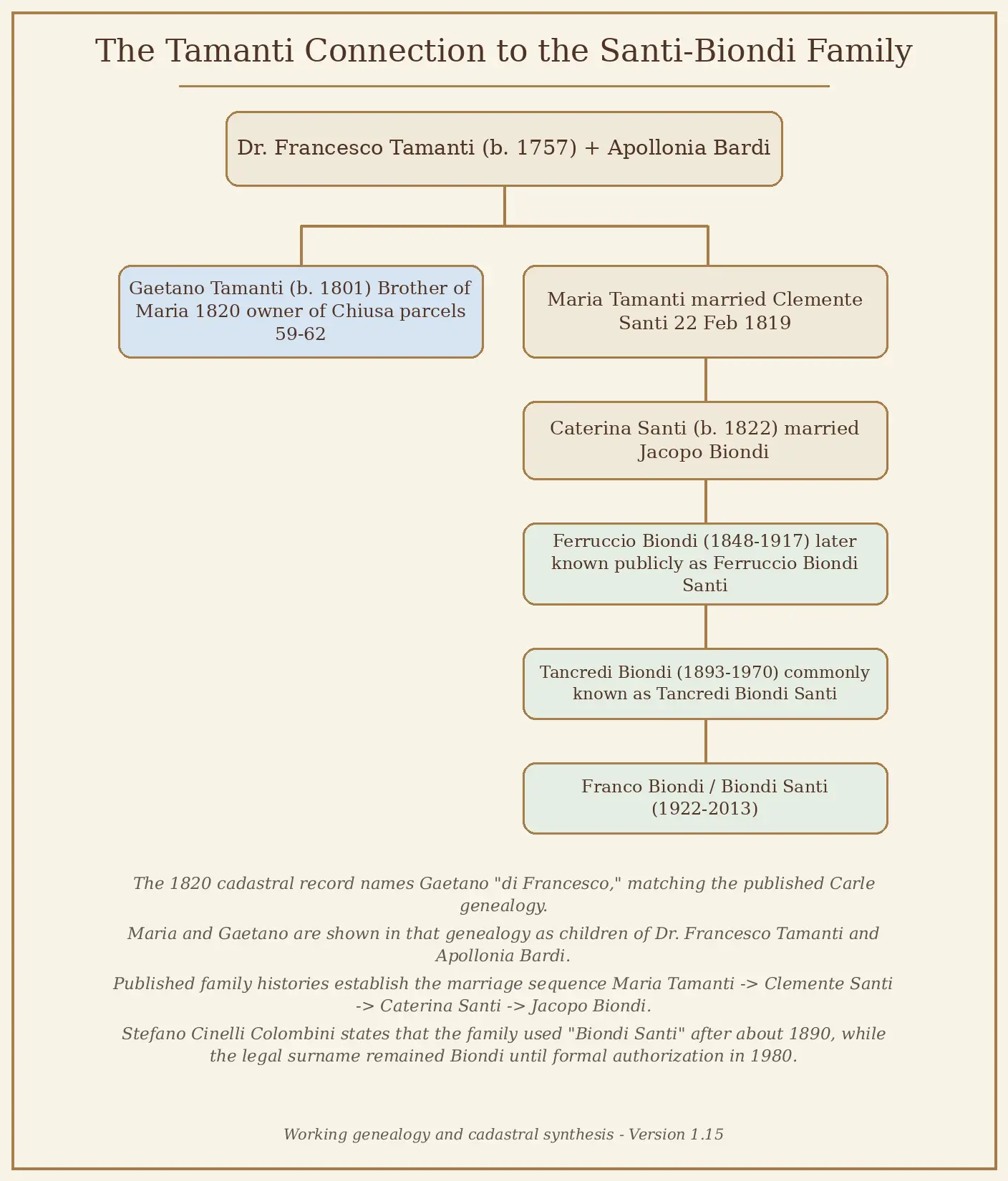
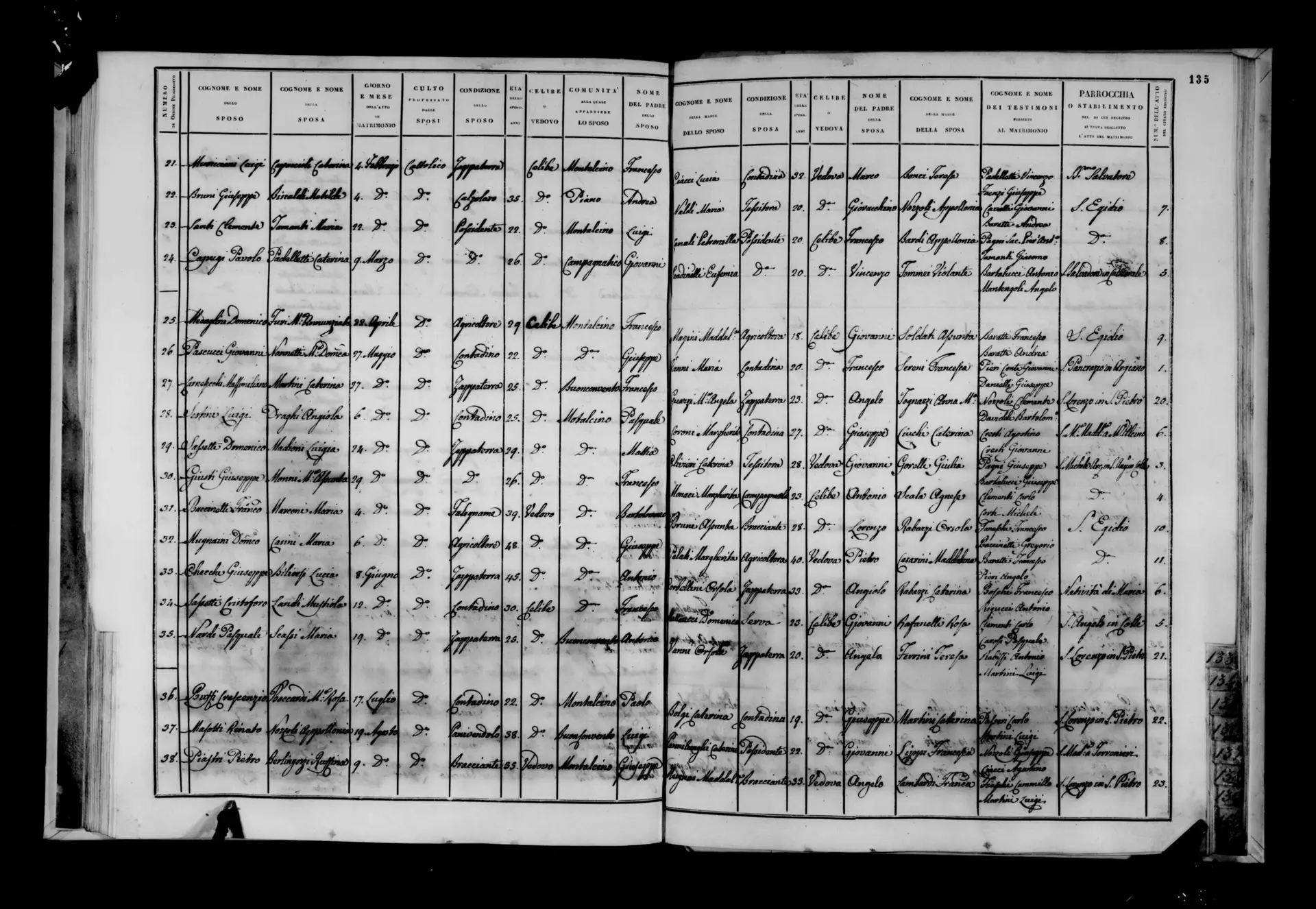
On 12 February 1819, Maria Tamanti, a landowner aged twenty, married Clemente Santi in Montalcino. The marriage act of 12 February 1819 (original on Antenati) names her parents as Francesco Tamanti and Appollonia Bardi. That places her in the branch of Dr Francesco Tamanti, alongside her brother Gaetano (Carle, La patria locale, 1996, p. 292).
Clemente was a trained pharmacist, a pupil of the naturalist Giorgio Santi, and an early experimenter with the wines of his Montalcino farms. His mother, Petronilla Canali, held one of the largest Santi-family estates in the commune. It included a farm centre with a chapel at Greppo, the name later carried by the Biondi-Santi estate. Read about Maria, Clemente and the Santi lands.
The second marriage: Santi to Biondi, 1844
On 22 January 1844 Maria and Clemente’s daughter Caterina Santi married Jacopo Biondi, a physician. The marriage entry of 22 January 1844 (original on Antenati) names her parents as Clemente Santi and Maria Tamanti. Together with the 1819 act, it anchors the whole Tamanti–Santi–Biondi connection in the civil registers.
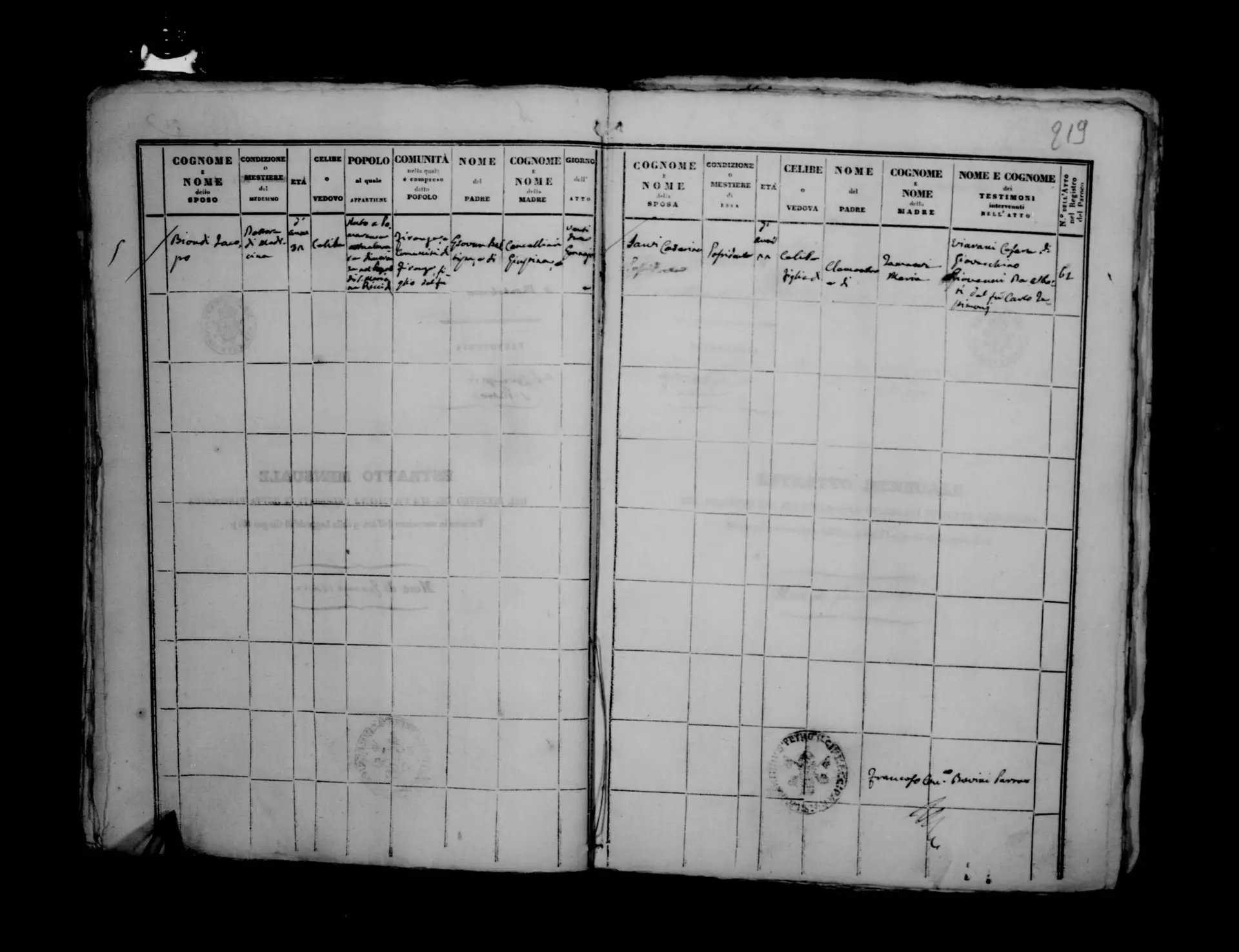
These two records also correct a long-standing error. Lucia Carle’s published Tamanti genealogy swaps the husbands’ surnames, making Maria the wife of a “Biondi” and Caterina the wife of a “Santi” (Carle, La patria locale, 1996, pp. 292, 296). The originals give the opposite order. Read about Caterina, Jacopo and the corrected record.
The grandson: Ferruccio and the birth of Brunello
Ferruccio Biondi was born in Montalcino in 1848. He added his mother’s surname to his father’s in public family use, and under the combined name he turned the family’s experiments into a recognised wine. His 1888 and 1891 Riservas are counted among the first historic Brunellos. According to Stefano Cinelli Colombini, it was through Caterina that Ferruccio inherited the Fattoria del Greppo, Le Chiuse and lands at Pienza (Cinelli Colombini, Brunello, ritratti a memoria, 2021, pp. 74–75). His son Tancredi, his grandson Franco and today’s family at Castello di Montepò carried the work forward. Read about Ferruccio, the Biondi Santi name and the generations after him.
Le Chiuse: where the Tamanti land can be seen
The clearest physical link between the Tamanti and the Biondi-Santi inheritance is Le Chiuse, a farm in the Montalcino countryside that is now a Brunello estate. In the Leopoldine cadastre of about 1820, the house at parcel 59 and the fields, vines and olives of parcels 60–62 are registered to “Tamanti Gaetano di Francesco”, Maria’s brother (CASTORE, Tavole indicative, Montalcino). In 1840 Gaetano asked the bishop’s permission to build a family burial chapel on his podere Chiusa, according to the transcriptions of Don Antonio Brandi. The estate’s own history says Le Chiuse entered the Santi family as part of Maria’s dowry, and a later tradition has it passing to Ferruccio. Read the Le Chiuse inheritance story.
What is proven, and what is not
The marriages, the parentage and the 1820 ownership of the Chiusa core are documented. What remains open is the legal mechanism that moved land between them. Maria’s dowry settlement has not been found. She does not appear as an owner anywhere in the cadastral owner tables. Her brother still owned the Chiusa core in 1820 and in 1840, after her marriage. A dowry of part of the property, a shared paternal estate or a later transfer could each explain the pattern. The original dowry act and the cadastral transfer registers (Campione and volture) should settle the question.
In this section
- Maria Tamanti and Clemente Santi, 1819
- Caterina Santi and Jacopo Biondi, 1844
- Ferruccio Biondi Santi and Brunello
- Le Chiuse: the inheritance story
Sources on this page
- Marriage of Clemente Santi and Maria Tamanti, 12 February 1819, Montalcino, S. Egidio, act 8. Local scan; Portale Antenati.
- Marriage of Jacopo Biondi and Caterina Santi, 22 January 1844, Montalcino. Local scan; Portale Antenati.
- Catasto Generale della Toscana, Comunità di Montalcino, Tavole indicative (Archivio di Stato di Siena), via CASTORE.
- Lucia Carle, La patria locale. L’identità dei Montalcinesi dal XVI al XX secolo (Regione Toscana / Marsilio, 1996), pp. 292, 296.
- Don Antonio Brandi, Studi e Trascrizioni (online compilation), 1840 Cappella della Chiusa record.
- Le Chiuse, official estate history.
- Stefano Cinelli Colombini, Brunello, ritratti a memoria, 2nd ed. (Fattoria dei Barbi, 2021), pp. 74–75.