

Maria Tamanti’s grandson never carried the Tamanti name. Yet the land, the household and the habits of mind he inherited ran back through his mother and grandmother to the marriages of 1819 and 1844. This page follows Ferruccio and the generations after him, from the first historic bottles of Brunello to a family still studying Sangiovese today.
Ferruccio: soldier, farmer, experimenter
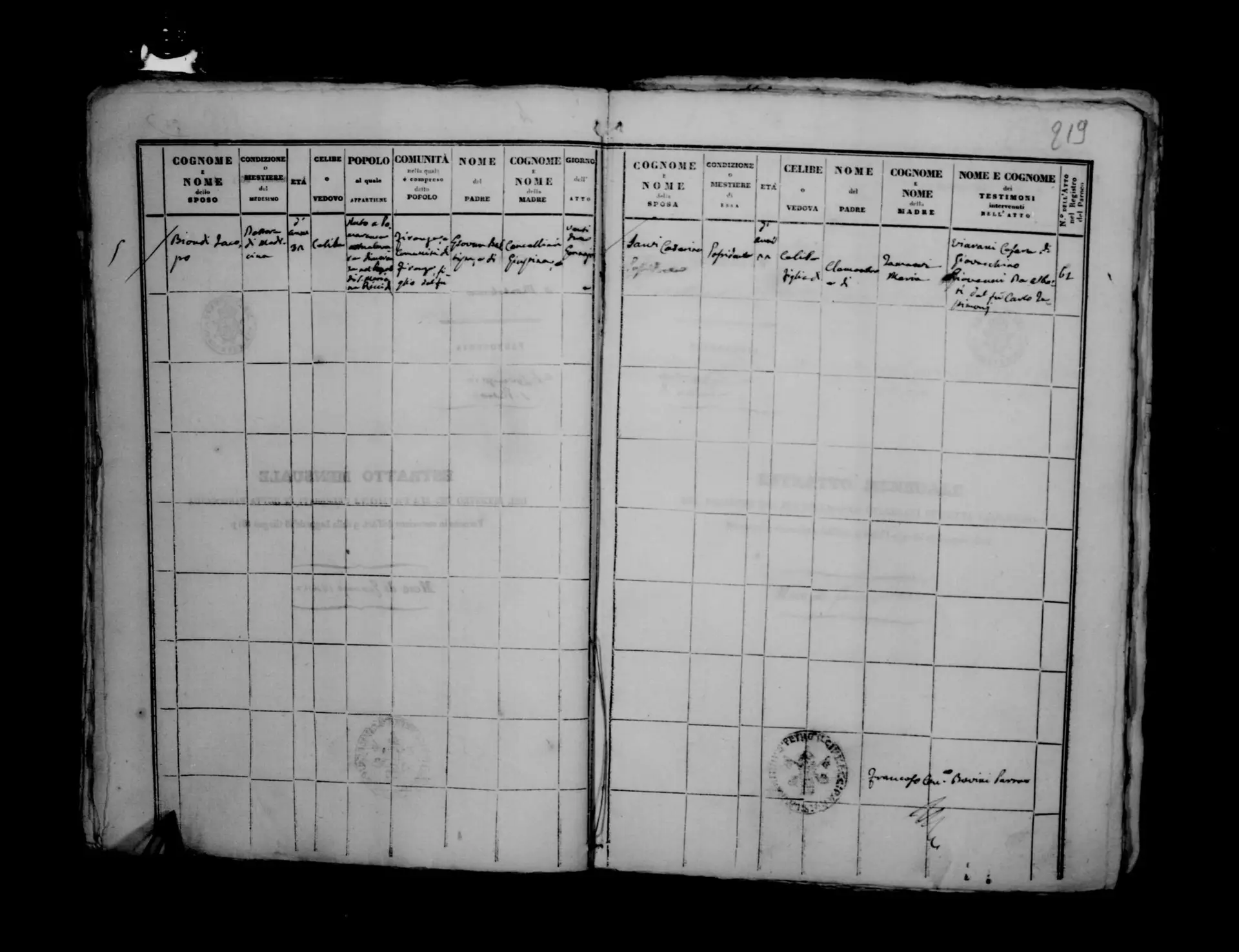
Ferruccio Biondi was born in Montalcino in 1848, the son of the physician Jacopo Biondi and Caterina Santi (their marriage entry of 22 January 1844). He was Clemente Santi’s grandson, not his nephew, as some accounts have it. At eighteen he fought with Garibaldi’s volunteers at Bezzecca. He then came home to manage the family lands (Cinelli Colombini, Brunello, ritratti a memoria, 2021, pp. 74–75).
Cinelli Colombini also records that Ferruccio inherited the Fattoria del Greppo, Le Chiuse and lands at Pienza through his mother. Greppo leads back to the farm centre of his great-grandmother Petronilla Canali, who held it in her own name by about 1820 and died in 1848; how it passed from her to Clemente is not yet documented. Le Chiuse, by every indication, came down to Ferruccio from his great-uncle Gaetano Tamanti, who died unmarried in 1861, through his grandmother Maria and his mother Caterina, though the will and land transfers that would show the exact steps have not yet been found (see Le Chiuse: the inheritance story).
His farming was serious and public. In August 1887, at the regional agricultural contest held in the old Fortezza at Siena, he took two first prizes: one for his vineyard at “La chiusa”, very probably the old Tamanti farm of his great-uncle Gaetano, and one for a fine red, a rosso fino, of the 1883 harvest, on the same list as Baron Ricasoli’s Brolio. (Some accounts add the 1884 harvest, but the printed list gives that year’s first prize to another grower.) Seven years later the Milan exhibitions of 1894 gave him a diploma of the second grade for a red wine. In 1888 and 1891 he made wine from Sangiovese alone. He founded a circle for agricultural improvement and paid for a travelling agricultural lectureship that later became a public institution in Montalcino. Cinelli Colombini dates the circle to 1899, but Ferruccio’s obituary of 1917 dates it to 1889 and the travelling chair, “nine years later”, to February 1898, and the arithmetic supports 1889. When phylloxera forced the replanting of vineyards on American rootstock, he rebuilt about ten hectares and selected the vines that Cinelli Colombini links to the later BBS11 clone. In 1902 he won a gold medal for his vineyard at “Scarnacuoia” (Cinelli Colombini, 2021, pp. 74–75). The same place-name appears in the cadastral section where the Tamanti held land in 1820.
1888 and 1891: the bottles that named a wine
The estate identifies its 1888 Riserva as the first Brunello di Montalcino in history, and the 1891 Riserva as the second. What mattered was not volume but proof. The bottles that survived, decades later, showed that Montalcino Sangiovese could make a red wine of great longevity with a character that belonged to its place. The name itself was older than these bottles: Clemente Santi’s fame had begun with a sparkling Moscadello, “Brunello” appears in print first as the name of a grape, in the catalogue of the London International Exhibition of 1862, where Clemente showed a “grape wine from Brunello, discoloured” (more on Clemente’s exhibitions), and again in Tassi’s survey of 1865; by 1870 it was on red wines of Clemente and of other Montalcino growers. It was Ferruccio who made a long-lived Brunello of the single grape the identity of the house.
The family’s wine shop, the Fiaschetteria Italiana on the town’s main square, traditionally dates from 1888 too, and its present owners call it the original Biondi Santi wine shop. The local paper first reports “the new fiaschetteria” of “sig. Ferruccio Biondi-Santi” in August 1897; the likeliest explanation is that the shop of 1888 was refitted, or moved to its present front, that summer, though the alternative, that the date 1888 was attached later, cannot yet be ruled out. Francesca Colombini Cinelli dates Ferruccio’s sale of the Fiaschetteria to Angelo Caporali to 1912, and after the Second World War it still belonged to Caporali. Ferruccio died at Il Greppo on 8 March 1917, with both his sons, Gontrano and Tancredi, away at the front.
A name that grew over time
“Biondi Santi” was not Ferruccio’s birth name. In a note to the owner in August 2026, Stefano Cinelli Colombini explained that the family’s legal surname was Biondi. The family began using the combined form, adding Caterina’s Santi, only after about 1890. In print it came a little earlier: the town clerk still wrote Ferruccio plain Biondi, but the Siena prize list of 1887 already calls him “Biondi Santi”, the earliest printed use of the double name yet found. They received legal authorisation to use “Biondi Santi” in 1980. This is family testimony, and the 1980 decree itself has not yet been inspected. These pages use the familiar name for the wine dynasty, but not as Ferruccio’s surname at birth.
Tancredi and Franco
Ferruccio’s son Tancredi, remembered as Tancredi Biondi Santi, carried the work through war, economic depression and the rebuilding of Montalcino farming. Cinelli Colombini counts him among Tuscany’s leading oenologists of the early twentieth century. Back from the war, he was elected in January 1923 one of the probiviri of the veterans’ association, and that spring joined the town’s giunta as an assessore. About 1927 Tancredi organised the Cantina Sociale Biondi Santi & C., a cooperative housed on the ground floor of the old Spedale di Santa Maria della Croce, and served as its technical director. Cinelli Colombini dates it to 1926, but in July 1926 the local paper was still campaigning for a cantina sociale to be founded, so it began with the 1926 vintage at the earliest, and more probably in 1927, the year Franco Biondi Santi gave. In April 1933 Tancredi was one of seven farmers of the province of Siena given the Stella al merito rurale, for turning the Greppo into “an oasis of intensive cultivation”, with two new specialised vineyards of Moscadello. The cooperative helped launch the first substantial Brunello exports to the United States in the 1930s. Franco Biondi Santi dated the first shipments to 1932 (Civiltà del Bere, 2011).
In 1944, with the front close to Montalcino, Tancredi, his son Franco and a trusted worker walled up the room holding the oldest Riservas, saving hundreds of bottles, including the nineteenth-century vintages. Tancredi also helped shape the production rules for Brunello’s DOC in 1966. The Consorzio followed in 1967, and in 1980 Brunello became Italy’s first DOCG wine (Consorzio del Vino Brunello di Montalcino).
Franco took Ferruccio’s vine selection into a more formal scientific age. The 1955 Riserva became one of the celebrated wines of the century. The clone BBS11, “Brunello Biondi Santi”, plant number 11 in the selection vineyard, was entered in Italy’s national vine register as clone I-B-BS-11, of Montalcino origin, by the Gazzetta Ufficiale of 18 November 1978, with the University of Florence as registrant; the date of 1975 given by Cinelli Colombini is not borne out.
The family today
In a 2025 interview, Tancredi Biondi Santi is described as the seventh generation. He and his father, Jacopo Biondi Santi, now focus on Castello di Montepò in the Maremma. There they continue research on Sangiovese Grosso BBS11 and on how grape, soil, slope and altitude interact (TABLE Magazine, 2025). Jacopo’s children are Tancredi, Clemente and Clio (Vin Finesse; Pebble Beach Food & Wine, 2026). The historic Biondi-Santi label and Tenuta Greppo are now separate from the family’s Montepò project. Palazzo Tamanti has no part in the Biondi-Santi wine business. The connection is one of ancestry: through Maria Tamanti, one Tamanti branch stands among the forebears of this family.
A Tamanti in the Biondi-Santi cooperative
The Tamanti name reappears in Tancredi’s cooperative. A 1933 University of Siena wine handbook, in an English translation published online, names Biondi-Santi, Cocchi Brothers, Padelletti and Tamanti among the cooperative’s leading farming companies, with 1,200 hectares of vines among its members and Brunello and Moscadello sold “easily and lucratively in Italy and abroad” (Do Bianchi, 2012). In 2011 Franco Biondi Santi recalled that his father had invited landowning friends, including Tamanti, Angelini, Crocchi and Padelletti, to join. He dated the start to 1927 (Civiltà del Bere, 2011). Cinelli Colombini’s list of founders does not include a Tamanti.
The safest reading is that a Tamanti landowner took part in the cooperative between the wars. It is not yet known which Tamanti, or whether the family was among the original founders. The founding act, statutes and membership lists should answer both questions.
Sources on this page
- Marriage of Jacopo Biondi and Caterina Santi, 22 January 1844, Montalcino. Local scan; Portale Antenati.
- Stefano Cinelli Colombini, Brunello, ritratti a memoria, 2nd ed. (Fattoria dei Barbi, 2021), pp. 74–83.
- Stefano Cinelli Colombini, email correspondence with Brian Pasch, August 2026 (family testimony on the Biondi Santi surname).
- Maurizio Boldrini, Bruno Bruchi and Andrea Cappelli, This Is My Land: Franco Biondi Santi, Montalcino and Brunello (Protagon Editori, 2010), pp. 22–50.
- Biondi-Santi, estate pages for the 1888, 1891 and 1955 Riservas.
- Consorzio del Vino Brunello di Montalcino, “Montalcino, the Territory and the Wines”.
- Emma Riva, “Tancredi Biondi Santi on Bringing an Italian Wine Legacy into the Future”, TABLE Magazine, 15 March 2025.
- Vin Finesse, “Jacopo Biondi Santi – Castello di Montepo”.
- Pebble Beach Food & Wine, “Castello Di Montepo: The Future of the Biondi Santi Family”, 11 April 2026.
- Do Bianchi, “Biondi Santi a cooperative winery?”, 4 June 2012 (translation of the 1933 Siena handbook entry).
- Emanuele Pellucci, “Le Cantine che hanno fatto l’Italia (2): Franco Biondi Santi – Tenuta Greppo”, Civiltà del Bere, 8 June 2011.
- Il Progresso (Montalcino): 1897 (the “new fiaschetteria”, 1 August); 1917 no. 6, 18 March (Ferruccio’s obituary; both sons at the front); 1926 no. 13 (campaign for a cantina sociale); 1933 no. 9, 29 April (Stella al merito rurale). Il Libero Pensiero (Montalcino), 10 February 1923 (probiviri of the veterans’ association). Via the Archivio della Memoria and the Biblioteca degli Intronati, Siena.
- Exhibition records for Clemente Santi’s wines: Florence 1850 and 1861 catalogues; International Exhibition 1862. Official Descriptive Catalogue. Kingdom of Italy (London, 1862), p. 138, no. 687, and the French edition, p. 169 (“Vin de raisin Brunello décoloré”); A. Tassi, Cenno sulla botanica agraria … della provincia di Siena (1865), pp. 24–25; Siena exhibition of Carnival 1870 as reported by the Consorzio del Vino Brunello di Montalcino.
- Gazzetta Ufficiale no. 323, 18 November 1978, and the Registro nazionale delle varietà di vite (clone I-B-BS-11).
- Bollettino del naturalista (Siena), vol. 7 (1887), pp. 122 and 124, prize list of the regional agricultural contest at Siena, August 1887 (“Vigne. Ferruccio Biondi Santi, La chiusa”; “Vini fini rossi del 1883. Biondi Santi Ferruccio, Montalcino”); Le Esposizioni riunite di Milano 1894, wine awards (Internet Archive).
- Roberto Salvioni (ed.), La storica farmacia di piazza a Montalcino (2010), with Bruno Bonucci’s study; Francesca Colombini Cinelli on the Fiaschetteria Italiana.