Of all the places tied to the Tamanti and the Biondi-Santi story, Le Chiuse is the one where documents, land and buildings come together most clearly. A Tamanti owner, a named farm, working fields and a surviving chapel can all be placed in the same historical frame. Today Le Chiuse is a Brunello estate. Its own history says it came into the Santi family with Maria Tamanti. This page sets out what the records show and where the story still depends on tradition.
The tradition
The official history of Le Chiuse says the property entered the family as part of Maria Tamanti’s dowry when she married Clemente Santi in 1819. The published Biondi-Santi family history names Chiusa, with Colombaio, among her dowry farms (Boldrini, Bruchi and Cappelli, This Is My Land, 2010, pp. 18–19). Stefano Cinelli Colombini writes that Caterina Santi, Clemente’s surviving daughter, passed Le Chiuse to her son Ferruccio, along with the Fattoria del Greppo and lands at Pienza (Cinelli Colombini, Brunello, ritratti a memoria, 2021, pp. 74–75). The estate history then traces Le Chiuse through Ferruccio’s son Tancredi to Tancredi’s daughter Fiorella. After Fiorella’s death in 1986, her daughter Simonetta Valiani began making Brunello there in her own right. With her husband Nicolò Magnelli and later their son Lorenzo, she restored the farm, chapel, vineyards and cellar.
A Tamanti name on the land since 1692
The Tamanti link to a farm called Chiusa is far older than 1819. In 1692 a Montalcino fiscal table lists a podere “Chiusa” under “Tamanti Dr.” (Bonelli Conenna, Il contado senese alla fine del XVII secolo, 1990, p. 162). The San Lorenzo parish tithe list of 1700 records “Chiusa Tamanti” and, separately, “La Chiusa Passari” (Brandi, Studi e Trascrizioni). Chiusa was not a unique place-name, so the case for continuity rests on the entries that name the Tamanti.
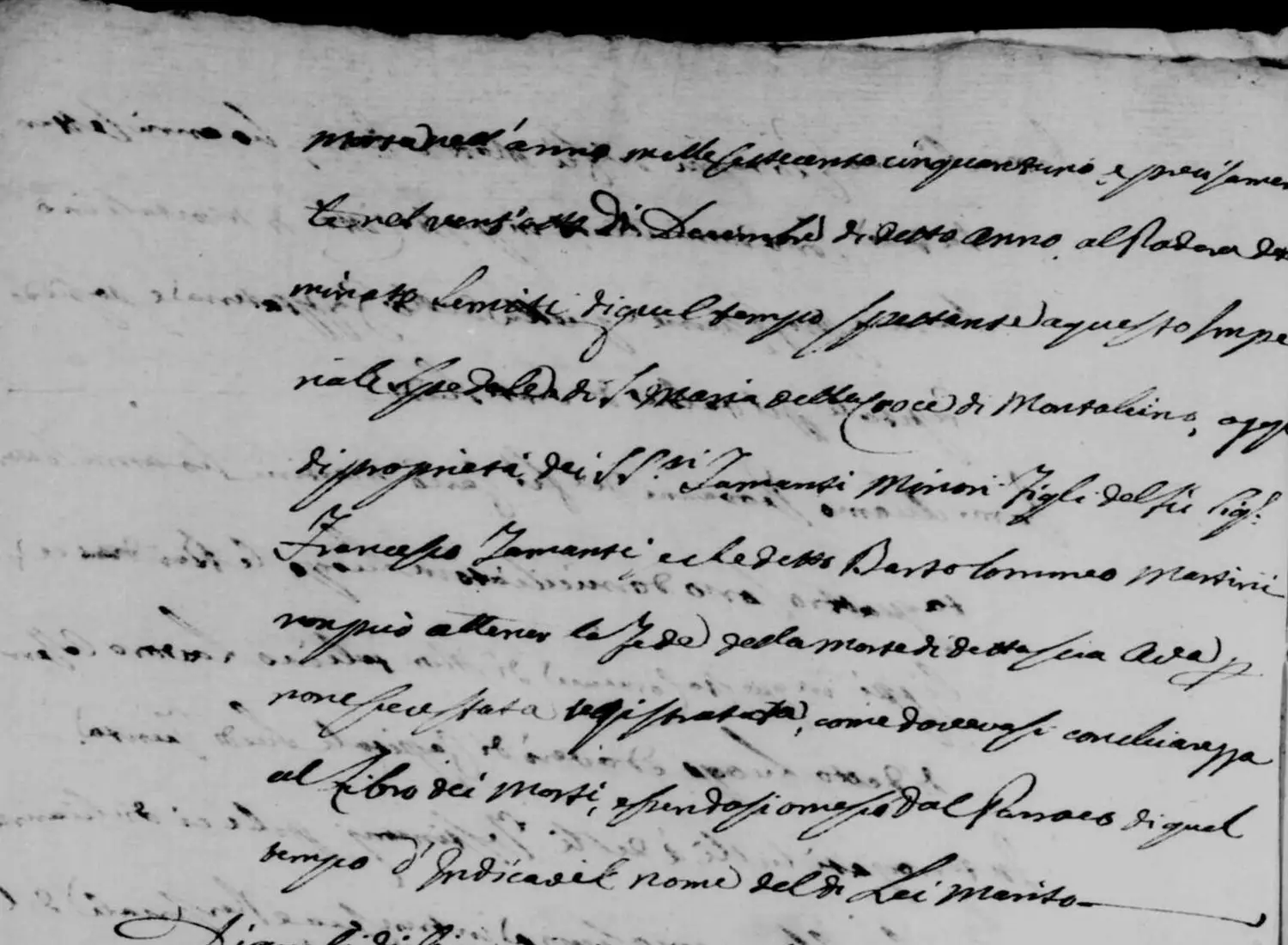
An 1810 statement preserved among marriage papers describes a farm once owned by the hospital of Santa Maria della Croce that belonged in 1810 to the “Tamanti Minori, figli del fu Francesco” (original on Antenati), the underage children of the late Francesco Tamanti. Maria and Gaetano are plausible candidates, but the children are not named. The farm’s name is unclear in the handwriting, and it cannot yet be identified with Le Chiuse.
Gaetano di Francesco at Scarnaquoja, parcels 59–62
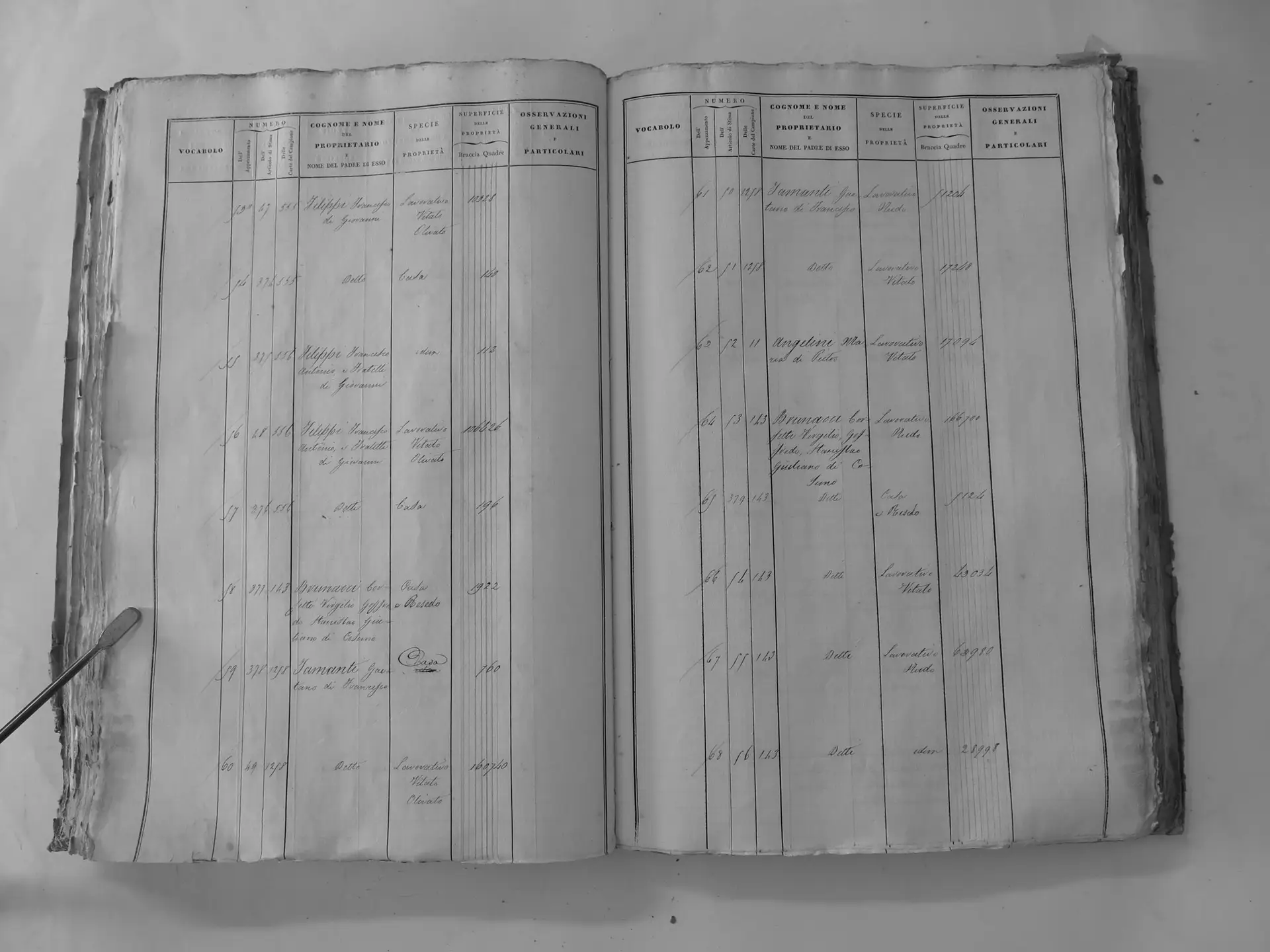
The decisive record is in the Leopoldine cadastre of about 1820. In the Scarnaquoja section, the owner table (Tavola indicativa) records parcel 59 as a Casa, a house, belonging to “Tamanti Gaetano di Francesco”. The next three parcels continue under the same owner, marked Detto (“the same”): parcel 60 is arable land with vines and olives, parcel 61 is bare arable land, and parcel 62 is arable land with vines (CASTORE, Scarnaquoja owner tables). Together they describe a house set in mixed farmland, the ordinary Montalcino farm unit before specialised vineyards.
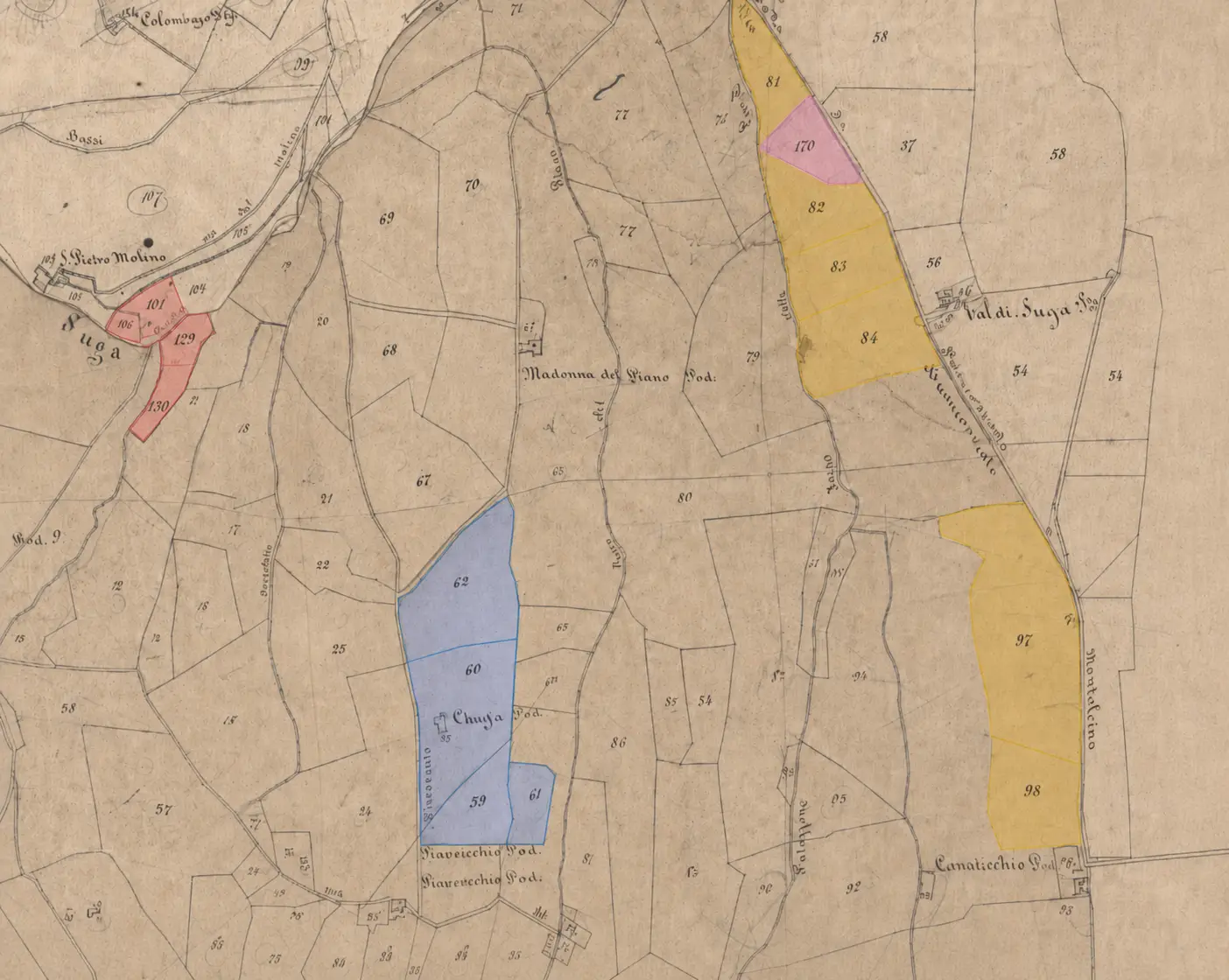
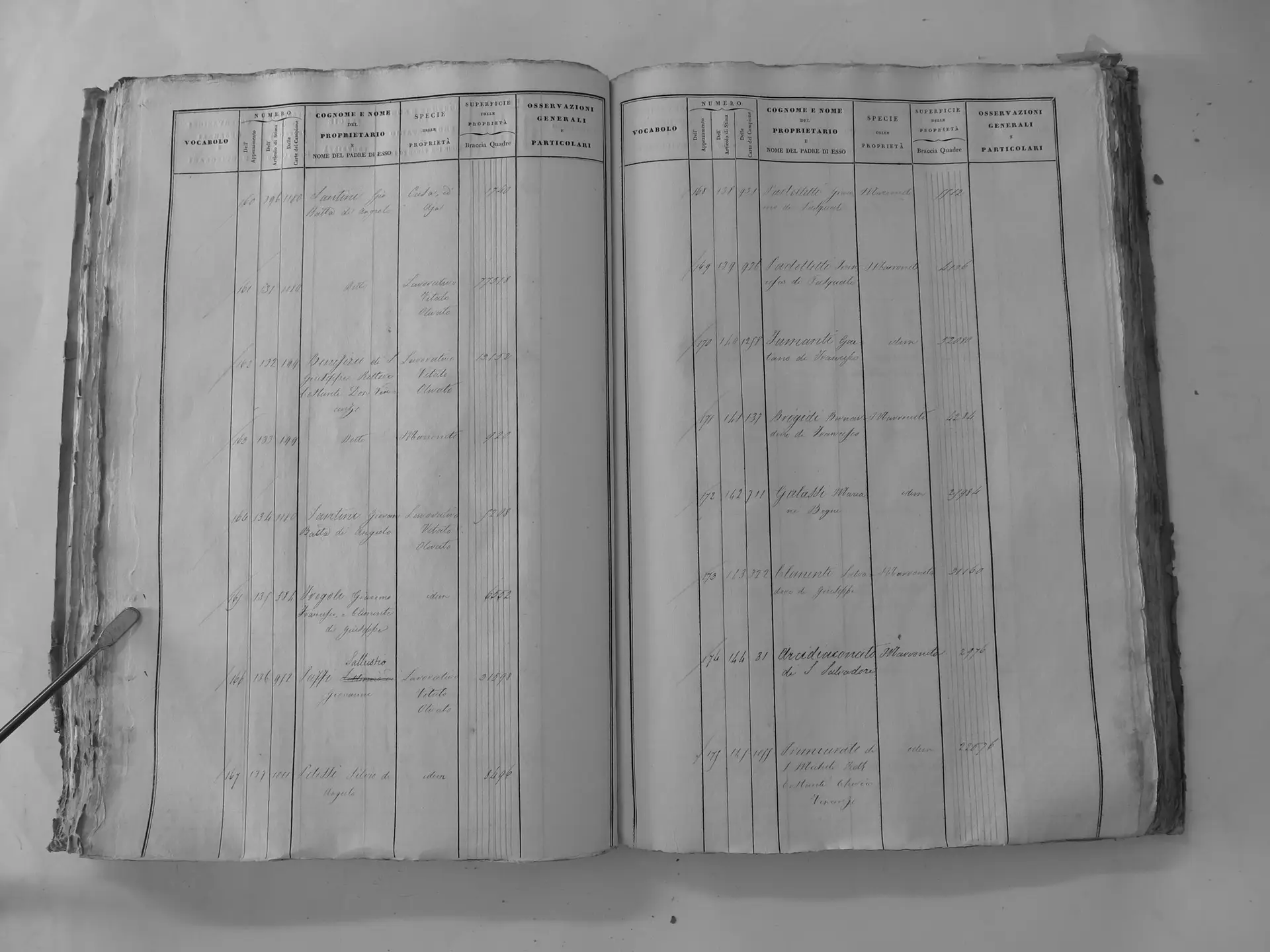
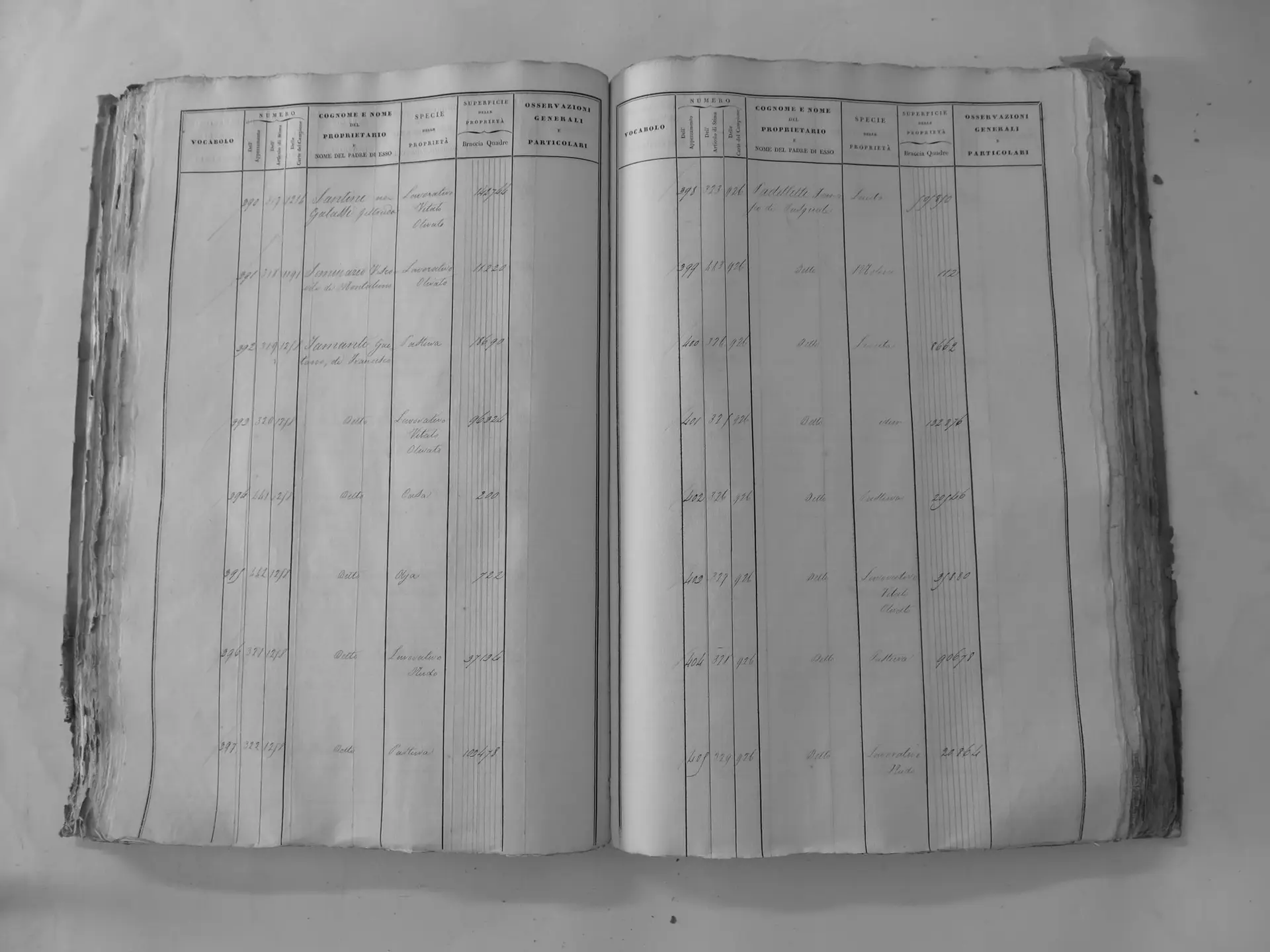
The patronymic “di Francesco” is what ties this owner to the family tree. Carle’s published genealogy makes Gaetano Tamanti, born 1801, a son of Dr Francesco Tamanti (Carle, La patria locale, 1996, p. 292). Maria’s marriage act of 12 February 1819 names her father as Francesco Tamanti. The owner of the Chiusa core in 1820 was therefore almost certainly Maria’s brother. Gaetano also held parcel 170 and parcels 392–397 in the same section, about 18 hectares there in all. Across the whole commune he held about 270 hectares, most of it at San Polo and Montosoli.
The Santi holdings in the same landscape
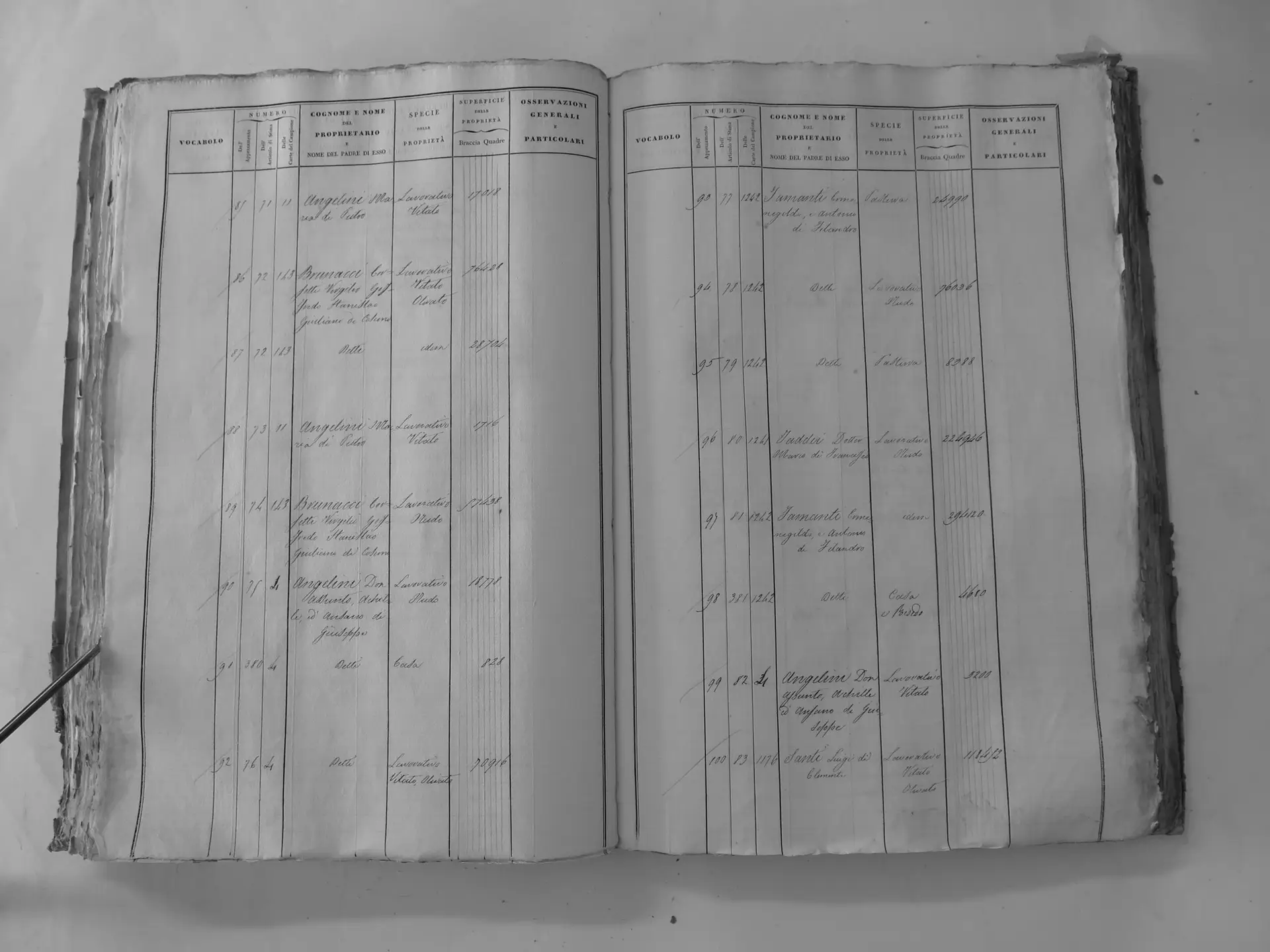
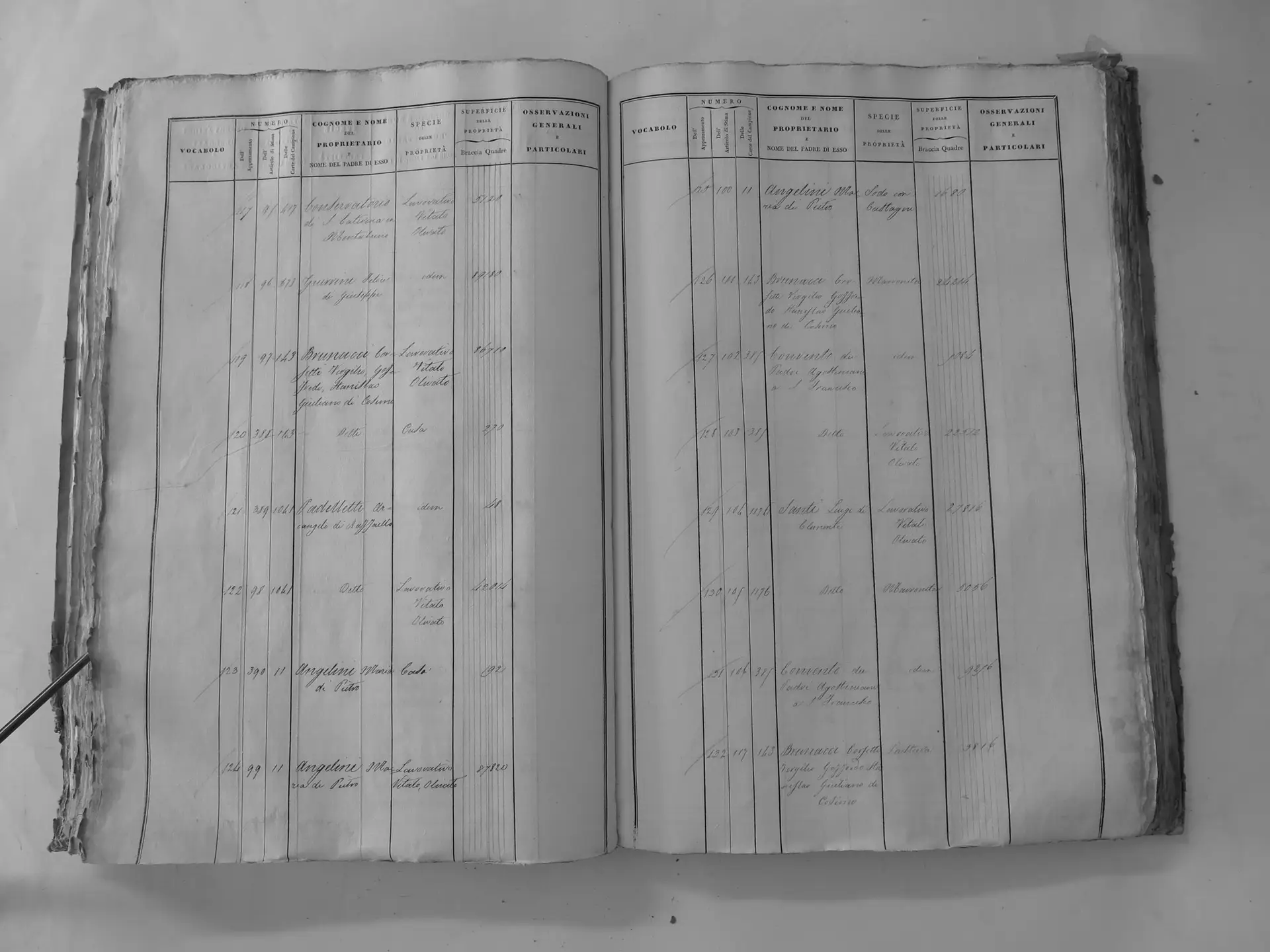
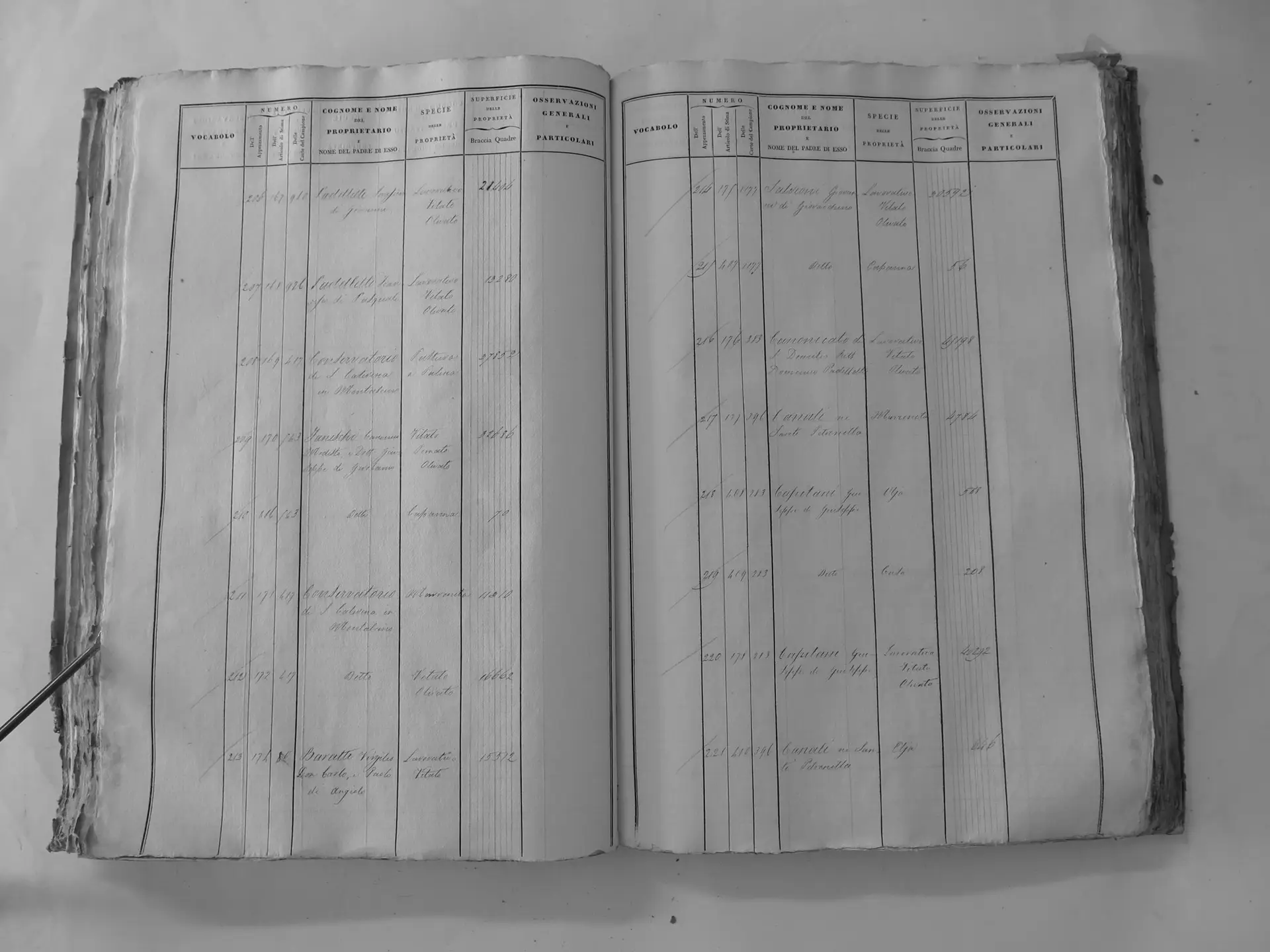
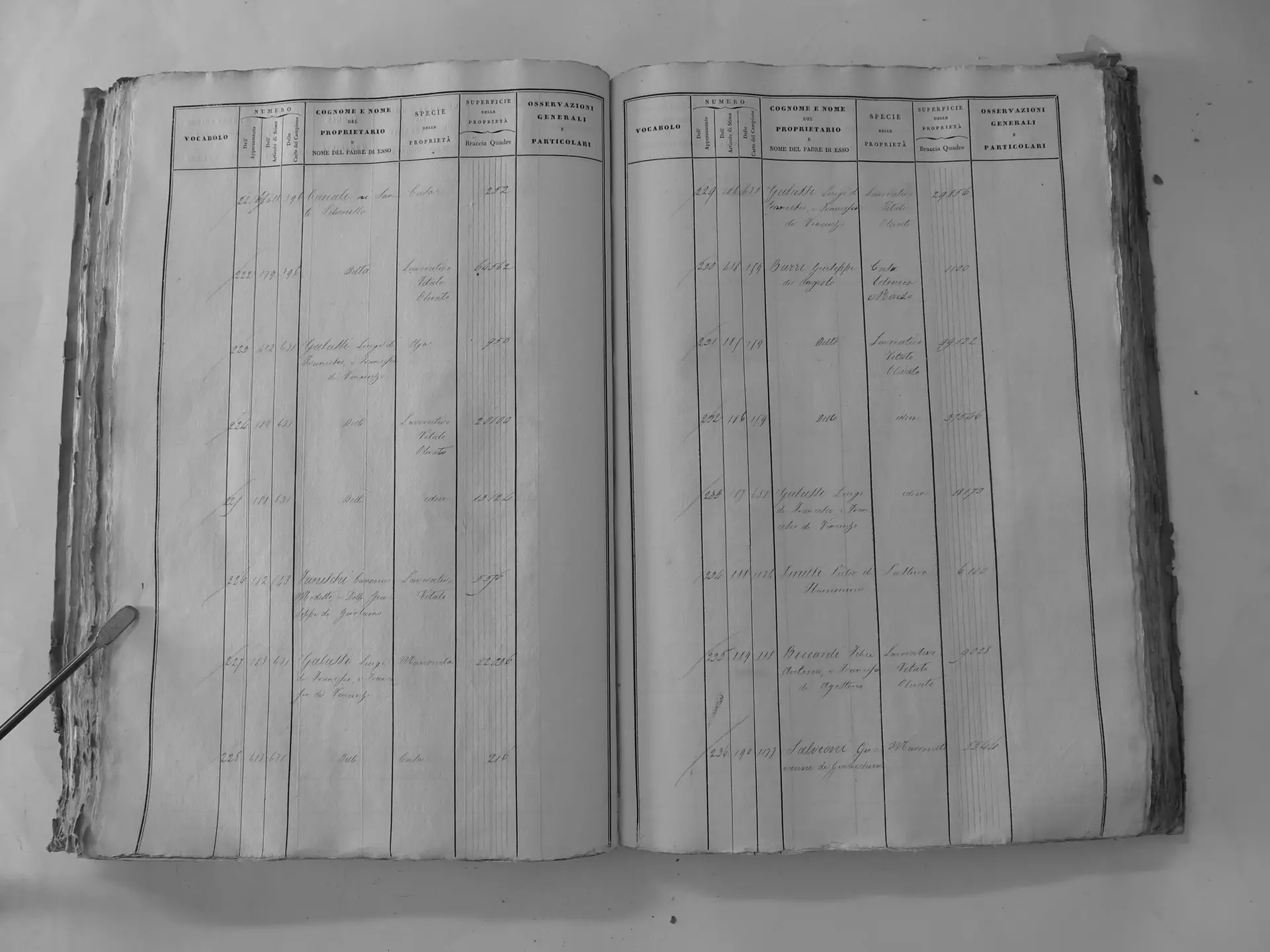
The Tamanti were not alone at Scarnaquoja. The same section records parcels 100, 101, 129 and 130 under “Santi Luigi di Clemente” (CASTORE, Scarnaquoja). Clemente’s mother, Petronilla Canali ne’ Santi, also held land in the section (CASTORE, Scarnaquoja). In 1820, Tamanti and Santi owners held land side by side in the same cadastral section.
The name “Luigi di Clemente” needs care. It looks like a son of the Clemente who married Maria, but no civil, parish or household record yet says which Clemente was Luigi’s father. The cadastral fact is secure. The family link is still open.
1840: a chapel at Chiusa
On 2 October 1840 Gaetano Tamanti asked the bishop for permission to build a chapel on the podere “Chiusa” that he owned. He proposed dedicating it to Saint Francis of Assisi, Saint Gaetano and Saint Apollonia. It was to be a burial place for the family, maintained at his own expense (Brandi, Studi e Trascrizioni). Twenty years after the cadastre, Gaetano was still the owner.
Le Chiuse today dates its historic residence to 1840 and includes an apartment called Cappella, made from a small deconsecrated church. The surviving building may well be Gaetano’s family chapel. That is still a hypothesis: the building’s dedication, fabric, any inscriptions or burials, and the estate papers have yet to be examined.
The open question
If Le Chiuse was Maria’s dowry, why was her brother still its owner in 1820 and again in 1840? Maria has no owner entry anywhere in the cadastre. Several explanations fit: a paternal estate shared between the siblings, part of Chiusa given as dowry while Gaetano kept the rest, rights rather than land, or a later transfer that family memory simplified. Carle reports that Gaetano, who never married, made a will in 1847 (Carle, La patria locale, 1996, p. 296). That will has not been examined. Maria’s dowry settlement and the cadastral transfer registers for parcels 59–62 are the records that should decide it.
One more thread links Le Chiuse to Ferruccio’s world. In 1902 Ferruccio won a gold medal for his vineyard at “Scarnacuoia” (Cinelli Colombini, 2021, pp. 74–75). This is essentially the same place-name as the cadastral section where Gaetano’s parcels lay, and close to the 1692 Tamanti podere “Scannaquoia”. Whether these were the same property is a strong lead for a parcel-by-parcel study, not yet a proven link.
Sources on this page
- Catasto Generale della Toscana, Comunità di Montalcino, Tavole indicative, Scarnaquoja (U′): Tamanti Gaetano di Francesco, Tomo III p. 101, p. 108, p. 123; Santi Luigi di Clemente, Tomo III pp. 103–105; Canali ne’ Santi Petronilla, Tomo III pp. 111–112.
- Coloured map of the Scarnaquoja parcels, an owner reconstruction on the CASTORE map (local image; CASTORE map viewer).
- Notarial statement of 19 June 1810, Montalcino, Matrimoni allegati reg. 196, p. 344. Local scan; Portale Antenati.
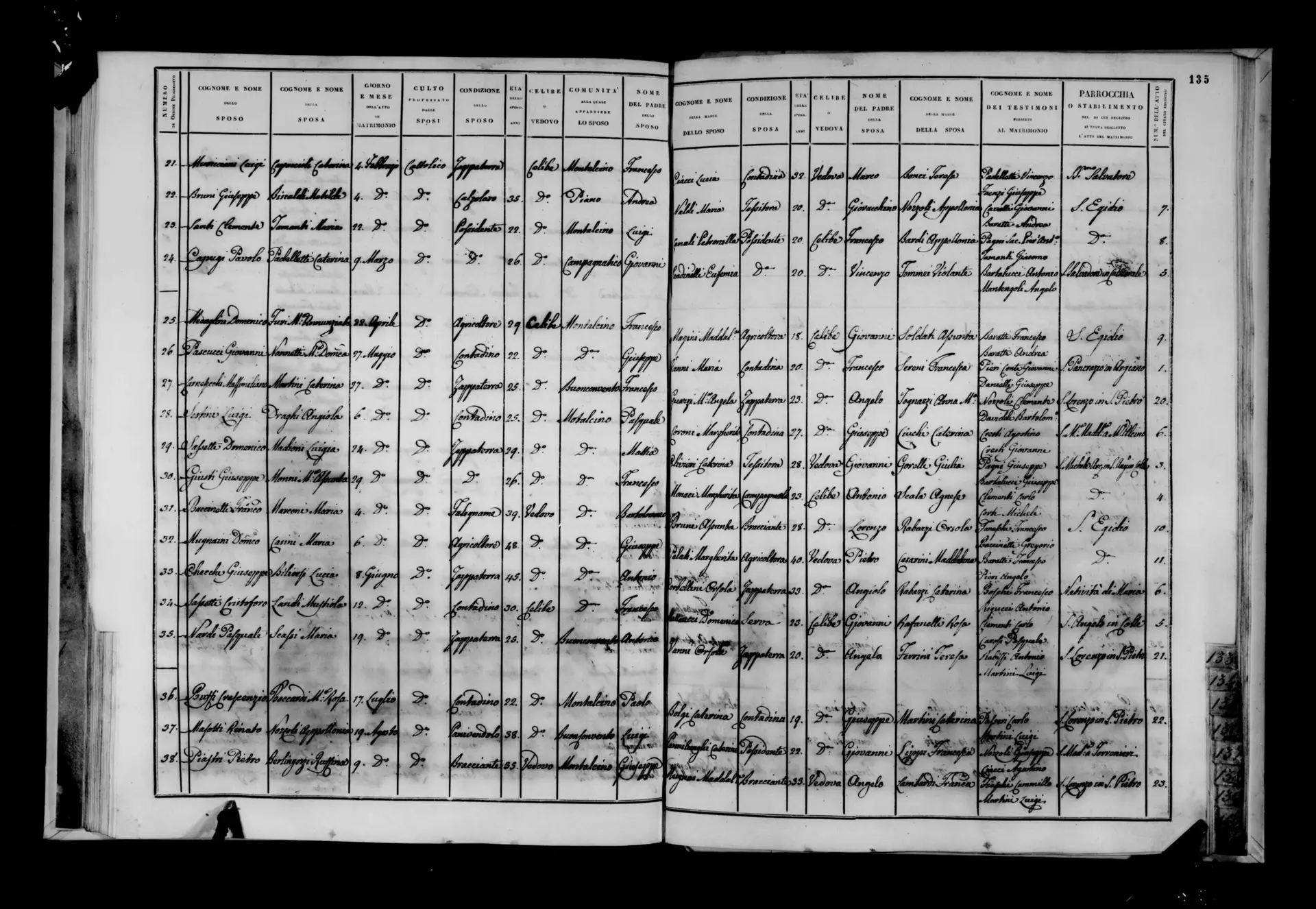
- Marriage of Clemente Santi and Maria Tamanti, 12 February 1819, Montalcino, S. Egidio, act 8. Local scan; Portale Antenati.
- Brian Pasch, survey of about 725 Tavole indicative owner-table pages for the Comunità di Montalcino, September 2026 (unpublished).
- Lucia Bonelli Conenna, Il contado senese alla fine del XVII secolo (Accademia Senese degli Intronati, 1990), p. 162.
- Lucia Carle, La patria locale. L’identità dei Montalcinesi dal XVI al XX secolo (Regione Toscana / Marsilio, 1996), pp. 292, 296.
- Don Antonio Brandi, Studi e Trascrizioni (online compilation): 1700 San Lorenzo decimario; 1840 Cappella della Chiusa record.
- Maurizio Boldrini, Bruno Bruchi and Andrea Cappelli, This Is My Land: Franco Biondi Santi, Montalcino and Brunello (Protagon Editori, 2010), pp. 18–19.
- Stefano Cinelli Colombini, Brunello, ritratti a memoria, 2nd ed. (Fattoria dei Barbi, 2021), pp. 74–75.
- Le Chiuse, official estate history and Cappella apartment page.