

In the eighteenth century the Tamanti family enters the parish record in its own right. The baptism index of Sant’Egidio lists twenty-nine Tamanti children between 1689 and 1757. It records Ermenegildo on 13 November 1704 and Filandro on 27 February 1755, and both dates agree with Carle’s published genealogy. Local records speak of the palazzo of the “Ill.mo Signor Ermenegildo Tamanti”, with a room called the Camera di San Gaetano. By the early 1800s the family had divided into two branches, each with its own land. That division runs through the rest of this story.
Two branches
Filandro’s line
Ermenegildo Gaetano Tamanti (b. 1704) and his wife Cristofana Feci had at least two sons, Giacomo and Filandro. Filandro’s children include the brothers Ermenegildo and Dr Antonio. In about 1820 the cadastre registered the two brothers together as owners of a 98-parcel estate at Il Casato (Sparampaglia), with a farmhouse and stable on parcel 83. It also listed their holdings in section A of the cadastre (Tavole indicative, Tomo I p. 9; original on CASTORE).
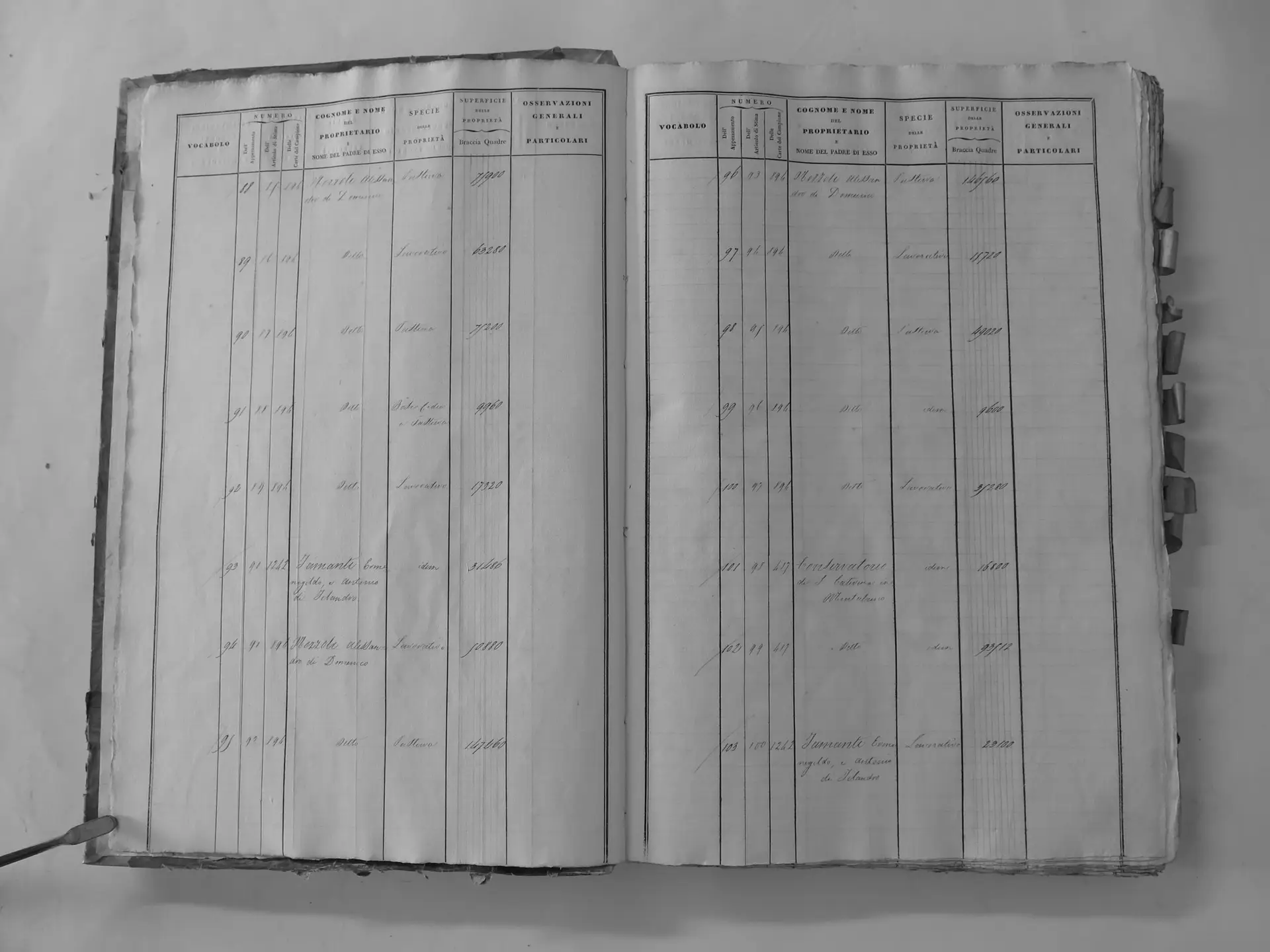
Dr Francesco’s line
Carle’s chart shows a second branch headed by Dr Francesco Tamanti (b. 1757) and his wife Appollonia Bardi. Their children include Maria and Gaetano (b. 1801). The cadastre of about 1820 names “Tamanti Gaetano di Francesco” as owner of a house on parcel 59 at Scarnaquoja, the core of the Chiusa farm, with vines and olives on the neighbouring parcels (see Gaetano’s Scarnaquoja ledger pages, for example Tavole indicative, Tomo III p. 101). Gaetano never married. Carle records that he wrote a will in 1847 and petitioned the Grand Duke about it (Carle, La patria locale, 1996, p. 296). Dr Francesco was probably another son of Ermenegildo Gaetano. That would make him Filandro’s younger brother and Maria and Gaetano Filandro’s niece and nephew. The research notes treat him this way, but none of the sources used here states it outright.
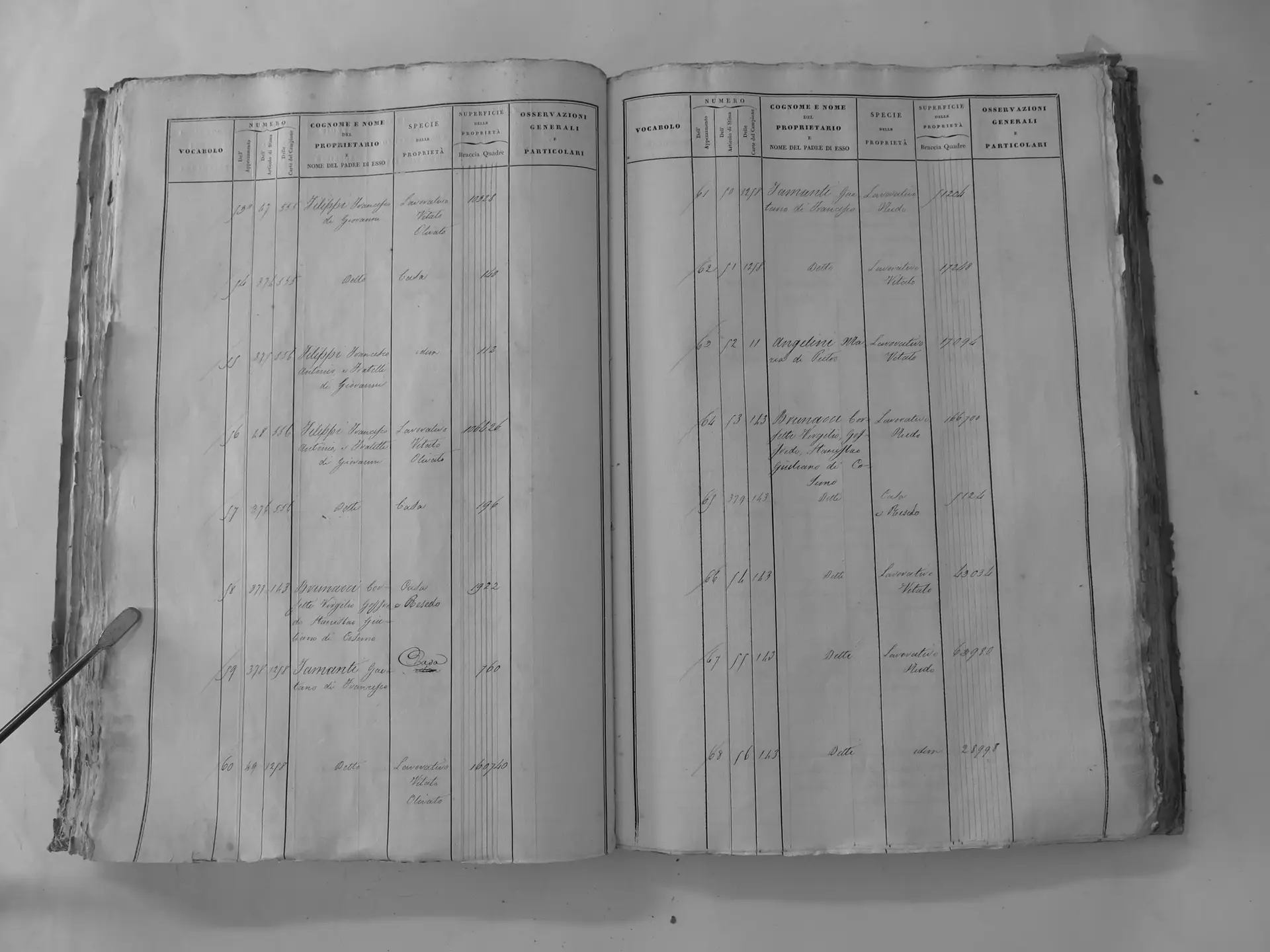
The “Tamanti Minori” of 1810
Dr Francesco was dead by the summer of 1810. On 19 June 1810 a sworn statement was filed with the marriage papers of one Bartolommeo Martini. It describes a farm where a woman had died in December 1751. At that time the farm belonged to the hospital of Santa Maria della Croce. In 1810 it belonged to the “Tamanti Minori, figli del fu Francesco”, the under-age children of the late Francesco Tamanti (notarial act of 19 June 1810, reg. 196, p. 344; original on Antenati).
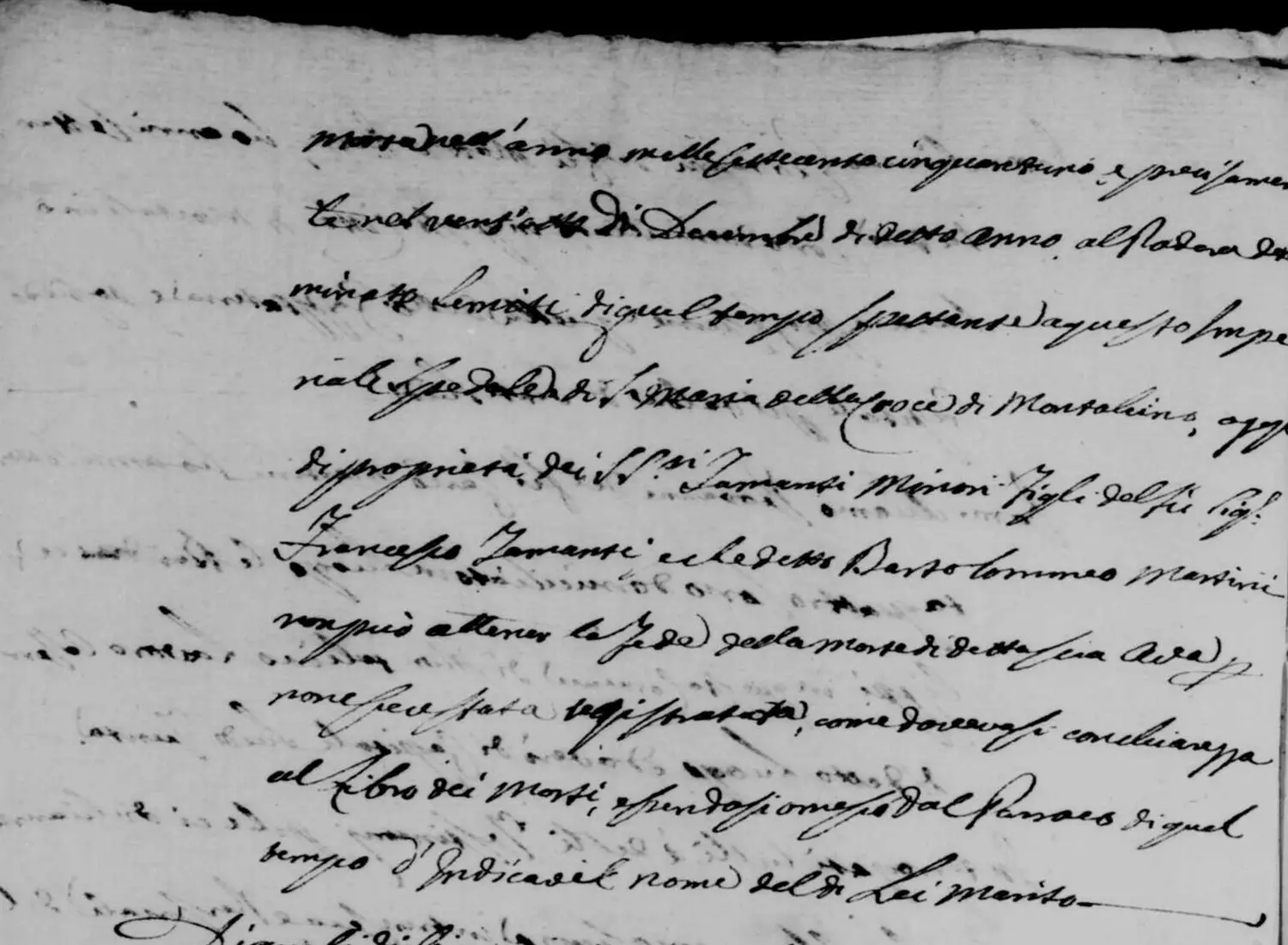
The act does not name the children, their guardians, or how they came to own the farm. The farm’s name is hard to read. Maria and Gaetano are the obvious candidates, but that needs a baptism or succession record to confirm. The idea that this farm later formed part of Maria’s dowry is a hypothesis, not a demonstrated transfer.
A run of marriages, 1809–1820
Under Napoleonic rule Tuscany began civil registration, and Tamanti marriages start to appear in it.
- 5 February 1809. Anna Tamanti, aged 18 and daughter of Filandro, married Guido Orazio Ducci(?) (marriage act, reg. 94, act 7; original on Antenati). Filandro consented. Anna, Filandro and Giacomo Tamanti all signed (signatures). The banns had been read on 1 and 8 January (banns on Antenati).
- 24 February 1811. Francesca Maria Giacoma Tamanti married Mario Giuliani. The act calls her father Filandro “son of the late Ermenegildo” (marriage act, reg. 96, act 10; original on Antenati), which confirms the line from Ermenegildo to Filandro to his daughters.
- 12 February 1819. Maria Tamanti, aged 20 and a landowner, daughter of Francesco Tamanti and Appollonia Bardi, married Clemente Santi (marriage act of 12 February 1819; original on Antenati). Their grandson was Ferruccio Biondi Santi.
- 25 November 1820. Barbara Tamanti, aged 19, daughter of Filandro and Teresa Capei, married Luigi Benigni (marriage act, act 21; original on Antenati).
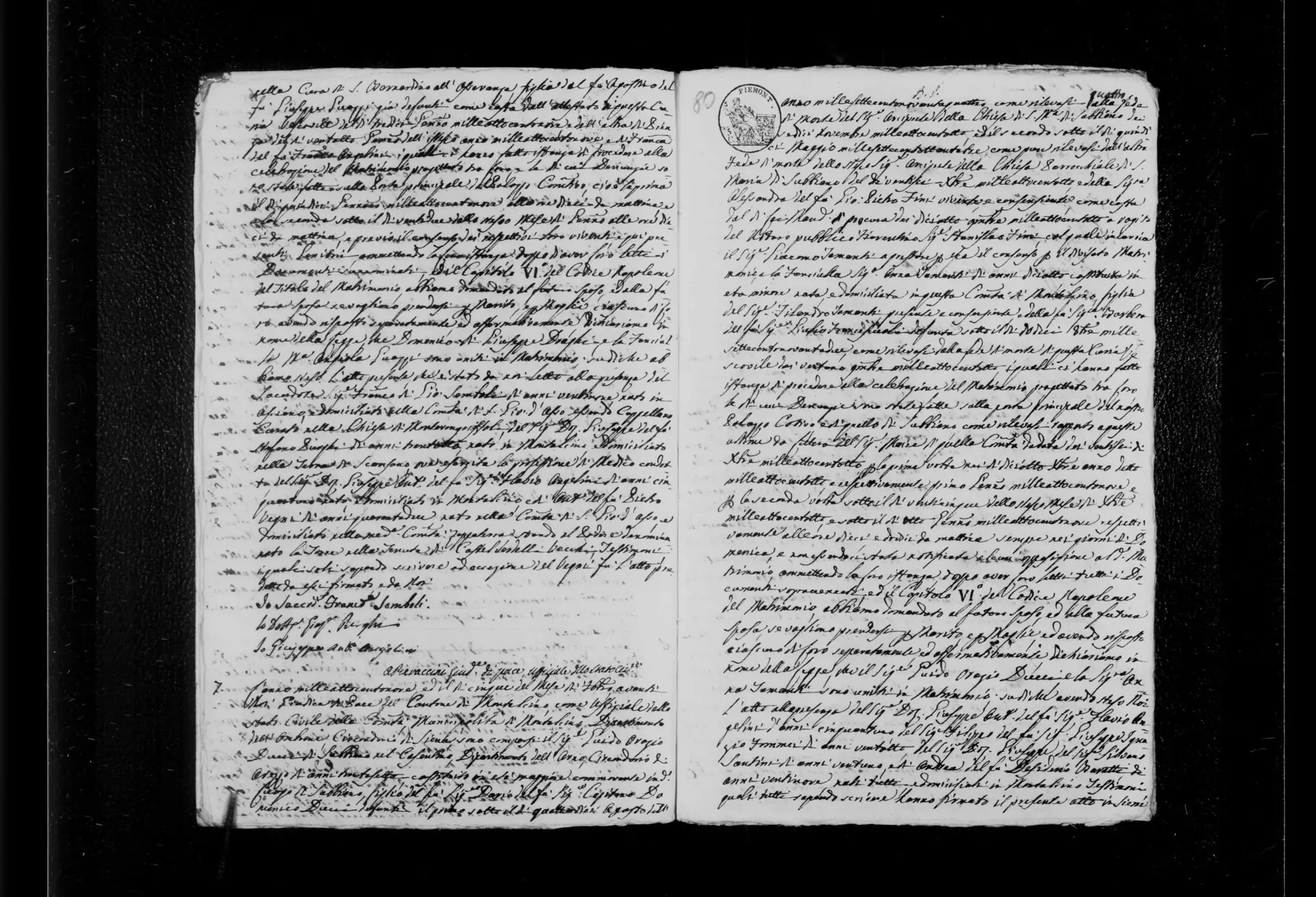
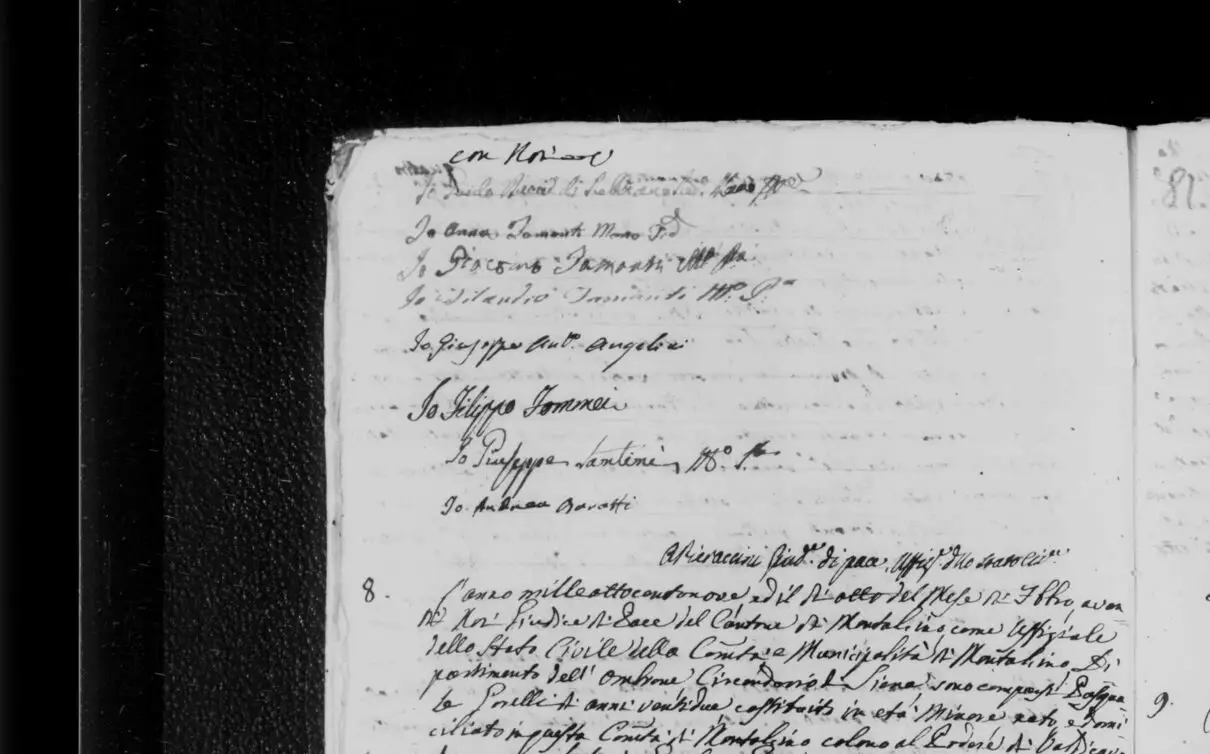
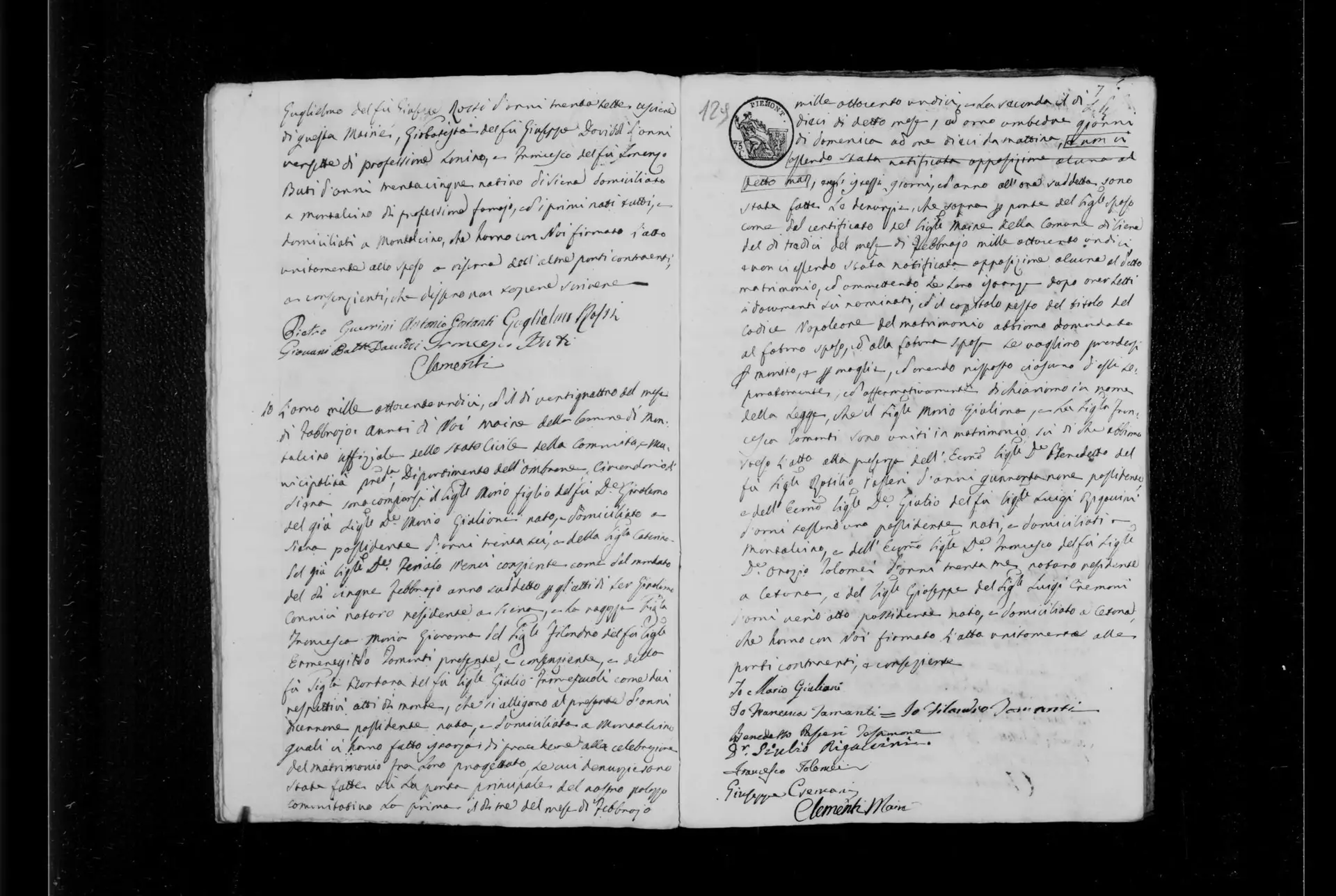
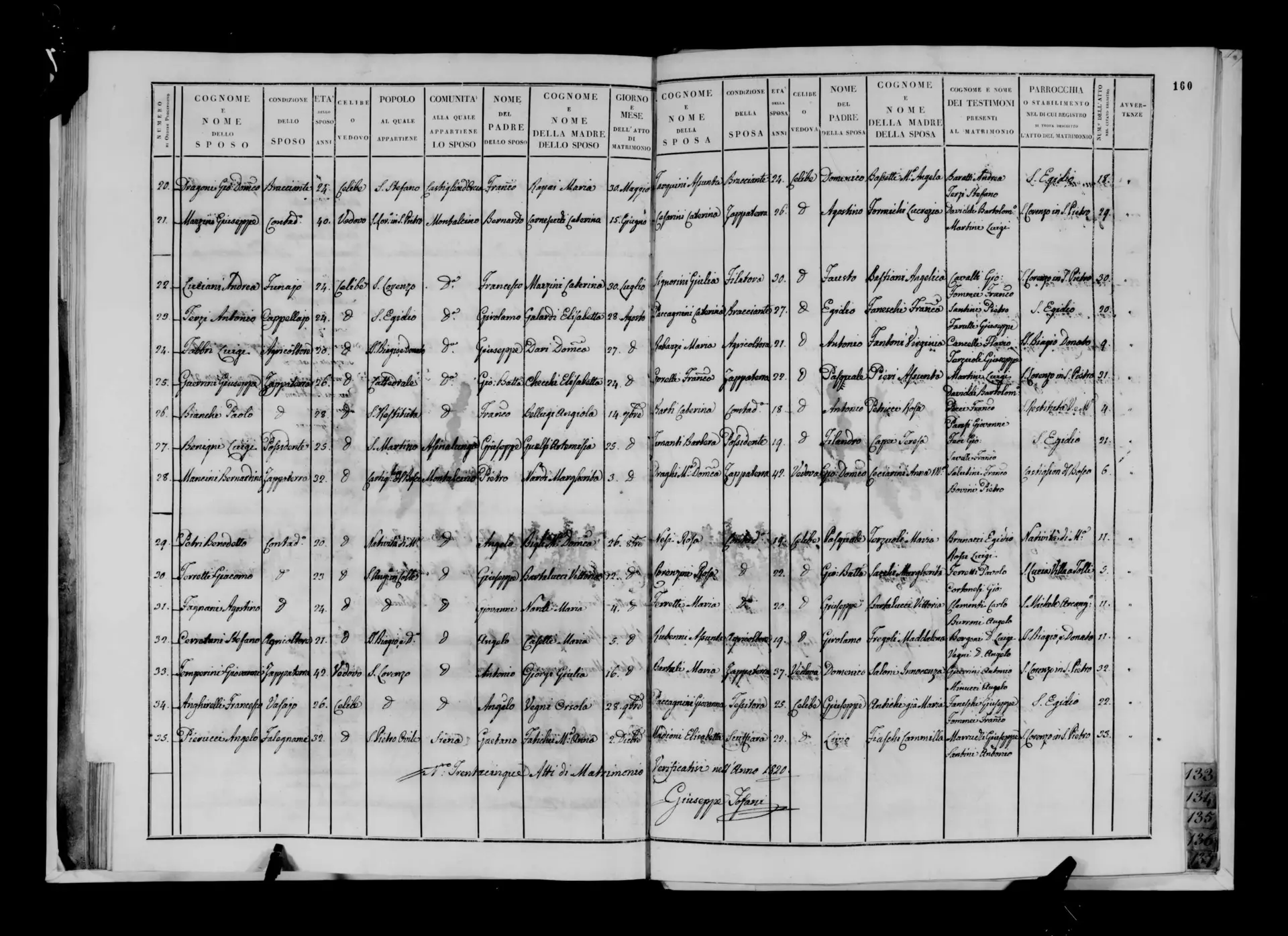
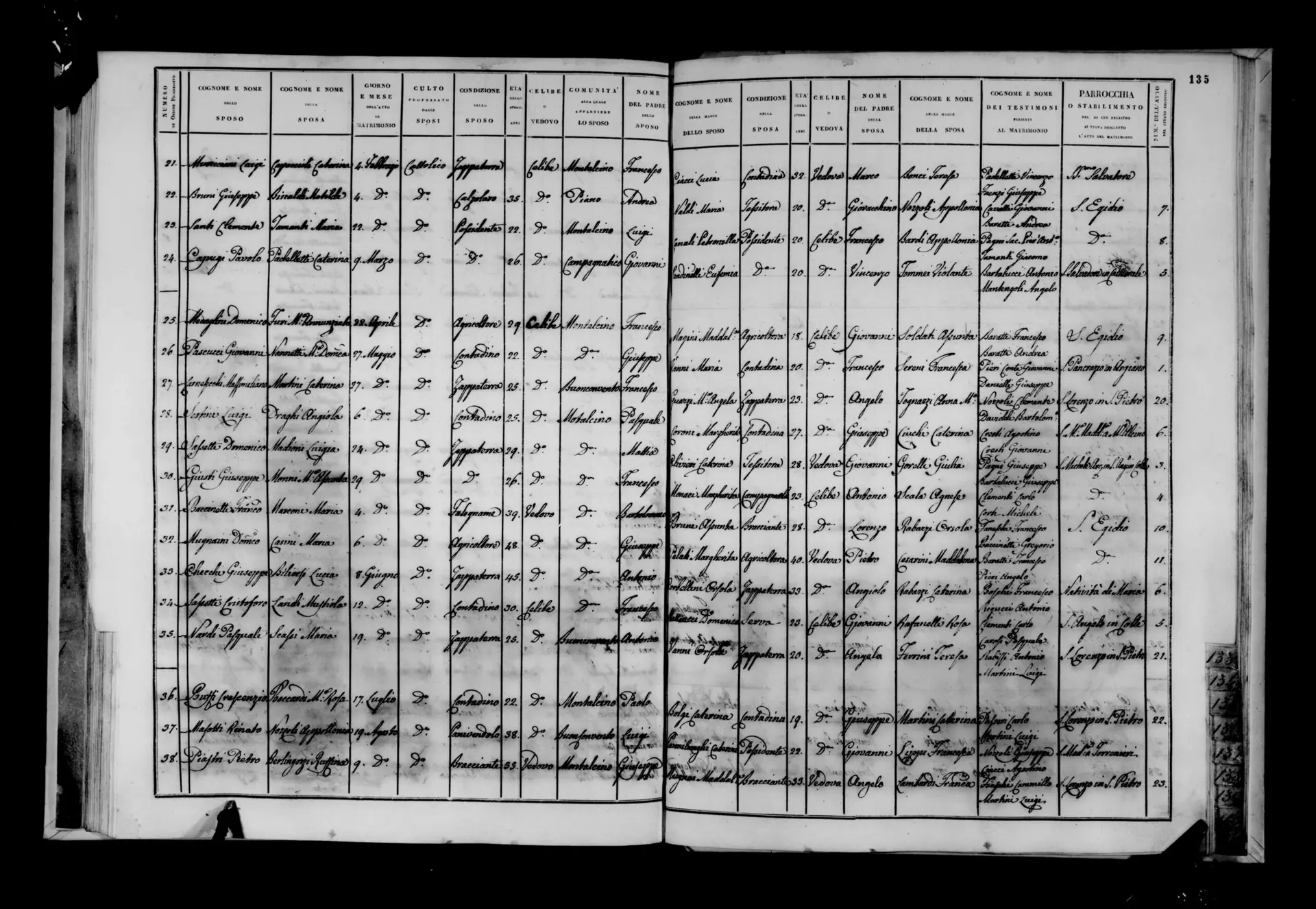
The records name two different mothers for Filandro’s children, and Carle’s family chart explains why: Filandro married twice. His first wife, Barbara Francescoli (1762–1792), mother of Cristofana, Anna and Francesca, died in 1792. He then married Teresa Capei of Lucignano in the Val di Chiana, about seventeen years younger than himself, between 1792 and 1799; she bore the sons, Ermenegildo and Dr Antonio, who kept the palazzo. Filandro died on 1 November 1824, aged seventy, a landowner of Sant’Egidio. Teresa outlived him by more than twenty years and died on 24 February 1846, aged seventy-four, “living on her sons’ patrimony”, in the parish of San Lorenzo in San Pietro.
Three daughters and a granddaughter
Filandro’s first marriage gave him daughters and no sons. Cristofana, the eldest, was born in October 1786, Anna about 1790 and Francesca a little later. All three made their lives away from Montalcino. Anna married Guido Orazio Ducci of Subbiano in the Casentino in 1809 (see Anna Tamanti Ducci); she died a widow at Bibbiena on 5 July 1860, aged seventy. Francesca married Mario Giuliani in 1811, and their twins Giuseppe and Barbara were born at San Casciano dei Bagni in 1822. Widowed in 1842, Francesca made her will before a notary of Bibbiena in July 1847, perhaps having joined her sister in the Casentino, and she was still living in December 1850, when her son married at Arezzo. She very probably died at Livorno in 1855: the general index of deaths for all Tuscany enters her that year twice, as Tamanti and under her married name, Giuliani, both times as a daughter of Filandro and with the same number, though the act itself has not been found.
Francesca married into an old family of San Casciano dei Bagni, in the far south of the Sienese state. Notaries named Giuliani drew up deeds there from the 1660s to the 1730s, and her husband, Dr Mario Giuliani, a landowner born in Siena, was the town’s gonfaloniere, its mayor, from at least 1823 to 1835; he died at San Casciano on 27 November 1842, four months before Anna’s husband died at Bibbiena. Anna’s Casentino family now has a page of its own, The Ducci of Subbiano, and both sisters appear among the women of the Tamanti story.
Cristofana went furthest, to the capital. She married into a family named Cremani, and when she died in Florence on 15 November 1851, aged sixty-five, in the parish of San Michele Visdomini near the cathedral, the register entered her as a woman of means and her husband as ‘Cremani, fu Giuseppe’: a Cremani son of the late Giuseppe, or perhaps the late Giuseppe Cremani himself.
None of the three came home. Francesca’s son did, and he brought his daughter. Giuseppe Giuliani became a lawyer and magistrate, and at Lucca on 15 November 1873 his daughter Maria, aged sixteen, married Francesco Antonio Tamanti, Dr Antonio’s only son: the bride was Filandro’s great-granddaughter and the groom his grandson. Maria lived in Montalcino for more than sixty years, in the place her grandmother had left as a bride (see Maria Giuliani Tamanti).
Giacomo, the elder brother (d. 1819)
Giacomo Tamanti appears again and again in these years. He signed Anna’s marriage act in 1809. He sat on the town council in 1812, alongside Filandro (Carle, 1996, pp. 81, 83). In February 1819 he was a witness when Maria, probably his niece, married Clemente Santi. His death record settles who he was. He died on 1 October 1819, aged 78, a landowner who had never married, the son of Ermenegildo and Cristofana Feci (death record, Morti 1819, reg. 15, row 185; original on Antenati).

Giacomo also left something that still stands. In 1808, as owner of the Castello di Romitorio, he asked the bishop to move the damp old country church of San Guglielmo d’Aquitania to “il palazzo di Romitorio”. He promised to build a new church of the same size, keep it and its furnishings in repair, and give the priest a stable and a fire, taking the old chapel and a ruined cottage in exchange. The bishop agreed, provided the old stones were reused. A priest was serving “the new church of Romitorio” by 1814, and Don Antonio Brandi identifies it as the chapel beside the castle today (see Romitorio).
So Giacomo was Filandro’s elder brother, not his son: the “Jacomo 1742” of Carle’s tree, baptized on 5 January 1742. Carle’s chart also explains the name: two little boys called Jacomo, sons of Dr Gaetano, had died in 1728 and 1733. Carle’s 1812 council table gives Giacomo’s age as 22 and Filandro’s as 70, which does not fit. Filandro, born in 1755, would have been 57. The Giacomo who married in 1848 was a different man, a grandson of Filandro who was probably named after this great-uncle.
Another relative died in the same decade. In May 1815 the death register records “Tamanti Carlo, Canonico Sacerdote”, aged 67, of the parish of Sant’Egidio, son of Ermenegildo and Cristofora Feci (Morti 1815, no. 91, on Antenati). This is Canon Dr Carlo Antonio Tamanti, born in March 1748, a son of Ermenegildo and brother of Giacomo and Filandro; the Napoleonic civic register of 1812 lists him as “dottore in legge e canonico”. He is the “Canonico Carlo Antonio Tamanti” who on 28 April 1808 bought the former Lucattini farms of Vie Piane, Montiano and Bozzolino from Niccolò Gori Pannilini of Siena, whose wife Chiara Lucattini, a Florentine heiress, had owned them; she died seven weeks after the sale. The canon’s rights later passed to Gaetano Tamanti. He must not be confused with an earlier priest of the same name, Carlo Antonio (1698–1733, written 1697 in the register’s Sienese year), son of Dr Jacomo and Anna Menchini, for whom the 1699 Soccorso altar honours Saint Carlo Borromeo.
Dr Gaetano at the hospital, 1792
Another brother, Dr Gaetano Tamanti (1747–1796), held two public trusts at once. In May 1792, when Montalcino held funeral rites for Emperor Leopold II, the former Grand Duke Pietro Leopoldo, in the church of the Conservatorio di Santa Caterina, the Gazzette Toscane named “il Sig. Dott. Gaetano Tamanti Operajo del Conservatorio predetto, e vigilantissimo Rettore di questo Regio Spedale”: he was lay administrator of the girls’ school and rector of the hospital of Santa Maria della Croce. Carle’s list of the hospital’s rectors gives a Tamanti for 1787–1798 without a first name; the newspaper supplies it for 1792.
Dr Francesco: a death between two systems
Dr Francesco was alive in December 1802, when his brother Giacomo made a gift to his children, and “the late Signor Francesco” by June 1810. Yet the Napoleonic death registers opened in Montalcino in the summer of 1808 never record him, so he died between 1802 and 1808, before they began, or away from home. Carle’s chart adds that he and Apollonia Bardi buried two little daughters, one born in 1797 and one who died in 1801, before Gaetano and Maria grew up.
Ermenegildo’s house on the Corso, 1841–1872
Filandro’s elder son was not the first of his name: a brother christened Ermenegildo in December 1800 died in infancy, and the name was given again to the boy born on 15 February 1804. In the census of 1841 Ermenegildo, 37, “proprietario”, lived at house 150 in the parish of San Lorenzo in San Pietro with his wife Marianna Tassinari, an old estate agent and a young servant; his two sons, then fourteen and thirteen, were not in the house. Four houses away, at no. 146, lived his cousin Maria Tamanti Santi with her husband Clemente. Marianna, a Florentine, died in their house on the Corso Vittorio Emanuele on 5 March 1868, aged sixty-one. Ermenegildo died there a widower on 11 February 1872; his death was reported by Avv. Orazio Brigidi, of the family whose Dr Dionisio had been his curator, and an old shoemaker, Federigo Fommei.
Ermenegildo’s elder son married first, and away from home. On 24 January 1848, at Arezzo, Filandro Tamanti of Montalcino, styled “Nobile”, the son of Ermenegildo and Marianna Tassinari, married Letizia Ducci, also “Nobile”, aged twenty, the daughter of Gio. Carlo Ducci and Anna Bacci. The act makes the bridegroom twenty-two, although his baptism of 3 February 1827 makes him not quite twenty-one. It was the second Tamanti marriage into a Ducci family: in 1809 Filandro’s aunt Anna, his father’s half-sister, had married Guido Orazio Ducci of Subbiano, though whether Letizia’s Ducci of Arezzo were kin to Anna’s the act does not say. Six months later Filandro’s younger brother Giacomo married Clementina Begni at Montalcino. What became of Filandro and Letizia is not known.
His son Giacomo was still called a landowner when his own son, Vittorio Giovanni Luigi, was born on 25 September 1859, “grandson of the most illustrious Signor Ermenegildo”; the godmother, “the most illustrious Signora Maria Anna Tamanti”, was almost certainly Giacomo’s aunt Anna Ducci, who sent a Begni lady to stand in for her. What became of Vittorio is not yet known.
Marianna’s Florentine family
Marianna brought the house on the Corso a family in the capital. She was the daughter of the late Francesco Tassinari and Gaspera Ferroni, and the Tassinari papers now at the Gabinetto Vieusseux in Florence name her, her brothers Giuseppe and Giovan Battista and her sister Maddalena as the couple’s minor children; her mother’s guardianship, remarriage, will and estate division survive in the inventory, unread. Her brother Giuseppe was a man of books and architecture. In 1843 he joined the long Florentine argument over a façade for the cathedral, Santa Maria del Fiore, with a printed pamphlet defending Niccolò Matas’s design: he pleaded for restraint, for a façade that told the truth about the building behind it, rather than for theatrical ornament. His library, more than 9,000 works, went in 1884 to the public library of Empoli, where the Sala Tassinari keeps its original shelves. Nothing yet shows that any of this taste reached the painted rooms of Palazzo Tamanti; it shows the world Marianna came from.
Her other brother, Cav. Giovan Battista Tassinari, served the grand-ducal court and married an Englishwoman, Mary Amalia Thornton, sister of the diplomat Sir Edward Thornton. They lived at Casa Pepi in Via dei Pepi: the Brownings’ address book lists “Cav. Giovanni Tassinari” there, and in December 1858 Elizabeth Barrett Browning sent a letter to a friend care of Madame Tassinari at the same house. The revolution of 1859 divided that circle. Barrett Browning, a passionate supporter of Italian unity, wrote that Tassinari regretted his duke rather loudly. In January 1860 he was arrested, and his case was debated in the House of Lords: on 9 March their lordships heard his wife’s plea for a trial and humane treatment, since his failing sight made solitary confinement especially cruel, and on 17 April his own letter, saying that the charge concerned money for a reactionary movement and printed circulars, for which the police had sentenced him to six months without trial. Lord Normanby reported that he had since been set at liberty. Marianna’s brother was a loyalist of the old Tuscany; nothing shows that Ermenegildo shared his politics.
Filandro and the Madonna del Soccorso
Filandro took his place among the town’s notables. On 7 May 1818, when the image of the Madonna del Soccorso was carried to the cathedral for the hundredth anniversary of its coronation, it was followed by “gl’illustrissimi signori Deputati al governo temporale del Sacro Tempio, cioè Filandro Tamanti, zelantissimo deputato camarlingo”, with Dr Giulio Rigaccini and Giuseppe Ciotti-Massi (Brandi, Studi e Trascrizioni). As camarlingo, Filandro kept the sanctuary’s accounts: the family that had given its right altar in 1699 now helped to run it.
Filandro’s last notice, 1823
A year before his death Filandro put a warning in the Gazzetta di Firenze. Dated at the Montalcino court on 21 November 1823, it declared void the blank papers he had signed and left with a man in Florence, to serve as powers of attorney in several lawsuits then pending in the courts of the capital. The man had never given an exact account of how they were used, and any claim written into them would be treated as an abuse of trust. Filandro added that, given “la inoltrata sua età ed i gravi incomodi di salute”, his advanced age and serious ill-health, he would contract no obligation without the consent of Antonio Costanti, a landowner of Montalcino, who had replaced his late adviser Flavio Angelini. He died less than a year later, on 1 November 1824. Which lawsuits were pending in Florence is not yet known.
An inheritance case, 1790–1817
The Archivio di Stato di Siena holds two files from the civil court of the Auditore del Governo titled “Martelli eredità giacente e Tamanti” (buste 568, 1790–1817, and 569, 1802–1811): a dispute between the Tamanti and the unsettled estate of a Martelli. The inventory does not name which Tamanti were involved. The dates fall squarely in the years of Giacomo, Filandro, Canon Carlo and Dr Francesco, and the files are to be consulted in October 2026.
Sources on this page
- Indice dei battezzati di Montalcino, parrocchia di S. Egidio, fascicoli 495–498
- Lucia Carle, La patria locale (Regione Toscana / Marsilio, 1996), pp. 81, 83, 292, 296
- ASSi, Catasto Generale della Toscana, Montalcino, Tavole indicative, Tomo I p. 9 (CASTORE)
- Tavole indicative, Tomo III p. 101 (Scarnaquoja, Gaetano di Francesco)
- Notarial statement, 19 June 1810, Matrimoni allegati reg. 196, p. 344 (Antenati)
- Marriage of Anna Tamanti, 5 February 1809, reg. 94, act 7 and signatures; banns, reg. 749
- Marriage of Francesca Tamanti and Mario Giuliani, 24 February 1811, reg. 96, act 10
- Marriage of Clemente Santi and Maria Tamanti, 12 February 1819, S. Egidio, act 8
- Marriage of Luigi Benigni and Barbara Tamanti, 25 November 1820, act 21
- Death of Giacomo Tamanti, 1 October 1819, Morti reg. 15, row 185, act 27
- Death of Canon Carlo Tamanti, May 1815, Morti no. 91
- Owner’s Ancestry.com family tree (Barbara Francescoli identification, 26 September 2026)
- Archivio di Stato di Firenze, Stato civile toscano, on Portale Antenati (read 21 October 2026): Firenze, Morti 1851, p. 952, no. 3638 (Cristofana Tamanti) and Repertori generali alfabetici, Morti 1851, Femmine, p. 450; Arezzo, Matrimoni 1850, p. 446, no. 297 (Giuseppe Giuliani, mother Francesca Tamanti living)
- Archivio di Stato di Firenze, Stato civile toscano, on Portale Antenati: Arezzo, Matrimoni 1848, p. 18, act 14 (Filandro Tamanti and Letizia Ducci, 24 January 1848); Repertori generali alfabetici, Morti 1855, Femmine (Tamanti and Giuliani, Francesca, daughter of Filandro, Livorno, no. 2841); the general indexes of marriages and deaths for all Tuscany, read for 1838–1865
- Almanacco della Toscana 1825 and Almanacco toscano 1832 and 1835 (Dr Mario Giuliani, gonfaloniere of San Casciano dei Bagni); Archivio di Stato di Siena, Guida-inventario III (1977), p. 52 (the Giuliani notaries)
- Don Antonio Brandi, Studi e Trascrizioni (1808 Romitorio petition; 1818 centenary of the coronation of the Madonna del Soccorso)
- Annali di giurisprudenza (Florence, 1842), decision of 22 September 1842 (purchase by Canonico Carlo Antonio Tamanti, deed of 28 April 1808)
- Gazzette Toscane, vol. 27 (Florence, 1792), p. 90, “Montalcino 12 Maggio” (Dr Gaetano Tamanti, operaio of the Conservatorio di S. Caterina and rector of the hospital) (HathiTrust)
- 1841 census of Tuscany, Montalcino, S. Lorenzo in S. Pietro, folio 172, houses 146 and 150 (Portale Antenati an_ua36203202)
- Montalcino deaths: 1824, no. 220 (Filandro); 1846, act 278 (Teresa Capei); 1868, act 61 (Marianna Tassinari); 1872, act 21 (Ermenegildo); births 1859, row 231 (Vittorio)
- Archivio di Stato di Siena, Tribunale civile dell’Auditore del Governo, Documenti depositati nelle cause civili, commerciali e di eredità, buste 568–569, “Martelli eredità giacente e Tamanti”
- Gazzetta di Firenze, notice of Filandro Tamanti dated at the Tribunal of Montalcino, 21 November 1823 (reprinted in the Gazzetta di Firenze, 1824)
- Gabinetto Vieusseux, Tassinari-Colnaghi-Malvani inventory (PDF); Giuseppe Tassinari, pamphlet of 1843, reprinted in N. Matas, Dimostrazione del progetto … S. Maria del Fiore (Florence, 1859), pp. 85–88; Comune di Empoli, Sala Tassinari
- The Brownings’ Address Book (1856–1863), p. 399, and The Brownings’ Correspondence, letters of 1858–1860; Hansard, House of Lords, 9 March 1860 and 17 April 1860, “Case of M. Tassinari”