

The Tamanti were not originally from Montalcino. Carle’s published genealogy traces them to Buonconvento, in the Ombrone valley. The geographer Emanuele Repetti put it six miles north of Montalcino. In Grand Duke Pietro Leopoldo’s day, travellers from Siena went as far as Buonconvento by carriage and continued to Montalcino on horseback. The family’s founder is remembered by a nickname: Cristofano, called “Il Tempesta” (“the Storm”), who died in 1590 (Carle, La patria locale, 1996, p. 292).
Buonconvento, 1522: the earliest Tamanti on record
The family name appears in Buonconvento almost seventy years before Il Tempesta’s death. In 1522, “in the tenth indiction”, under Pope Adrian VI and the Emperor Charles V, the commune of Buonconvento had its statutes written down. The volume of “statuti e leggi municipali del Comune et uomini di Buonconvento e sua Corte” was “ordinato, composto e compilato per gli savi e prudenti uomini Bartolommeo di Francesco Tamanti, Pietro di Bartolommeo Minucci, Giovanni di Matteo Baccinetti e Bartolommeo di Salvestro Brunelli, statutarii e deputati per gli opportuni consigli di detto Comune”. The notary was Ser Bernardino di Bartolommeo Faneschi of Montalcino, the commune’s official. His son, the notary Bartolommeo Faneschi, wrote out the volume.
The wording matters. Bartolommeo and the other three men were deputed by the town’s councils to compile its laws. The statute covered how priors were drawn by lot, how the council and treasurer worked, civil cases, crimes and damage to fields and crops. Being one of four men trusted with that work places the Tamanti among Buonconvento’s established citizens in 1522. His name carries no “Ser” or “Messer”, so he was neither a notary nor a titled man. Whether he owned much property is not yet known; Siena’s tax declarations (the Lira) for Buonconvento should answer that. His patronymic adds one more generation, a Francesco Tamanti living in the late 1400s. How Bartolommeo relates to Cristofano “Il Tempesta” is still unproven, but the dates would allow him to be Cristofano’s grandfather or great-uncle.
Silvio Pucci, who published the modern edition in 1991 for the Circolo culturale “Amici di Buonconvento”, knew two copies, both in the Archivio di Stato di Siena: the parchment original, Statuti dello Stato di Siena no. 17, whose margins carry later reforms (the only dated one is of 30 December 1522), and an eighteenth-century paper copy, no. 18. A Buonconvento copy is also listed in the Comune di Montalcino historical archive.
Tax classes and a court up the hill
The statute shows how Bartolommeo’s neighbours governed themselves. Eighteen men sat on the council, six each from the “maggiore”, “mezana” and “minore” Lira, the three classes of the town’s tax assessment, and every office was filled in fixed shares from the three classes. No one could be treasurer unless he was “allirato da una lira in su”, assessed at a lira or more. A Buonconvento Lira of about 1520 should therefore place Bartolommeo in one of the three classes, and it is now on the research list. A. Liberati, writing in the Bullettino Senese di Storia Patria in 1933, adds that the council was made of “one man for each taxed household”, and that criminal justice belonged to the Capitano di giustizia of Montalcino. Pucci dates that arrangement to 1560: Buonconvento kept a podestà for civil cases but sent its criminal cases up the hill, in the very decade the Tamanti began to move there.
The original, read on 14 October 2026. In the reading room of the Archivio di Stato di Siena, Brian Pasch examined the Siena copy itself, “Statuti del Contado, Buonconvento, Registro n. 17” (89 leaves; the archive dates the register 1544 from its later additions). Its first leaf names, in a clear chancery hand, “li savi et prudenti homini Bartholomeo di Francesco tamanti, Pietro di Bartholomeo Minucci, Giovanni di Matteo baccinetti et Bartholomeo di Salvestro” (with “Brunelli” added above the line), “statutarii electi et deputati per li oportuni consegli di decto comune di Bonconvento”, recorded by Ser Bernardino Faneschi, notary of Montalcino, in “MDXXII”. The page describes Pope Adrian VI as “electo… et non ancora coronato”, elected but not yet crowned, which places the work between 9 January and 31 August 1522. The rest of the volume holds the chapter index and the renewals by which Siena’s officials confirmed the statute, with seals and dated notes of 1579, 1605, 1637 and 1654. Descendants of the Baccinetti still appear a century later; no later Tamanti does, which fits the family’s move to Montalcino. The 1989 printed inventory of the Montalcino archive (vol. I, pp. 47–48, item 10) quotes the same four names from Buonconvento’s own copy and notes that Siena holds two copies, Statuti del contado 17 and 18.
The vote of 6 July 1522. Pucci’s edition gives the final step. Its last chapter records that the statutes were “lecta, approbata et confirmata” in the general council of Buonconvento on 6 July 1522 “per lupinos albos xxiiii, nigris quattuor”: twenty-four white lupins against four black. The councillors voted with seeds, white for yes and black for no. Bartolommeo is the only Tamanti anywhere in the statute. The surname itself was older in the Sienese state: a “Ghino di Forese Tamanti da Torrita” was a notary of the bishop’s court in Siena from about 1317 to 1352. Giovanna Chironi’s study of the Sienese church’s records, checked in the Biblioteca degli Intronati on 19 October 2026, names him as one of the three notaries who wrote the court’s oldest register and as the writer of its book of synodal constitutions; he joined the notaries’ guild in 1341, still witnessed a sentence in the bishop’s palace on 3 July 1352 as “ser Ghino Foresis”, and was dead by 1358. Also, a Nicolò Tamanti was baptized in Siena on 16 November 1540. Neither has been linked to the Buonconvento family.
Buonconvento revisited, 18 October 2026. Brian Pasch walked the walled town, its clock tower and the church of Santi Pietro e Paolo, where Francesco Tamanti was baptized in 1565, and photographed the headstones and the arms of the old podestà on the Palazzo Pretorio. No Tamanti stone was found, which is no surprise for a family that had left four and a half centuries before.
Arrival in the later 1500s
According to Carle, the family moved from Buonconvento to Montalcino in the later sixteenth century. They settled in the Terzo di Sant’Egidio, one of the town’s three historic districts. Their house stood in the street then called the Mattonato, today’s via Soccorso Saloni (Carle, 1996, pp. 289–300). Palazzo Tamanti itself holds older clues. Its hearth carries the date MDX (1510), earlier than any securely traced Tamanti in Montalcino. The family probably bought or incorporated an older building, but that remains a working hypothesis, not a documented fact.
The name is not new in town, though. A compilation of early Montalcino baptisms records a Marco di Cesare di Francesco Tamanti in 1570 (Brandi, Studi e Trascrizioni). No record yet connects Marco to Il Tempesta. He may belong to an earlier or side branch, and for now he is the earliest Tamanti found in Montalcino, not a proven ancestor.
The registers also narrow down when the move happened. Brandi’s transcription of Montalcino’s baptisms for 1521–1553 contains no Tamanti at all. Buonconvento’s own baptism register still records a Francesco Tamanti, baptized there on 28 October 1565. Taken together, the family came from Buonconvento to Montalcino in the 1560s and 1570s, in more than one branch, in the years after Montalcino’s last stand as the Republic of Siena in exile (1555–1559). Buonconvento itself had been battered in the last war of the Republic: garrisoned in 1552, occupied by the cavalry of Don Pietro de Toledo in 1553, it surrendered to the Marquis of Marignano on 6 August 1554, and Siena granted the town relief for its “grandissima iactura et perdita” (Liberati, 1933). No document yet says why the Tamanti moved. Carle notes that after the siege “a number of new lineages from outside” settled in the recovering town, and the pull of its reviving trade and crafts fits the evidence better than flight from the war.
Later records bear the move out. No Tamanti appears in the Buonconvento name indexes of births, marriages and deaths for the Napoleonic years 1808–1814, among the 460 people of the town parish in the census of 1841, or among the owners of the town and of Casale in the land register of the 1820s. The family’s only nineteenth-century tie to the town came by marriage: Marietta Monciatti, born at Casale in 1878, the daughter of the estate manager Gaspare Monciatti, married Vieri Padelletti of Montalcino in 1897 (see the Padelletti).
Three households and a father called Oriente
Carle describes the arrival in more detail: “In the second half of the sixteenth century”, several Tamanti households “coming from nearby Buonconvento” settled in Montalcino’s territory. Two lived outside the walls, at Aitesi by 1567 and at Corgnuoli by 1579. The third, that of “Cristoforo called il Tempesta, son of Oriente“, lived in the town by 1574. “The degree of kinship is not known… but they were probably cousins” (Carle, 1996, p. 290). Oriente was an ordinary Sienese given name, not a nickname.
This corrects an older reading of the family tree, which made Cristofano and Cesare brothers. The dates suggest a different shape. Scipione, born in 1574 to Cristofano’s first marriage, puts his father’s birth about 1540–50 and Oriente’s about 1500–25. That is the generation of Bartolommeo’s sons, so Oriente and Cesare’s father Francesco may have been brothers, both sons of the Bartolommeo of 1522, and Cesare and Cristofano first cousins. That remains a hypothesis until a notarial act names “Cristofano di Oriente”.
Carle gives Cristofano two wives: first Drapea, and then, in 1584, Niccola, daughter of Pietro Cenni, from a family of artisans. The Pietro baptized in 1585 as “di Cristofano” carries her father’s name, and Fausto (1588) and the posthumous Tofana (1591) were probably her children too.
A family of artisans rises
Scipione Barnaba, the ancestor of the later line, married three times: Ottavia Melini in 1601; in 1603 Andrea, daughter of Giulio, a linaiolo or linen-worker of Siena, who died in 1608 after bearing three children who did not grow up, very probably the Eufrasia, Cristofano and Giulio baptized in 1604, 1605 and 1606 (Carle’s chart p. 292 and the cathedral index); and then Gentile Angelini, whose children carried the line on. He served as Prior for the quarter of Sant’Egidio between 1634 and 1653, yet in 1651 he was kept from higher office by “il suo ruolo di artiere”, his standing as an artisan. Around 1600 there were three Tamanti households in the town. Antonio married Artemia Salvis in 1608, borrowed from the Monte Pio in 1621 and was dead by 1628. Fausto married Silvia Bovini in 1614 and ran a commercial company in 1628. The third was Scipione himself. The family was still a “famiglia novizia”, newly admitted, in 1644. In 1651 it was declared a veteran family in the person of “Carlo Notaio”, Scipione’s son Carlo the notary. In two generations the craftsmen from Buonconvento had joined the town’s governing families.
The cathedral’s own baptism register, indexed from 1521 to 1594, confirms the arrival. Its first Tamanti, spelled “Tomanti”, is Marco, baptized on 26 April 1570: the Marco di Cesare di Francesco of Brandi’s transcription, which gives the family three generations, Marco, his father Cesare and his grandfather Francesco. Then come Susanna Tamanti (27 March 1572), Jacomo (24 September 1575), Maddalena (14 March 1584), “Pietro di Cristofano” Tamanti (15 December 1585) and Fausto (8 August 1588). Pietro is the first baptism that names Cristofano as a Tamanti father. Two more entries, among those where the priest left out the surname, fit Carle’s genealogy closely. “Scipione di Crisofano” was baptized on 11 June 1574, the feast of Saint Barnabas, which matches Carle’s Scipione Barnaba Tamanti, born in 1574. “Tempesta Tofana” was baptized on 11 February 1591, a few months after Il Tempesta’s death in 1590. Tofana is the familiar form of Cristofana, so she may be his posthumous daughter, named after him and registered under his nickname. Both are inferences from the index and need the original acts (Archivio Vescovile di Montalcino, fascicoli 636–637).
The next volume of the cathedral index (1594–1716) shows the family multiplying in the following generation: twenty-eight Tamanti baptisms between 1604 and 1649, and none after. From the 1680s the family’s children were baptized at Sant’Egidio instead. Several entries fit people already known from other records. Fulvia, baptized on 19 July 1615, is the Fulvia di Scipione who married Girolamo Donnoli in 1639. Christofana “del Sig. Scipione”, who left 100 scudi for Masses, is one of two of that name, baptized on 12 October 1621 and 24 July 1624. Carlo was baptized on 4 June 1627, and two Lavinia Donnoli on 9 April 1624 and 2 January 1629, one of whom became his second wife. Three Jacomo appear, on 17 March 1617, 24 May 1648 and 15 October 1649; the last fits Carle’s Dr Jacomo Cosimo, born in 1649. The index gives no parents, so these identifications still rest on names and dates until the original acts (fascicoli 605–607) are read.
Scipione’s children and the Donnoli marriages
Carle’s line runs through Scipione Barnaba Tamanti (1574–1657) and Carlo Giuseppe Tamanti. Carle gives Carlo’s birth as 1629, but the cathedral baptism index records his baptism on 4 June 1627; he died about 1666. Marriage records show the family joining Montalcino’s established households. Carlo’s first wife was Lucrezia Borghesi, mother of Dr Jacomo Cosimo (b. 1649); his second was Lavinia Donnoli. The year 1629 once attached to that marriage is Lavinia’s birth year, so the wedding belongs to the 1650s or 1660s. On 10 September 1639 Girolamo Donnoli married Fulvia, Scipione’s daughter (Bonucci, “Per una genealogia dei Donnoli di Montalcino”, 2022, pp. 50–51). The evidence comes from a register of marriages in the town’s five parishes, compiled in the 1790s by Canon Vincenzo Chiarini.
Property and devotion went together. Christofana, another daughter of Scipione, left 100 scudi to pay for Masses. Fulvia’s estate was arranged so that its income paid dowries for female relatives in some years and Masses in the others (Brandi, Studi e Trascrizioni). The printed inventory of the Comune’s archive (1989, vol. II, pp. 429–430) now gives the exact papers of the “Doti Terzi, Anghirelli e Tamanti” fund: an eighteenth-century copy of Fulvia Tamanti’s will of 29 December 1662 (item 27); the regulation of the Tamanti dowry of 12 May 1788 with orders to 1866 (item 30); the girls’ applications with family trees, 1782–1830 (items 32–34); and the “Nota delle fanciulle che ottengono la dote”, the register of the girls who received the dowries, 1788–1825 (item 35). When no relative qualified, the deputies of the Madonna del Soccorso chose the girls. Fulvia’s gift was still being awarded in 1895.
Ten Tamanti farms in 1771
A survey found in Siena on 14 October 2026, the “Campione di tutti i Poderi esistenti nell’antico Capitanato di Montalcino” (Archivio di Stato di Siena, Estimo del Contado 107), lists every farm of the district with its owner, compiled for the new land tax and the upkeep of the Strada Romana under the edict of 5 August 1771. Under “Tamanti” it names ten poderi: Cottimello, Fornello, Poggitoja, Scannaquoia, Collodini, Sorbolino, Valvosi, Chiusa, Gambocci and Pelagrilli. All six Tamanti farms of 1692 are still there, now with four more, in the generation of Ermenegildo Gaetano (b. 1704) and his son Filandro. The same pages list the family’s neighbours: the Brunacci at Capanna and Valdicava, the Spagna at Canalicchio, the Begni, Bucelli, Menchini, Padelletti, Angelini and Santi, and the hospital of Santa Maria della Croce, the largest owner of all.
A veteran family and a Gonfaloniere
By the mid-1600s the Tamanti had a recognised civic rank. Carle records that the family was declared a “veteran” family in 1651. This was the status Montalcino gave to long-established citizen families, as distinct from newer residents, following a reform of 1644. Half a century later, in 1701, “dr. Jacomo” Tamanti became Gonfaloniere, the town’s chief magistrate (Carle, 1996, pp. 289–300). The storybook still lists the original civic registers for both points as research targets, so for now they rest on Carle. Carle also shows Dr Jacomo as Rettore of the Spedale di Santa Maria della Croce, the town hospital, from 1692/93 to 1704, and as the first of his family to reach the Gonfalonierato.
A handwritten “Casa Tamanti” entry, photographed in 2026 by Valentina Pieri in the Montalcino municipal library, now confirms part of this. It is probably in the eighteenth-century book of Montalcino families (Memorie storico-letterarie no. 7, c. 231), written after 1731. It describes Dr Jacomo as learned in “belle lettere e scienza legale” (letters and law) and “eletto Rettore dello Spedale”, elected Rector of the hospital. It records that he, as father of the family, was “accoppiato… con nobil Donna Anna Menchini”, married to the noblewoman Anna Menchini, which places the Menchini among the town’s noble families. It also records that Jacomo’s son Dr Gaetano died before his brother Ermenegildo, leaving his widow Francesca Begni without a son.
That Jacomo is almost certainly Dr Jacomo Cosimo Tamanti (1649–1710), Carlo Giuseppe’s son. He is also probably the “Tamanti Dr.” who owned five of the six Tamanti farms in the 1692 fiscal tables, among them Chiusa, Scannaquoia and Pelagrilli (Bonelli Conenna, Il contado senese alla fine del XVII secolo, 1990, pp. 162–166). The source prints only the honorific, but his age and presence in Montalcino fit well. In 1699 a Giacomo Tamanti and his wife Anna Mechini gave the right altar of the Madonna del Soccorso, dedicated to the Virgin, Saint Gaetano and Saint Carlo Borromeo (Brandi, Studi e Trascrizioni). The donor was Dr Jacomo Cosimo. The original 1702 baptism of his son Ermenegildo names the parents as “the Most Excellent Signor Dottor Jacomo”, son of the late Carlo Tamanti, and Anna, daughter of the late Domenico Menchini, and the altar’s two saints match the names of their sons Gaetano and Carlo Antonio, baptized just before the gift. His story is told on his family leader page.
A book inscribed in 1675
The Italian book-provenance database records a volume inscribed on its title page “Jacobi Tamantij | 1675” (“of Giacomo Tamanti”). A later owner’s note by an Antonio Tamanti is on the front flyleaf (Archivio possessori, “Tamanti, Giacomo”). It is tempting to read the hand as Dr Jacomo Cosimo’s, written at 26, around his university years. Closer study makes this doubtful. The book is an edition of the Golden Verses of Pythagoras, and its provenance leads to an abbey at Cesena, in Romagna, where another Tamanti family lived, with no known link to Montalcino. Until the holding library’s provenance record says otherwise, the volume is best treated as belonging to that Cesena family, not to the Montalcino Tamanti. Mario Ascheri’s observation that the Tamanti were among the Montalcinesi who reached the university and the professions, in a town with substantial private libraries, stands on its own.
The anchor and three stars
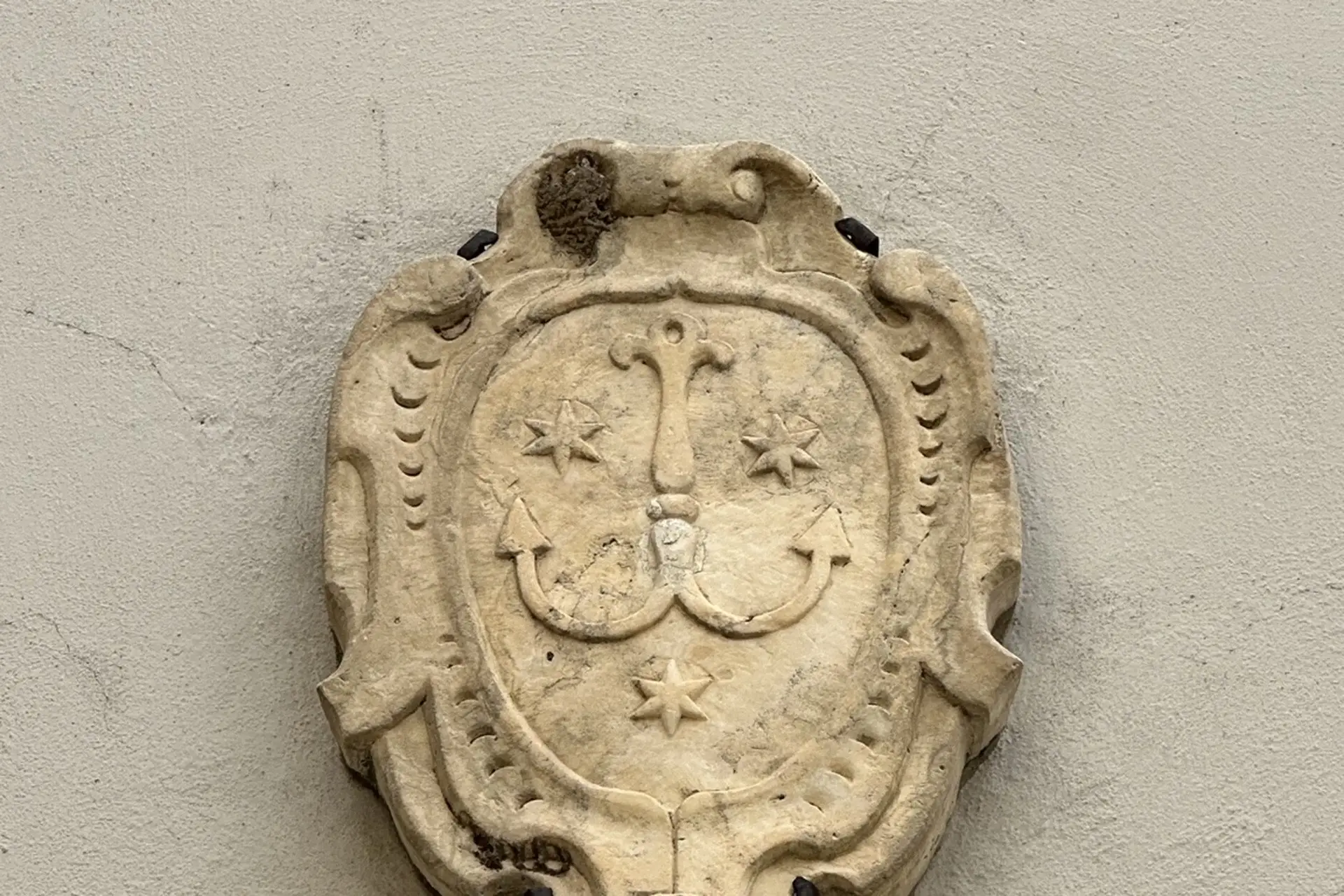
Above the palazzo’s main door is an oval shield in a scrolled stone frame. It shows an upright anchor with three eight-pointed stars, two above and one below. Metal clamps hold it to the facade, so it is a separate piece added to the older portal, and the door and the arms need not date from the same time. The anchor appears again on an iron shield in the old wine cellar, between the letters T and A. The Italian cultural-heritage catalogue gives the traditional Tamanti arms as an anchor with three gold stars on blue.
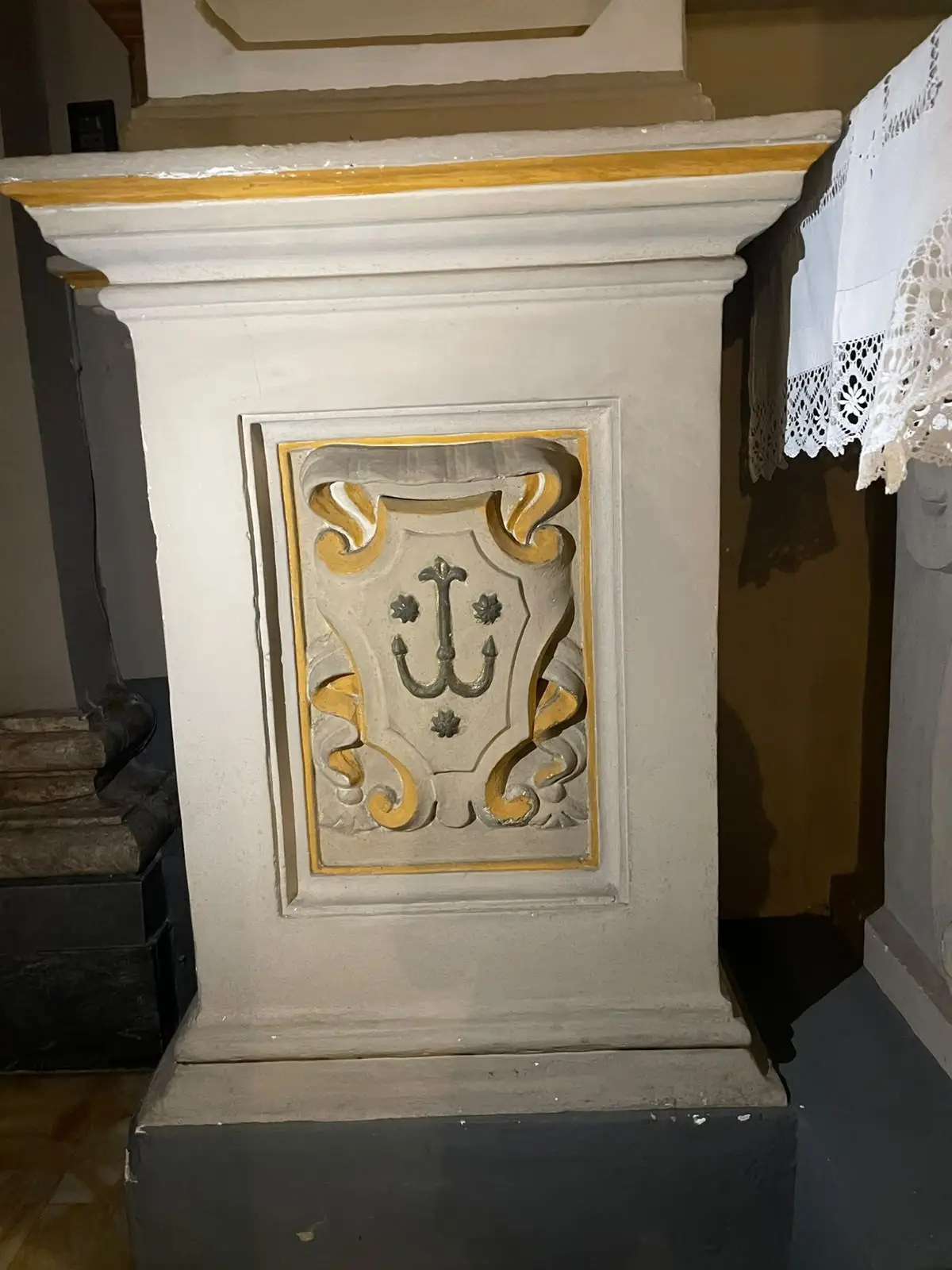
The oldest written description found so far is in the same eighteenth-century “Casa Tamanti” manuscript in the Montalcino library. Beside a painted shield it reads: “Porta d’Azzurro ad un’Ancora a 3 punte in palo, contornata di tre Stelle”, “bears on blue a three-pointed anchor set upright, surrounded by three stars”. The blue field, the upright anchor and the three stars match both the carving over the door and the catalogue description.
The same emblem is carved inside the Madonna del Soccorso, the church where the 1699 altar was given. That repetition strongly ties the device to the family. It is still unknown whether that relief belongs to the 1699 altar or to a later gift.
It is tempting to read the anchor as a sign of seafarers or sea merchants. The anchor is also a common heraldic figure and a Christian symbol of hope. Until an early dated seal or a merchant or maritime record connects the Tamanti with the sea, it is best read as a family emblem that may carry either meaning, or both.
Sources on this page
- Lucia Carle, La patria locale. L’identità dei Montalcinesi dal XVI al XX secolo (Regione Toscana / Marsilio, 1996), Tamanti chapter pp. 289–300; family tree p. 292
- Don Antonio Brandi, Studi e Trascrizioni (baptismal surname list, 1570; Tamanti legacies; 1699 Madonna del Soccorso altar inscription)
- Bruno Bonucci, “Per una genealogia dei Donnoli di Montalcino”, appendix to M. A. Ceppari Ridolfi, “San Donnolo martire di Ceuta (1227)”, Rivista Accademia dei Rozzi XXIX/1 (2022), no. 56, pp. 50–51; underlying repertory Archivio Vescovile di Montalcino, cart. 339
- Lucia Bonelli Conenna, Il contado senese alla fine del XVII secolo: Poderi, rendite e proprietari (Siena, 1990), pp. 162–166
- Mario Ascheri, “Montalcino nella storia: alle sorgenti del Brunello”
- Archivio possessori, record “Tamanti, Giacomo” (inscription “Jacobi Tamantij | 1675”)
- “Statuto di Buonconvento del 1522”, La Temi: giornale di legislazione e di giurisprudenza, vol. 6, pp. 670–676 (text of the 1522 preamble)
- Silvio Pucci (ed.), Gli Statuti del Comune di Buonconvento dell’anno 1522 (Buonconvento: Circolo culturale “Amici di Buonconvento”, 1991), introduction pp. 7–16 and n. 33 (the two Siena copies; criminal cases to Montalcino from 1560), Book I chs. II and IV (Lira classes), preamble p. 25, final chapter XLIX p. 78 (approval of 6 July 1522); read at the Biblioteca degli Intronati, 19 October 2026
- A. Liberati, “Buonconvento”, Bullettino Senese di Storia Patria XL (1933), pp. 164–181 (the war of 1552–54; Capitano di giustizia of Montalcino; population 1595 and 1640)
- Lucia Carle, La patria locale, pp. 289–300, open access at hdl.handle.net/1814/18581 (households of 1567, 1574 and 1579; Cristofano son of Oriente; marriages and offices)
- G. Chironi, La Mitra e il Calamo (Siena, 2005), Table 1 p. 360 and pp. 81, 113, 297–298: Ghino di Forese Tamanti da Torrita, notary 1317–1352, guild 1341, dead by 1358; Siena baptistery index, vol. 44 (Nicolò Tamanti, 1540), ilpalio.org
- Archivio di Stato di Siena, Statuti dello Stato di Siena nos. 17 and 18 (Buonconvento); Comune di Montalcino historical archive (Buonconvento copy listed in the 1989 inventory)
- Archivio di Stato di Siena, Statuti del contado 17, c. 1r and renewals 1579–1654; Estimo del Contado 107, “Campione di tutti i Poderi… Capitanato di Montalcino” (1771–72). Owner photographs, 14 October 2026
- P. G. Morelli, S. Moscadelli, C. Santini (eds.), L’Archivio comunale di Montalcino. Inventario della Sezione storica, 2 vols. (Siena, 1989): vol. I pp. 47–48 (item 10); vol. II pp. 429–430 (Doti Terzi, Anghirelli e Tamanti)
- Buonconvento baptisms 1564–1742, published index (ilpalio.org): Francesco Tamanti, 28 October 1565
- Archivio di Stato di Siena, Stato civile, Buonconvento, on the Portale Antenati: Napoleonic name indexes of births, marriages and deaths, 1808–1814; census of 1841, parish of SS. Pietro e Paolo; Nati 1829 (Gaspare Monciatti), Matrimoni 1875 (Gaspare Monciatti and Giulia Bongini) and Nati 1878 (Marietta Monciatti, with the marginal note of her marriage of 18 January 1897); Catasto generale toscano, Comunità di Buonconvento, Tavola indicativa, sections A (Casale) and F (the town), CASTORE
- Battesimi di Montalcino, Cattedrale di SS. Salvatore, 1521–1594, index by Luigi Bichi and Miriam Cuatto (2024), Fondo Archivio Vescovile di Montalcino, fascicoli 635–637 (ilpalio.org)
- “Casa Tamanti”, manuscript family entry with painted arms, Montalcino municipal library (probably Memorie storico-letterarie no. 7, c. 231; photographed by Valentina Pieri, 2026)
- Emanuele Repetti, Dizionario geografico fisico storico della Toscana, vol. 3 (1859)
- Un granduca “popolare” sul trono di Toscana: saggi su Pietro Leopoldo d’Asburgo Lorena (travel observations, owner-supplied compilation)
- Italian cultural-heritage catalogue, description of the traditional Tamanti arms (as cited in the storybook)
- Treccani, “Àncora”, Vocabolario online (heraldic meaning of the anchor)