

In February 1819 a twenty-year-old landowner from one of Montalcino’s old families married a young pharmacist with a scientific education. Neither could have known that their grandson would give the town its most famous wine. This page tells the story of Maria Tamanti and Clemente Santi: the marriage itself, the man Clemente was, the daughter born that December, and the land the Santi family held around them.
The marriage of 12 February 1819
The marriage act of 12 February 1819 (original on Antenati) was entered as act 8 in the civil register for the parish of Sant’Egidio. It describes Maria as a landowner aged twenty and names her parents as Francesco Tamanti and Appollonia Bardi. This matches Lucia Carle’s published genealogy, which places Maria, with her brother Gaetano (b. 1801), in the branch of Dr Francesco Tamanti (b. 1757) and Apollonia Bardi (Carle, La patria locale, 1996, p. 292). Earlier drafts of this history tried placing Maria as a daughter of an Antonio Tamanti. The 1819 act rules that out.
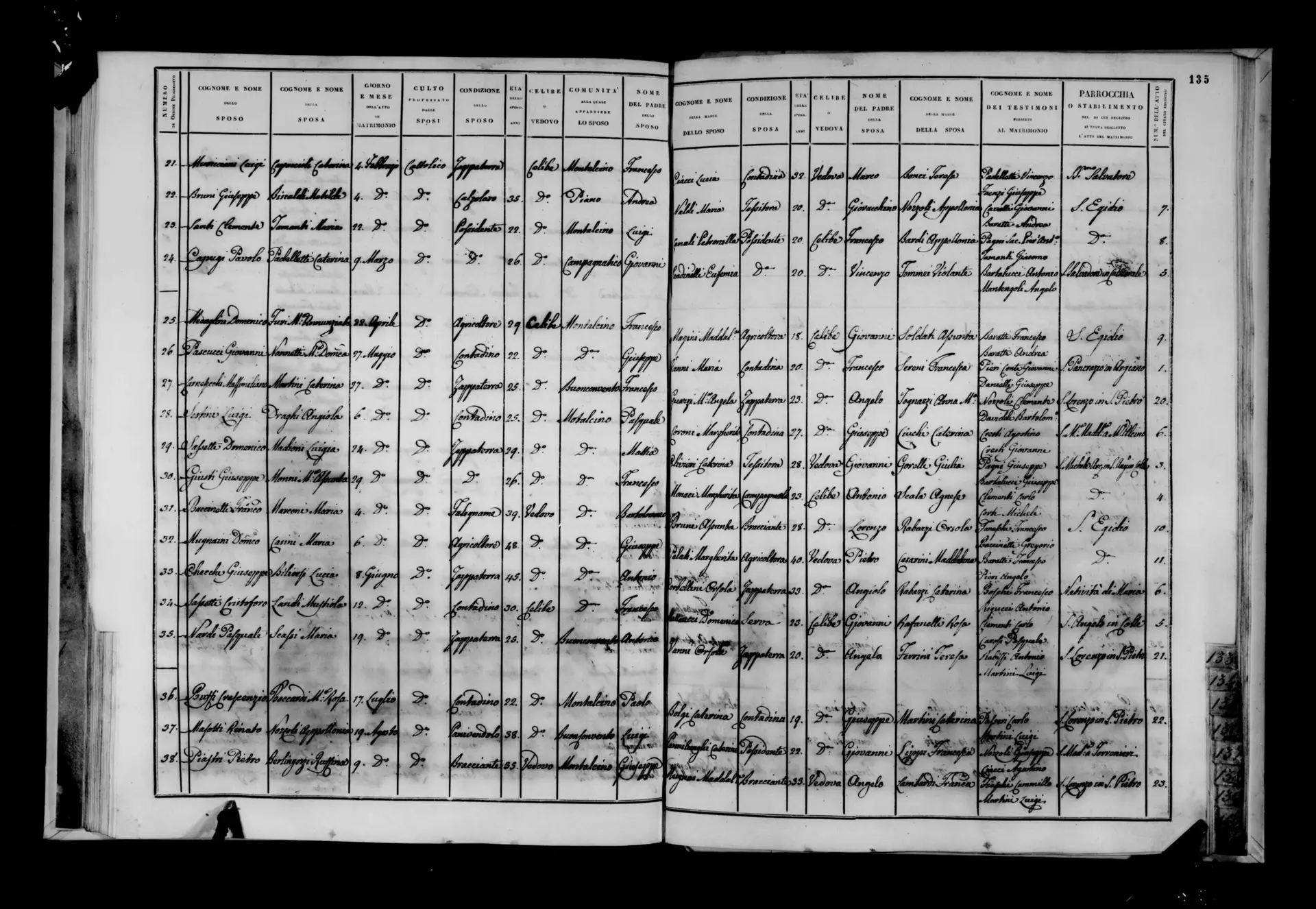
The act also names Clemente’s mother. Her surname is partly hidden in the entry, but the cadastre spells it out as “Canali ne’ Santi Petronilla”, which supports reading it as Canali. A witness was Giacomo Tamanti, an elderly bachelor of the family who died that October aged 78, according to his death record of 1 October 1819 (original on Antenati).

Maria brought property to the marriage. The published Biondi-Santi family history calls her a landowner whose dowry included Montalcino farms, named as Colombaio and Chiusa (Boldrini, Bruchi and Cappelli, This Is My Land, 2010, pp. 18–19). The dowry act itself has not been found. Without it, the exact farms and terms remain unconfirmed.
Clemente Santi: a scientific formation
Clemente was born in Montalcino in 1795 to Luigi Santi of Pienza and Petronilla Canali. He studied at Siena and Pisa and was a pupil of Giorgio Santi, the Pienza naturalist whose work joined natural history, agronomy and close observation of the landscape. Giorgio sat as a commissioner at Clemente’s graduation. After the scientist’s death Clemente helped look after his surviving papers, and letters from Giorgio’s widow in 1839 show material being sent under his direction (Bindi, Giorgio Santi, 2014, pp. 59–63). Clemente called Giorgio his prozio, his great-uncle. Bindi warns, however, that the family tree he examined does not show the exact link, so the kinship is still unproven.
The Biondi-Santi family history says Clemente studied pharmaceuticals at Pisa, kept up his ties to scientific and agrarian circles, and experimented with the wines of his Montalcino properties (Boldrini, Bruchi and Cappelli, This Is My Land, 2010, pp. 18–29). He also saw the farm as a connected system. He warned that careless felling of the woods would leave growers without the wooden poles that held up their vines (Armellini, Bollettino A.I.C. 144–146, 2012). His civic standing grew too: Carle records him admitted as Gonfaloniere, the town’s chief magistrate, in 1829–30 (Carle, La patria locale, 1996, pp. 81, 83).
A later web chronology by Mirco Sanchini and Stefano Cinelli Colombini places his wines at the London and Paris exhibitions of 1856. It also records a silver prize at Montepulciano in 1869 for an 1865 “Brunello”. That chronology has some date errors elsewhere, so these details are best treated as corroboration until the exhibition catalogues are checked.
Paolina, born December 1819
Ten months after the wedding, a daughter was born. The birth record of Paolina Santi (original on Antenati) records her birth at six in the evening on 13 December 1819 and her baptism the next day. It is act 86, the last birth entered in Montalcino that year. Her parents are listed as Clemente Santi and Maria Tamanti, landowners of the cathedral parish of San Salvatore.

What became of Paolina is unknown. Montalcino’s death registers from December 1819 through 1823 have been searched without finding her. Later family history remembers her sister Caterina as Clemente’s surviving daughter, and it was Caterina who carried the line on.
The Santi and Canali lands in the cadastre
The Leopoldine cadastre, compiled for Montalcino in the years around 1820–1835, shows the Santi household as substantial landowners in its own right. Brian Pasch has reviewed roughly 725 owner-table pages for the whole commune. His figures are approximate section totals from that survey, not measurements of each parcel.
Clemente Santi di Luigi
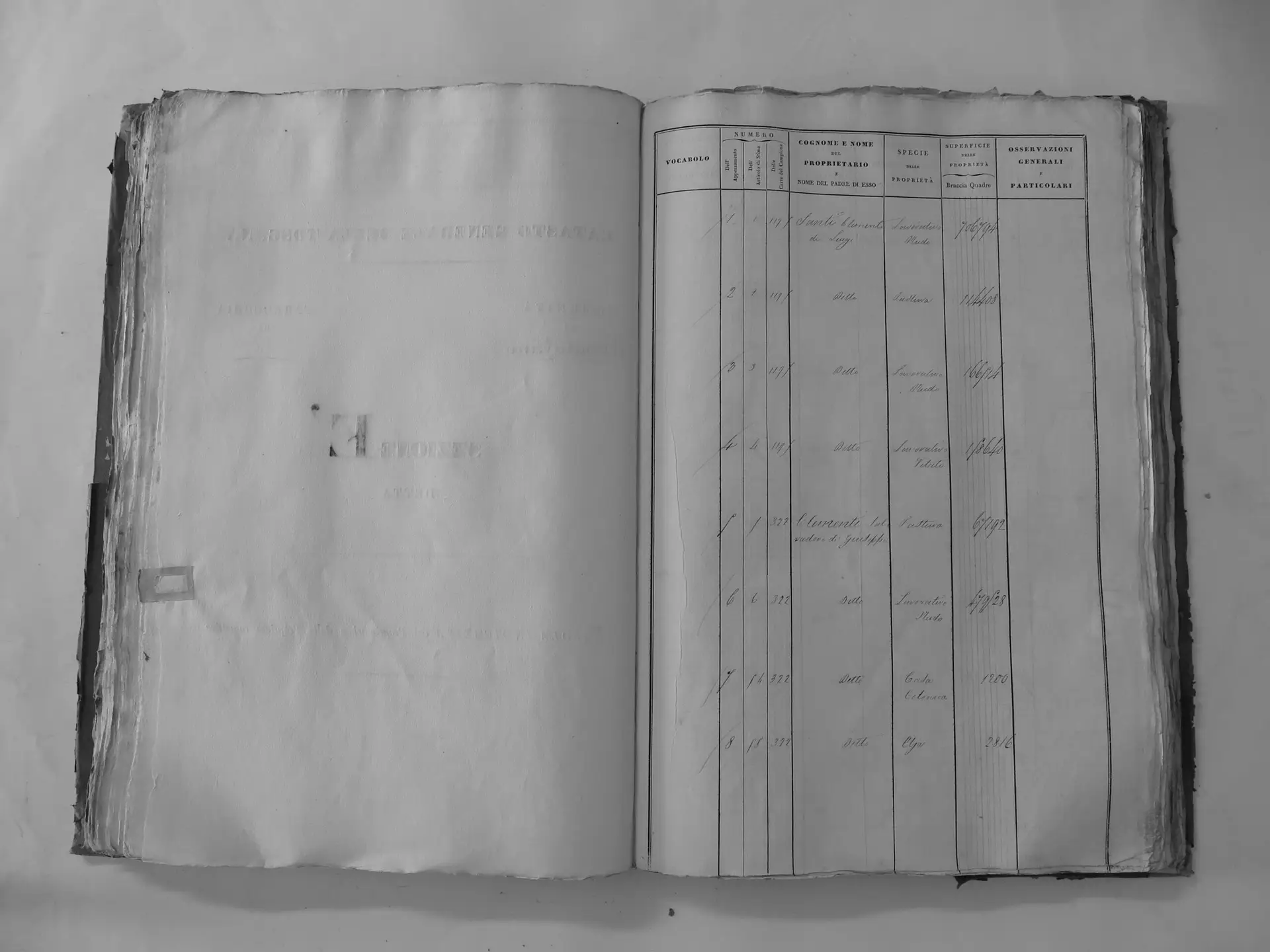
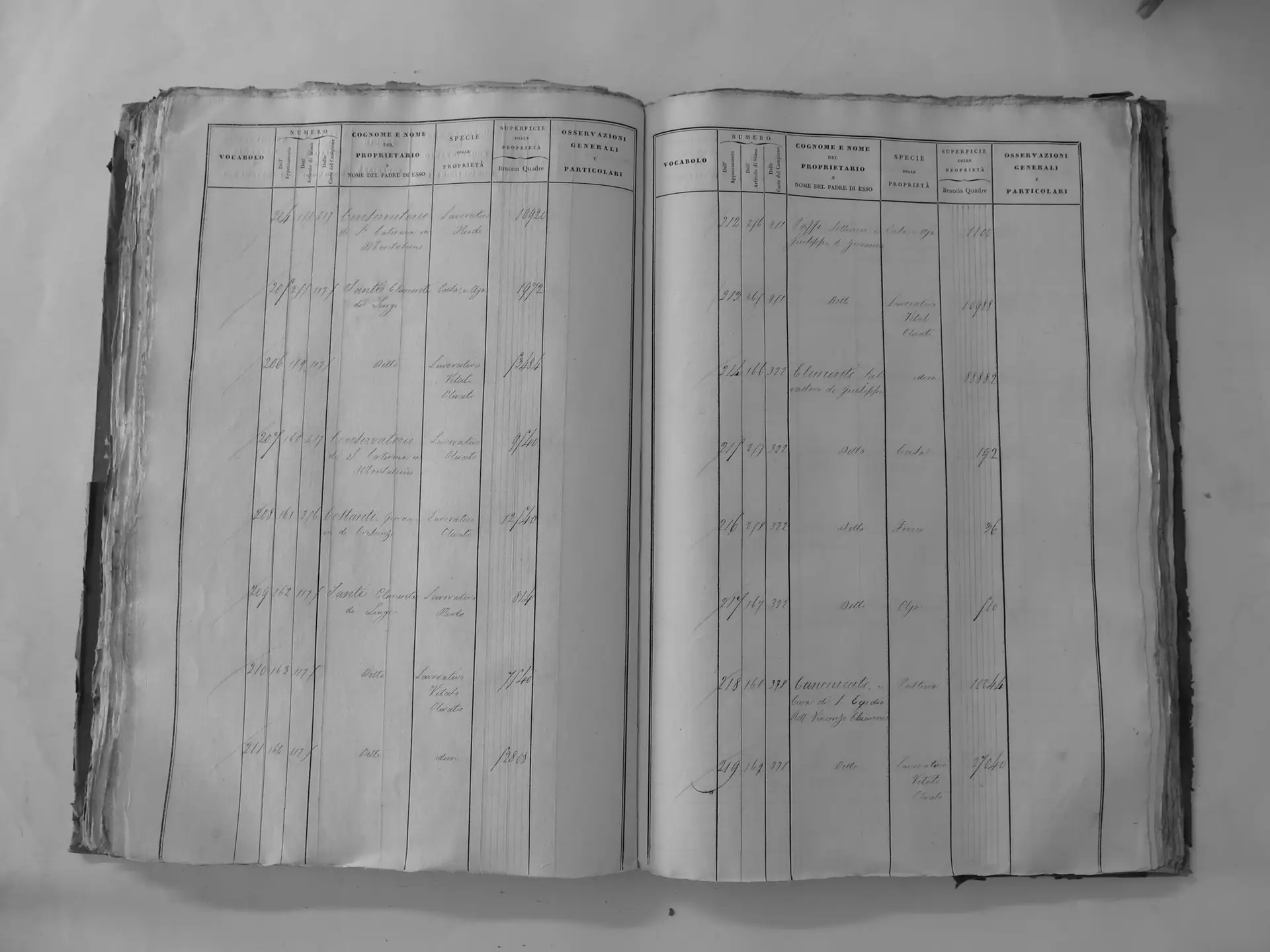
Clemente appears on ledger page 1175 with about 75 hectares. Most of it lay at Fiesole (about 67 hectares, with a farmhouse). There were smaller holdings in Osservanza (original on CASTORE), where parcels 205–206 and 209–211 include a house with a threshing floor, and a parcel at Lumespento. No town house was found in his own name.
Petronilla Canali ne’ Santi
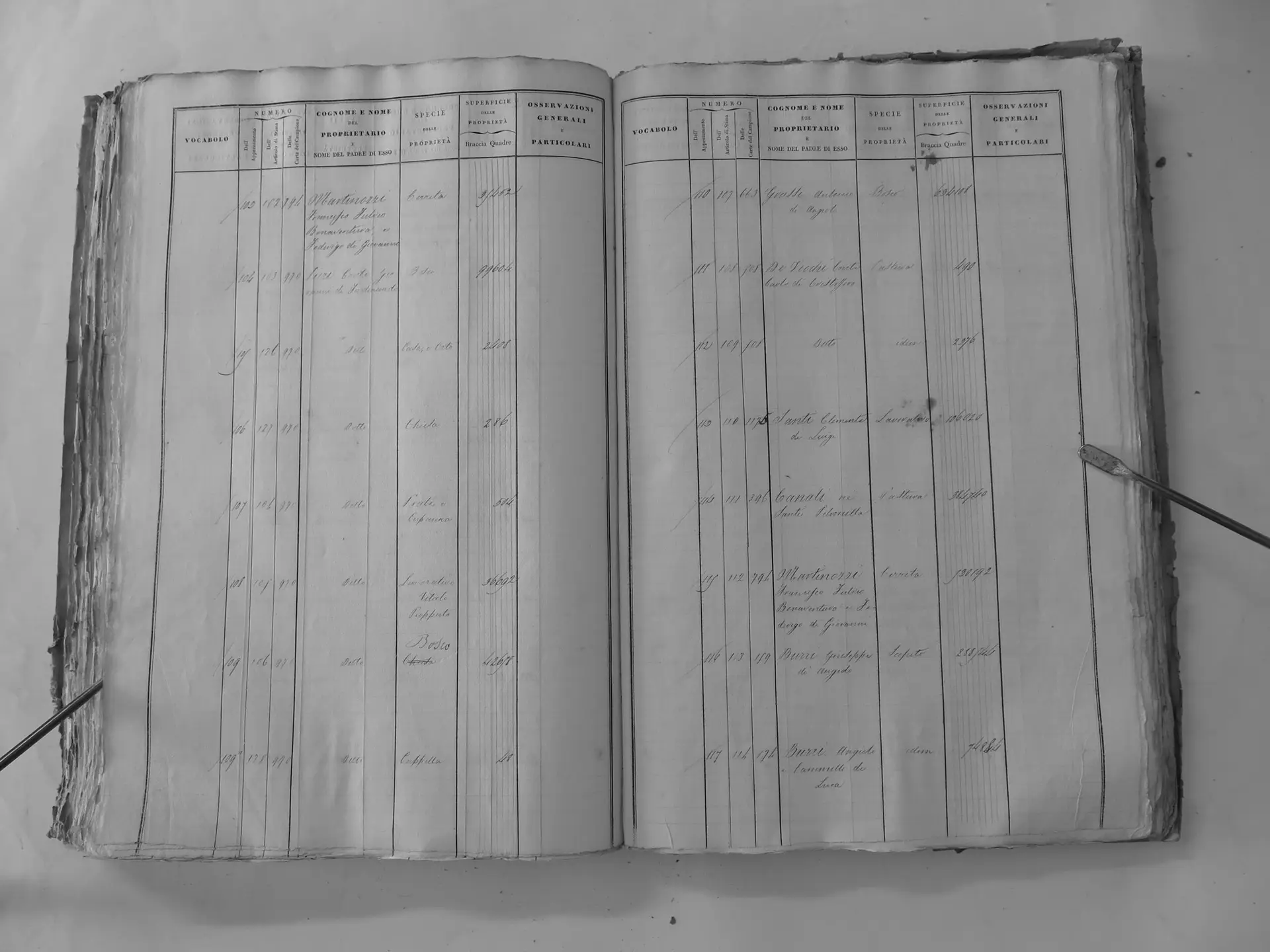
Clemente’s mother held far more: about 230 hectares on ledger page 396. Roughly 105 lay at Comunale, 38 each at Greppo and San Polo, and smaller amounts at Pelagrilli, Lumespento and Montosoli. She also owned two town houses. At Greppo, parcels 180–186 form a complete farm centre: a chapel, main house, farmhouse, gardens and threshing floor. The Greppo owner-table page (original on CASTORE) shows several of these buildings under her name.
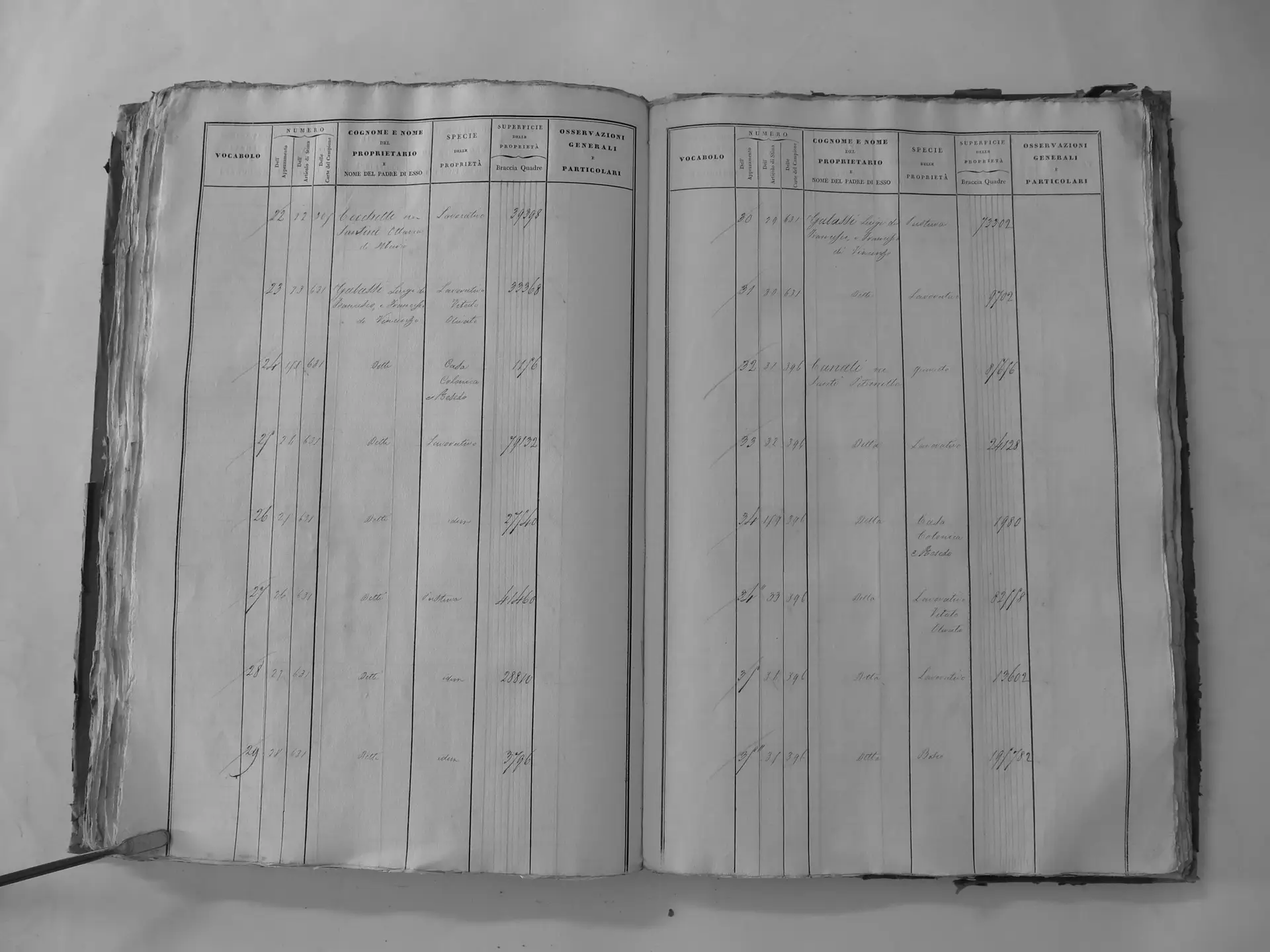
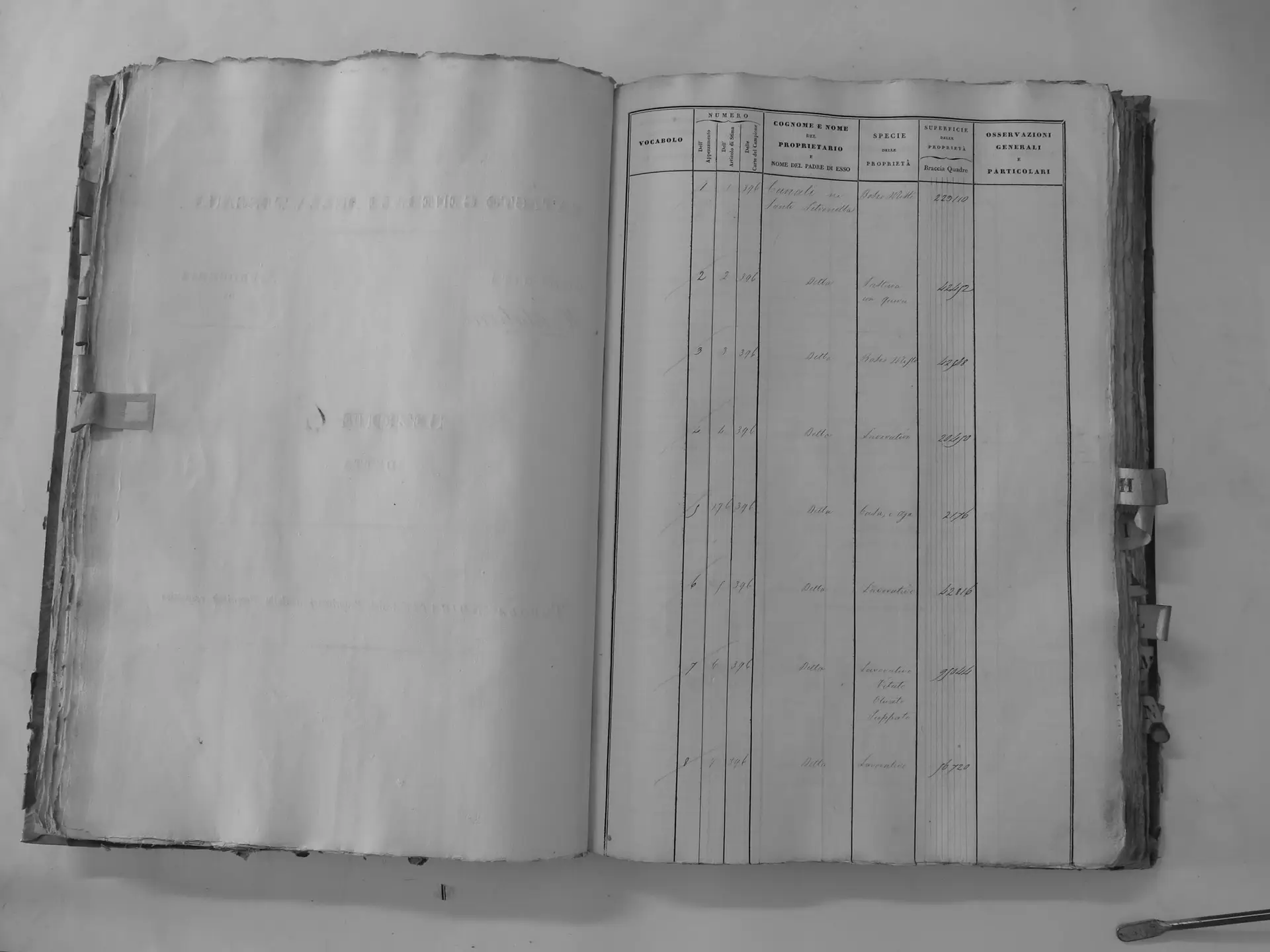
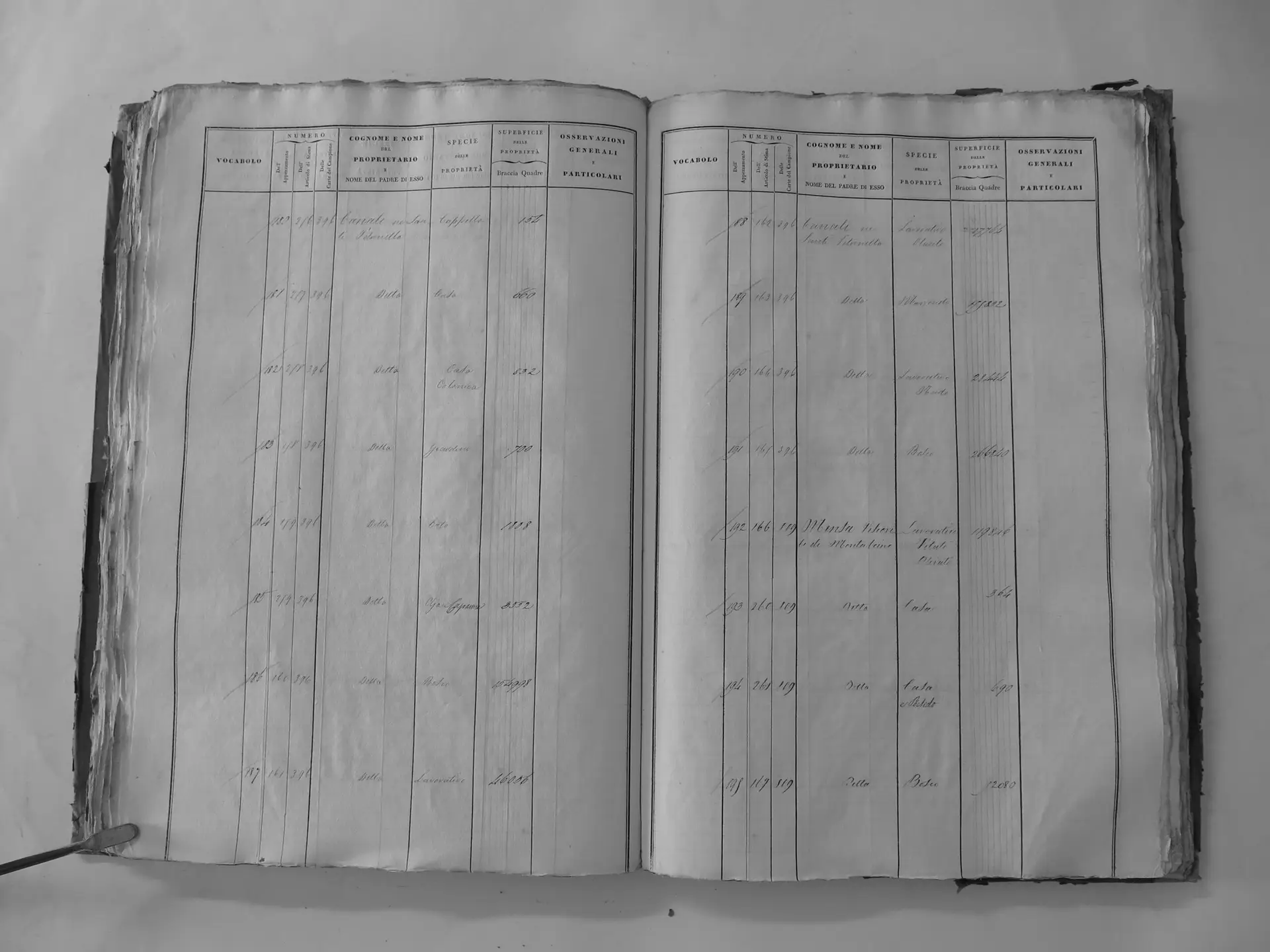
The Biondi-Santi winery today gives its address as Villa Greppo. Petronilla’s farm centre is the strongest lead for the origins of the later Il Greppo estate. The cadastre does not name that estate, though, and the chain of title between them has yet to be traced.
What the owner tables do not show
Maria Tamanti has no owner entry of her own anywhere in the survey, and no Biondi appears as an owner. A separate “Santi Luigi di Clemente” holds about nine hectares and a town house on ledger page 1176. His patronymic is suggestive, but it is not yet known whether he was Clemente’s son or a namesake from another generation. Clemente was still adding land later: at an auction of former Santa Caterina property on 6 June 1846, he bought Lot V for 55 scudi, 5 lire and 17 soldi (Brandi, Studi e Trascrizioni). None of these entries shows which land, if any, came to Clemente through Maria’s dowry.
Sources on this page
- Marriage of Clemente Santi and Maria Tamanti, 12 February 1819, Montalcino, S. Egidio, act 8. Local scan; Portale Antenati.
- Death of Giacomo Tamanti, 1 October 1819, Montalcino, Morti reg. 15, act 27. Local scan; Portale Antenati.
- Birth of Paolina Santi, 13 December 1819, Montalcino, Nati reg. 18, act 86. Local scan; Portale Antenati.
- Catasto Generale della Toscana, Montalcino, Tavole indicative: Santi Clemente di Luigi, Osservanza, Tomo II p. 156 (local scan; CASTORE); Fiesole, Tomo II p. 137; Lumespento, Tomo III p. 208.
- Same series: Canali ne’ Santi Petronilla, Greppo, Tomo II p. 173 (local scan; CASTORE); Comunale, Tomo II p. 184; San Polo, Tomo I p. 89.
- Brian Pasch, survey of about 725 Tavole indicative owner-table pages for the Comunità di Montalcino, September 2026 (unpublished).
- Lucia Carle, La patria locale. L’identità dei Montalcinesi dal XVI al XX secolo (Regione Toscana / Marsilio, 1996), pp. 81, 83, 292.
- Maurizio Boldrini, Bruno Bruchi and Andrea Cappelli, This Is My Land: Franco Biondi Santi, Montalcino and Brunello (Protagon Editori, 2010), pp. 18–29.
- Umberto Bindi, Giorgio Santi. Scienziato pientino del Settecento (Pienza, 2014), pp. 59–63.
- Riccardo Armellini, “Le trasformazioni del paesaggio rurale di Montalcino tra Ottocento e attualità”, Bollettino A.I.C. 144–146 (2012), pp. 33–50.
- Mirco Sanchini and Stefano Cinelli Colombini, “The history of Brunello of Montalcino from 1500 to date”, Enjoy Montalcino.
- Don Antonio Brandi, Studi e Trascrizioni (online compilation), 1845–46 Santa Caterina allivellazione.
- Biondi-Santi, “Brunello di Montalcino”, official estate page.