

Above the piazzetta that bears the family name, a marble plaque on the facade of Palazzo Tamanti honours a soldier. It is the most public trace the family has left on the house. Behind it are two men of the same name, a father and a son. Both were decorated for valour and both were killed in war, twenty-seven years apart. This page tells their stories separately, because they are easily confused.
The memorial on the facade
The plaque honours Lieutenant of Artillery Giovanni Tamanti, awarded the Gold Medal for Military Valour after his death. Its inscription describes how he commanded a self-propelled artillery battery during a dangerous counterattack. It records his death at Enfidaville, in Tunisia, on 20 April 1943. The Montalcino veterans’ association put up the memorial on 4 November 1966. The small square in front of the house carries his name.
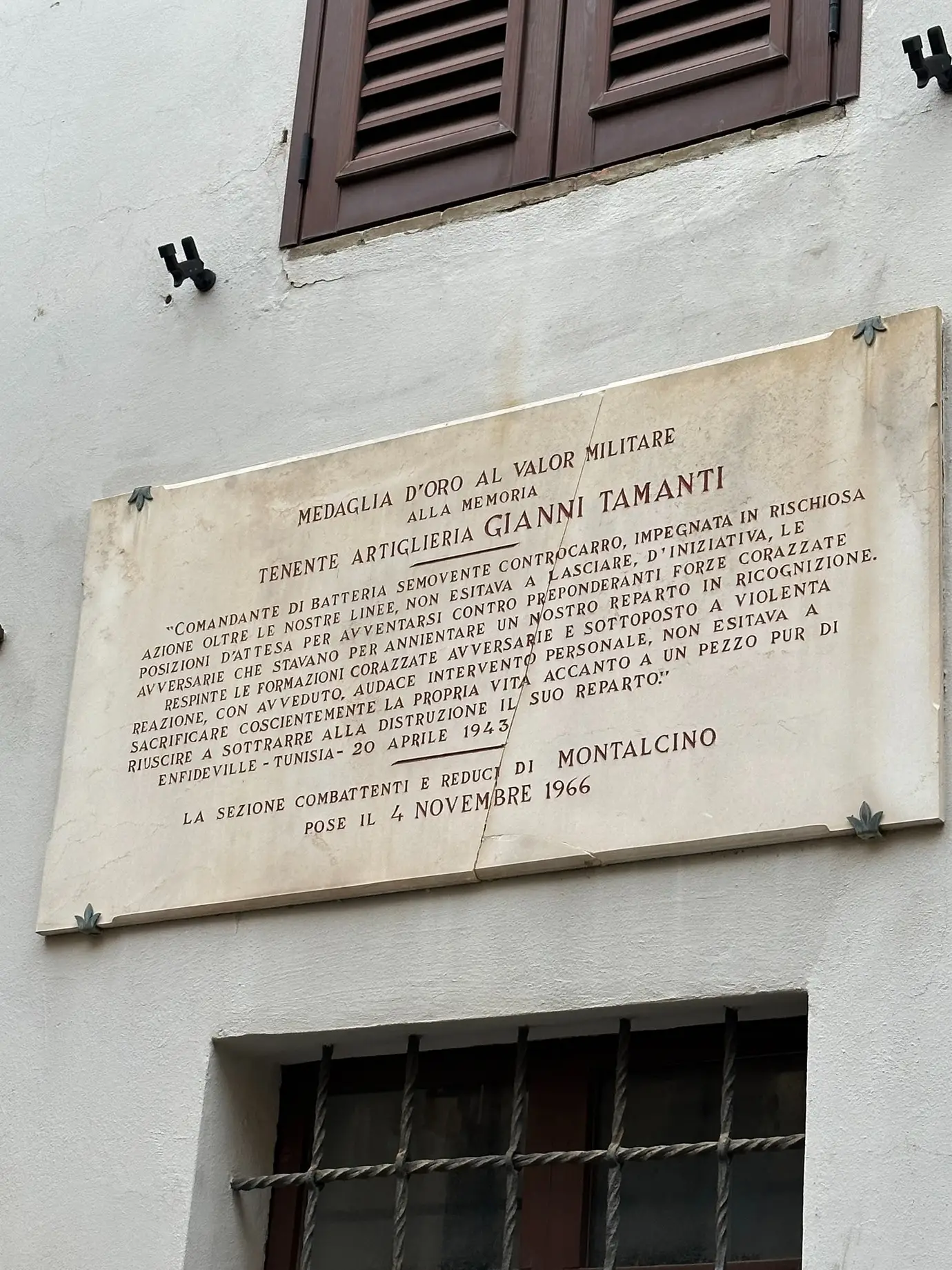
The officer on the plaque is usually known by the familiar form of his name, Gianni, and that is how he appears in the gold-medal registers. His father, also Giovanni, was a separate man with a separate decoration, a Silver Medal won in the First World War.
Giovanni Tamanti (1881–1916): the father
Giovanni Tamanti was born in Montalcino on 6 April 1881 to Francesco Antonio Tamanti and Maria Giuliani (birth act, 1881, act 91). He took his civil engineering degree in Rome in 1904 and married Francesca Barluzzi in Rome on 4 May 1907. Giovanni built railways: the Livorno–Vada line, then the Aulla–Monzone section of the Lucca–Aulla railway, where he was chief engineer by 1907, and from 1912 the Bivio Margonia–Favara section in Sicily, which he completed with his own firm, the “Impresa Tamanti”. In the First World War he could have claimed exemption as a director of state works. Instead he enlisted, was commissioned in the Engineers and was sent to the Cadore front. On 13 February 1916, hearing that an engineer was needed in the front lines on the Col di Lana, he went up without orders, crossed ground swept by rifle fire and was killed. He was awarded the Silver Medal for Military Valour. He left three young children, and one of them, then six, was the future Gold Medal officer. In October 1924 his body was brought home to the Montalcino cemetery.
The family behind him is now better documented. His bride came from the old centre of Rome: Francesca Barluzzi had been born on 26 October 1885 at Piazza del Gesù 96, beside the mother church of the Jesuits, and when the banns went up on 31 March 1907 she was living at Via della Valle 16. Giovanni, an engineer of twenty-five, gave his residence as Antignano, on the sea just south of Livorno, where he was working on the Livorno–Vada line, so the banns were posted in Rome, at the Ardenza office of the Livorno registry and at Montalcino. They were married in Rome on Saturday 4 May 1907. The family’s grief after 1916 also went into the street. On the night of 9 August 1916, when news came that Gorizia had fallen, about a thousand people marched through Montalcino behind the band and behind a tricolour lent by the Tamanti, a family, Il Progresso wrote, which though still grieving for the death of their son Giovanni kept unchanged “its fine traditions of kindness and patriotism”. His full story is on his family leader page.
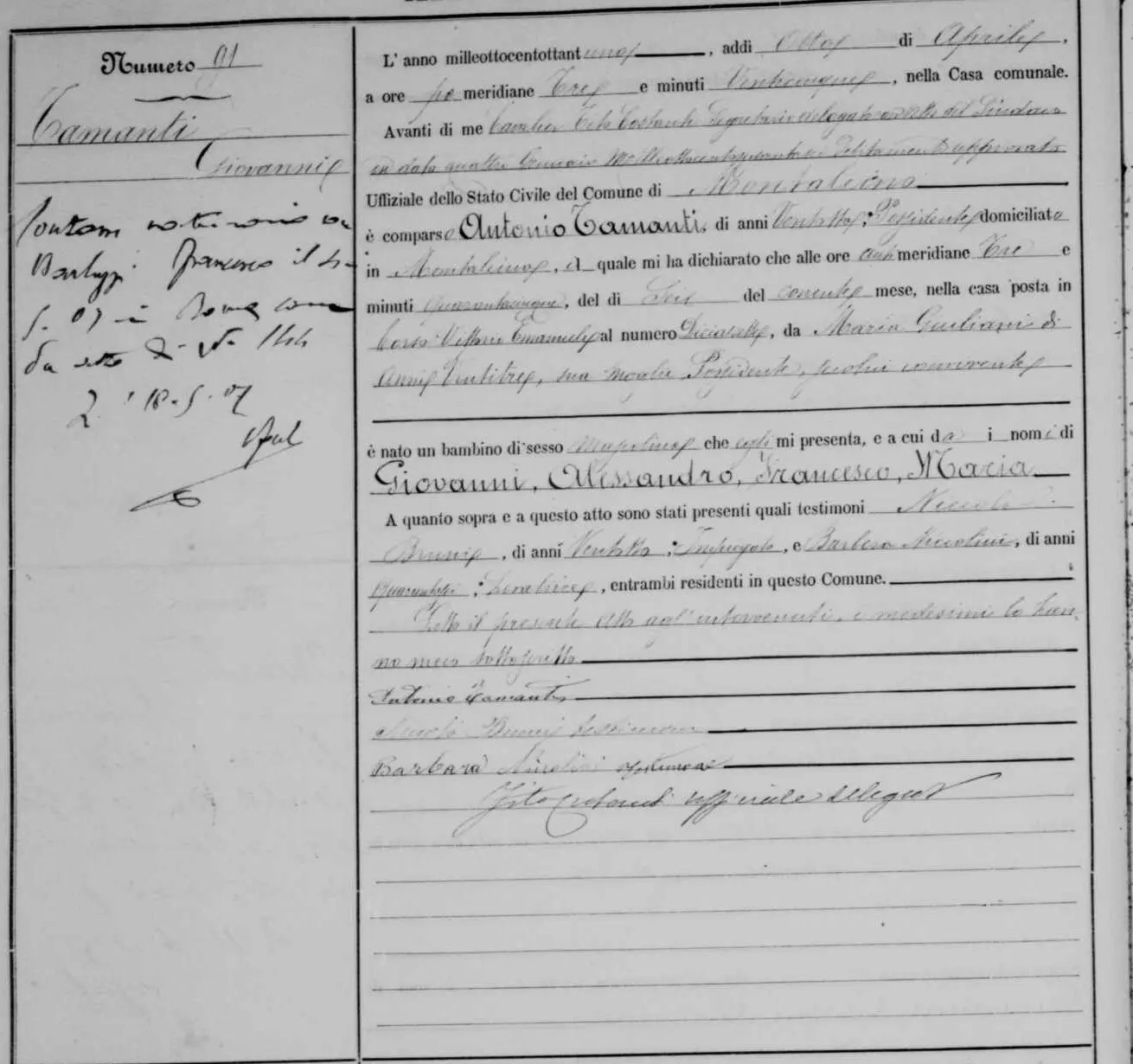
Giovanni’s parents tie him to the main family line, and the link is now proven. His birth act and his baptism of 8 April 1881 name his father as Antonio (Francesco) Tamanti, son of the late Dr Antonio, and his mother as Maria Giuliani; his godfather was his mother’s brother, Avv. Alessandro Giuliani of Arezzo. Francesco Antonio, born in 1852, was the only son of Dr Antonio Tamanti and Fidalma Muzzarelli (Carle, La patria locale, 1996, p. 298). The memorial therefore connects the Tamanti of the nineteenth century directly to two generations of decorated soldiers.
Gianni Tamanti (1909–1943): the son
Gianni, formally Giovanni, was born in 1909 at Aulla, not in Montalcino. By the Second World War he was a lieutenant of artillery, commanding a battery of self-propelled anti-tank guns. On 20 April 1943 he was killed at Enfidaville, in Tunisia, defending that battery. He was awarded the Gold Medal for Military Valour, with promotion to captain. His life is recorded in the Italian gold-medal registers, the honours database of the Quirinale, and the Montalcino local press.
Gianni was orphaned of his father at six and of his mother at twelve, and grew up in the care of his grandmother Maria Giuliani Tamanti. He followed his father into engineering. By June 1933, as a final-year student at the Rome engineering school, he won the Archbishop of Messina’s competition for the design of a church in an earthquake zone, and he passed the state engineering examination at Naples in 1934. Before the war he built roads in Ethiopia and an airfield in Albania. His full story is on his family leader page.
Twenty-three years later the town placed his memorial on the family house. At almost the same moment, in 1966, Brunello di Montalcino received DOC status, the start of the modern wine era in which other branches of the Tamanti family played a part.
Keeping the two men apart
The two men are easily confused. They share a name and a family, both were officers, and both died in war. The details separate them clearly:
- Giovanni: born Montalcino, 1881. Engineer officer, First World War. Killed at Col di Lana, 13 February 1916. Silver Medal.
- Gianni (Giovanni): born Aulla, 1909. Artillery lieutenant, Second World War. Killed at Enfidaville, 20 April 1943. Gold Medal. Memorial installed 1966.
Leonardo, the brother who did not come home
Giovanni’s eldest child, Leonardo, was not born in Rome, whose birth indexes for 1907 and 1908 have no Tamanti, and he was still a minor in 1927; he was probably born in 1908, perhaps at Antignano on the Livorno coast while his father was building the Livorno–Vada line; the 1907 marriage papers, which give his father’s residence as Antignano, make that more likely, but it remains to be proved. In October 1924, when his father’s body came home, Leonardo and his brother Giovanni, boys of the Avanguardia, kept watch day and night over the coffins in the chapel of the Misericordia, and on the Sunday they walked first in the cortege: “seguono i figli del valoroso, Leonardo e Giovanni”. In 1926 Leonardo sat on the council of the town’s sports club.
Like his father and his brother, he became a builder of roads. In 1943, when Gianni was killed in Tunisia, the family had no news of Leonardo in East Africa. He had survived. The Colonial Office List for 1950 names “L. Tamanti” as Senior Road Superintendent in the Public Works Department of the British Somaliland Protectorate, and on 22 December 1952 he took British nationality there. The Home Office duplicate of his certificate survives at the National Archives at Kew (HO 334/271/7787: “Leonardo Tamanti. From Italy. Resident in Somaliland. Certificate O7787”). It is the only Tamanti in the archive’s catalogue; once read, it should give his exact birth date and place, his parents and whether he married. What became of him after 1952 is not yet known.
Giuliana, and the cooperative of 1926
The storybook’s family line gives Giovanni and Francesca Barluzzi another child, Giuliana Tamanti. She married Giovanni Colombini (1906–1976), and their daughter Francesca Colombini (1931–2022) later led Fattoria dei Barbi’s expansion abroad. This connection is told in full in the Colombini section.
The family also appears in the interwar revival of Montalcino wine, through Giovanni’s brother rather than his own household. Montalcino’s newspaper shows Avv. Giuseppe Tamanti working beside Tancredi Biondi Santi and Carlo Padelletti in the town’s wine and oil cooperatives of the late 1920s and early 1930s: in 1931 he was a partner in the cooperative olive mill, and in 1932 he hosted the farmers’ federation at the Cantina Sociale (Avv. Giuseppe’s family leader page). A 1933 Siena wine handbook describes the Cooperative Cellars of Biondi-Santi & Co., founded in 1926 under Tancredi Biondi Santi. It names “Tamanti” among the leading farming companies taking part (translation reproduced by Do Bianchi, 2012). In 2011 Franco Biondi Santi recalled his father inviting landowning friends, among them Tamanti, into the venture, which he dated to 1927 (interview in Civiltà del Bere, 2011). Franco’s date is probably the right one: in July 1926 Il Progresso was still campaigning for a cantina sociale to be founded in Montalcino. Stefano Cinelli Colombini’s list of the founders does not include a Tamanti (Cinelli Colombini, Brunello, ritratti a memoria, 2021, pp. 97–103). Giuseppe is the likeliest Tamanti in the venture, but no document yet names him as a founding member. Only the cooperative’s original founding act and membership lists can settle it.
Sources on this page
- Birth of Giovanni Tamanti, Montalcino, 1881, act 91
- Biographical and military record of Giovanni Tamanti (1881–1916), Silver Medal for Military Valour
- Italian gold-medal registers and Quirinale honours database, Gianni (Giovanni) Tamanti (1909–1943); Montalcino local press
- Memorial plaque, Palazzo Tamanti facade (installed 4 November 1966)
- Lucia Carle, La patria locale (Regione Toscana / Marsilio, 1996), p. 298 and family tree p. 292
- Sant’Egidio parish baptism register, Giovanni Alessandro Francesco Maria, act 1484, 8 April 1881, photographed by Valentina Pieri, 1 October 2026
- Il Progresso (Montalcino), 1924–1933, via the Comune di Montalcino’s Archivio della Memoria (Giovanni’s reburial, 1924; Gianni’s Messina prize, 1933; the cooperatives, 1931–32)
- L’Ingegneria Ferroviaria, 1914 (the “Impresa Tamanti”); Silver Medal citation, Bollettino ufficiale, 1918; Gold Medal citation, Quirinale honours database
- Owner’s Ancestry.com family-tree export (GEDCOM), 20 August 2026
- Do Bianchi, “Biondi Santi a cooperative winery?” (4 June 2012), translating the 1933 University of Siena handbook
- Emanuele Pellucci, “Le Cantine che hanno fatto l’Italia (2): Franco Biondi Santi – Tenuta Greppo”, Civiltà del Bere (8 June 2011)
- Stefano Cinelli Colombini, Brunello, ritratti a memoria, 2nd ed. (Fattoria dei Barbi, 2021), pp. 97–103
- Consorzio del Vino Brunello di Montalcino, historical brochure (DOC 1966)
- Il Libero Pensiero (Montalcino), October 1924, pp. 3–4, “Salme di Eroi nostri” (bound volume, Biblioteca degli Intronati, Siena); Il Progresso, July 1926, no. 13 (“Sorga la Cantina sociale a Montalcino”)
- Rome, Matrimoni 1907, Parte I, Serie B, act 144, and its allegati (banns no. 673/1907); Rome, Nati 1885, Serie B, act 1944 (Francesca Teresa Barluzzi, born 26 October 1885) (Archivio di Stato di Roma, via Portale Antenati); Il Progresso 1916 no. 17, 20 August 1916 (‘Evviva l’Esercito!’), and 1933 no. 11, 3 June 1933 (Messina prize)
- The Colonial Office List 1950, Somaliland Protectorate, Public Works Department; The National Archives, Kew, HO 334/271/7787 (naturalisation certificate O7787, 22 December 1952); Gazzetta Ufficiale, 23 April 1927, no. 94 (guardianship of the minor children)