

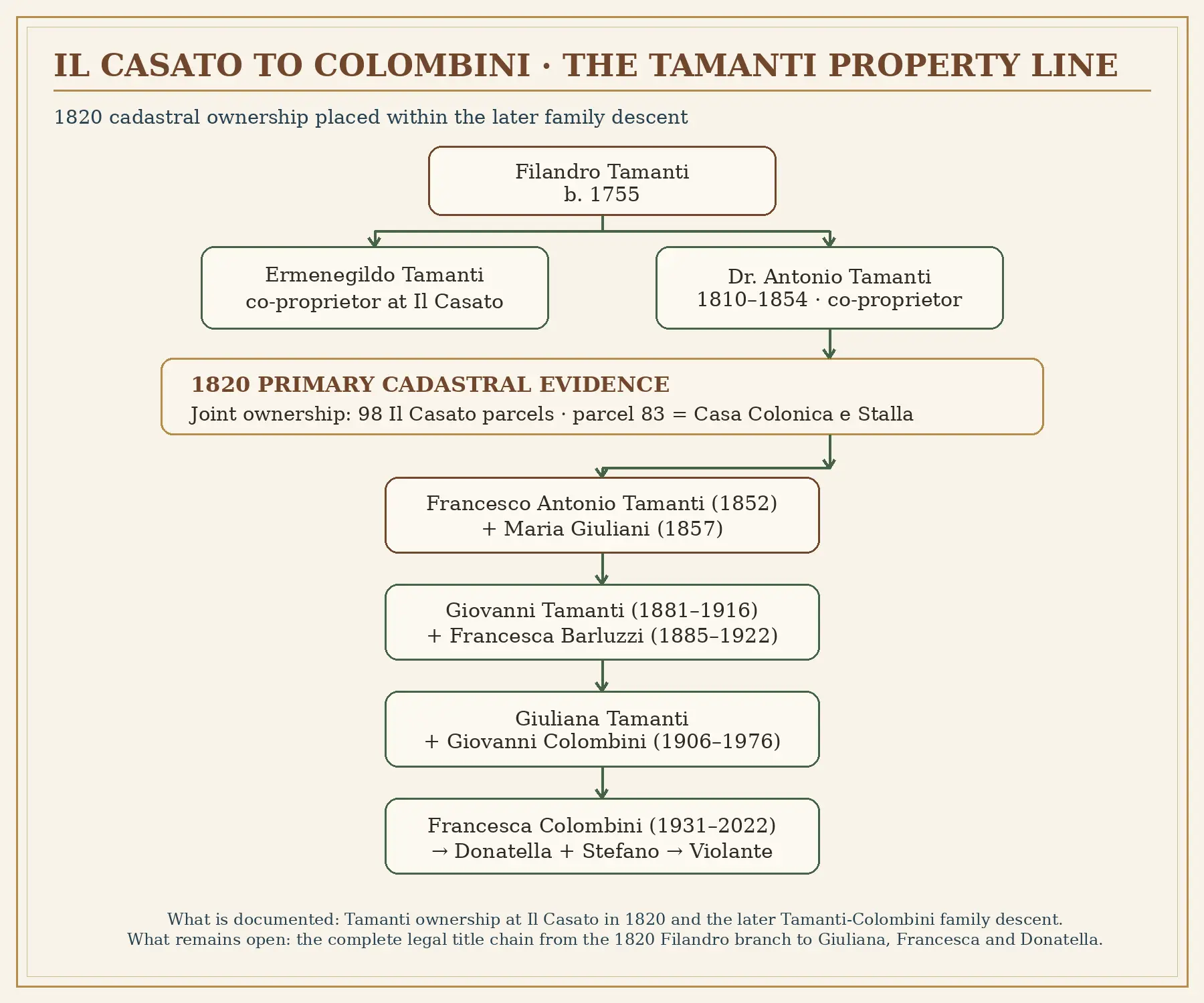
Palazzo Tamanti’s family has two separate paths into the modern history of Brunello. The better known one runs through Maria Tamanti, her daughter Caterina Santi and the Biondi-Santi estate, and it has its own section. This section follows the other path. A later Tamanti daughter, Giuliana, married Giovanni Colombini. Their family went on to run Fattoria dei Barbi and Il Casato, and helped turn Brunello from a local wine into an international one.
The two stories don’t overlap. The Biondi-Santi line descends from Dr Francesco Tamanti and his children Gaetano and Maria. The Colombini line descends from a different branch, headed by Filandro Tamanti (b. 1755), through Filandro’s son Dr Antonio. The two branches owned land in the same countryside, but they owned it separately.
From a cadastre page to a wine family
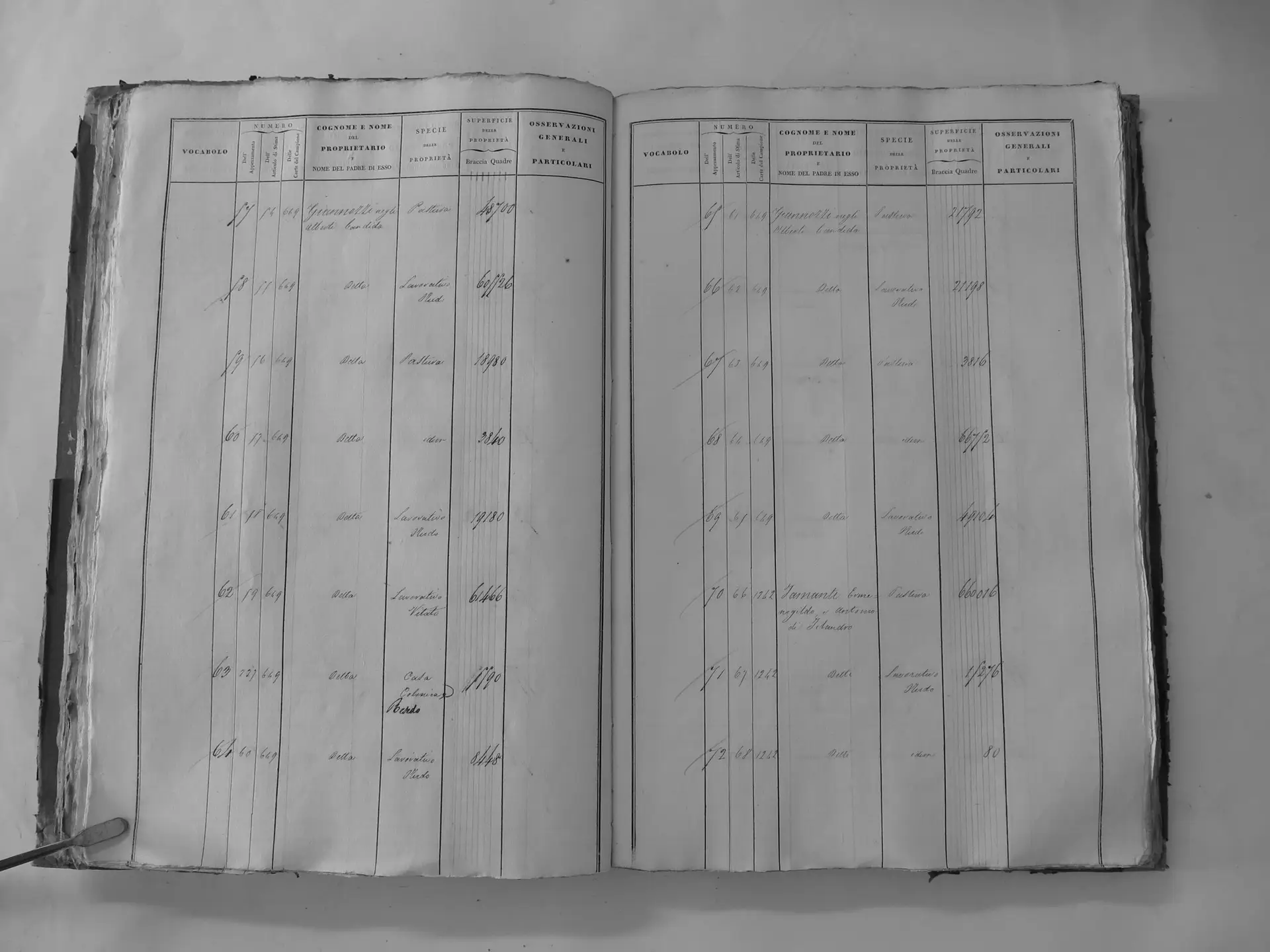
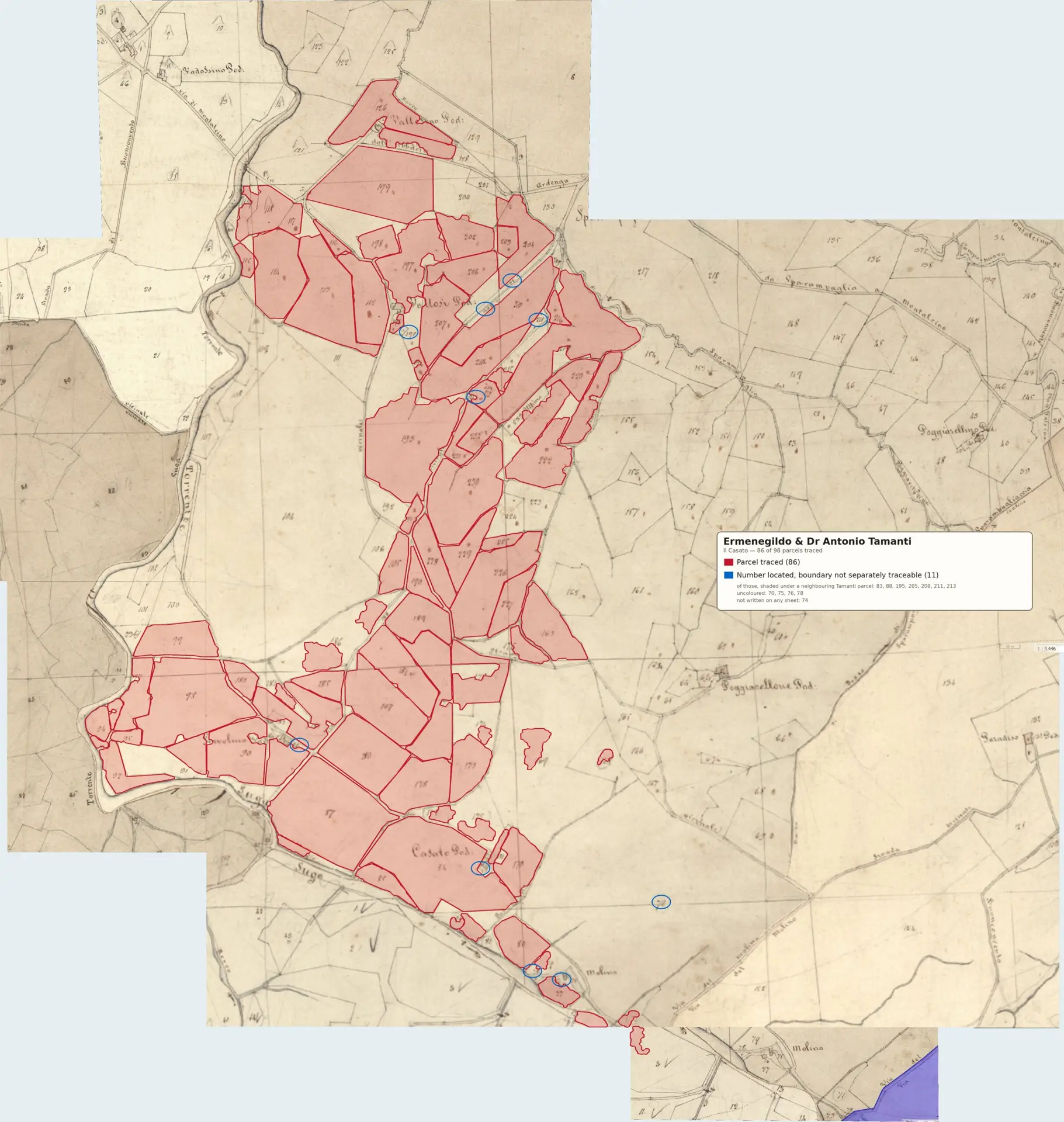
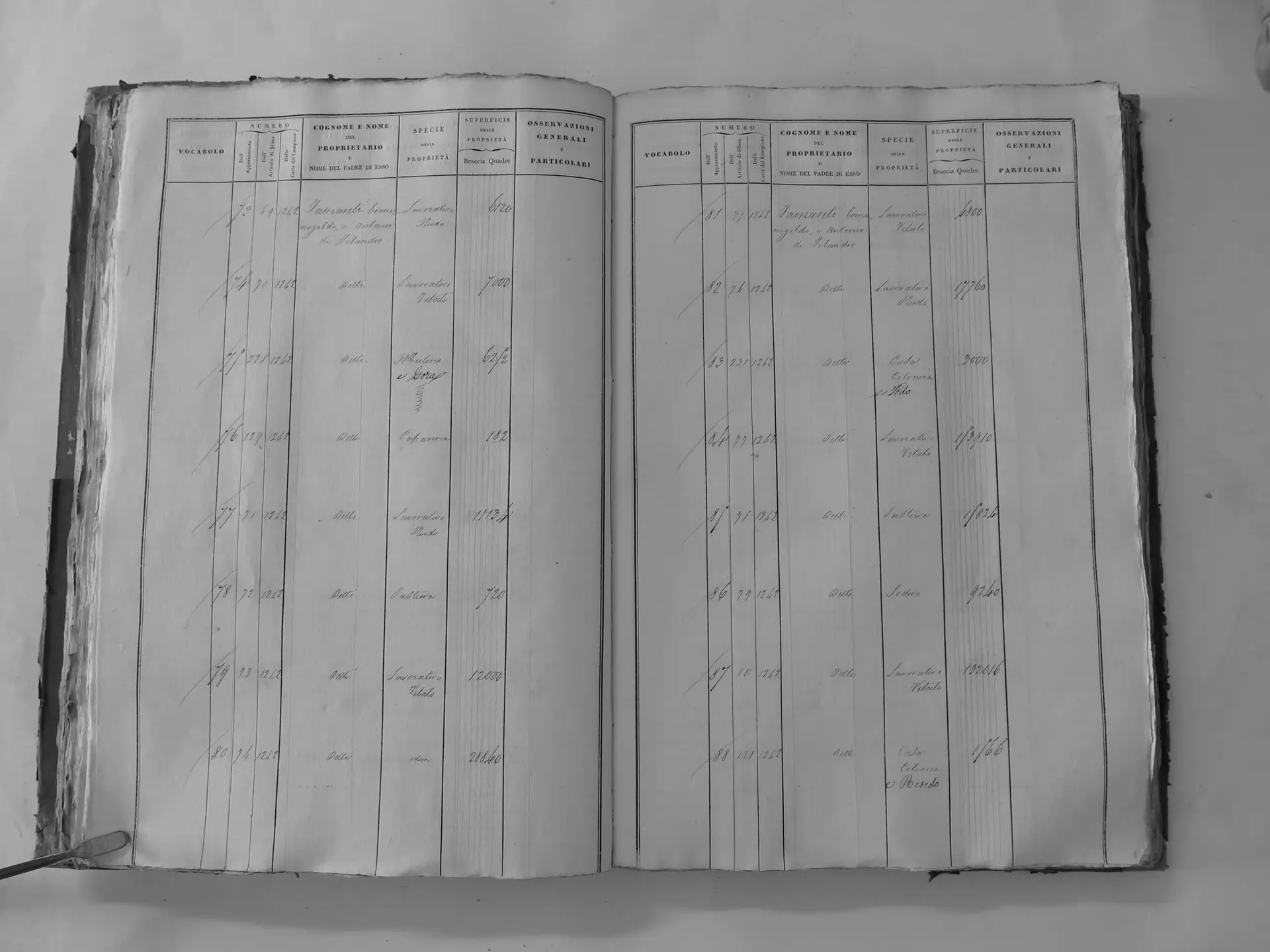
This branch is unusual because a single piece of land connects its oldest and newest records. In the Tuscan land survey of about 1820, the owner tables for the Sparampaglia section name “Ermenegildo e Antonio Tamanti di Filandro” (Ermenegildo and Antonio Tamanti, sons of Filandro) as the owners of a large estate at Il Casato. The owner’s parcel-by-parcel reconstruction assigns 98 numbered parcels to the two brothers. One of them, parcel 83, is a farmhouse and stable.
A century later, Il Casato belonged to Giuliana Tamanti Colombini. Her granddaughter Donatella Cinelli Colombini owns it today. Her grandson Stefano Cinelli Colombini runs Fattoria dei Barbi, and he describes Casato as “the centerpiece of the Tamanti lands” (Stefano Cinelli Colombini, correspondence with the owner, August 2026).
What is proven, and what is not
Each link in this chain rests on a different kind of evidence, and some links are firmer than others.
- Documented: in about 1820 Ermenegildo and Dr Antonio Tamanti, sons of Filandro, jointly owned the Il Casato estate (Tavole indicative, Tomo II).
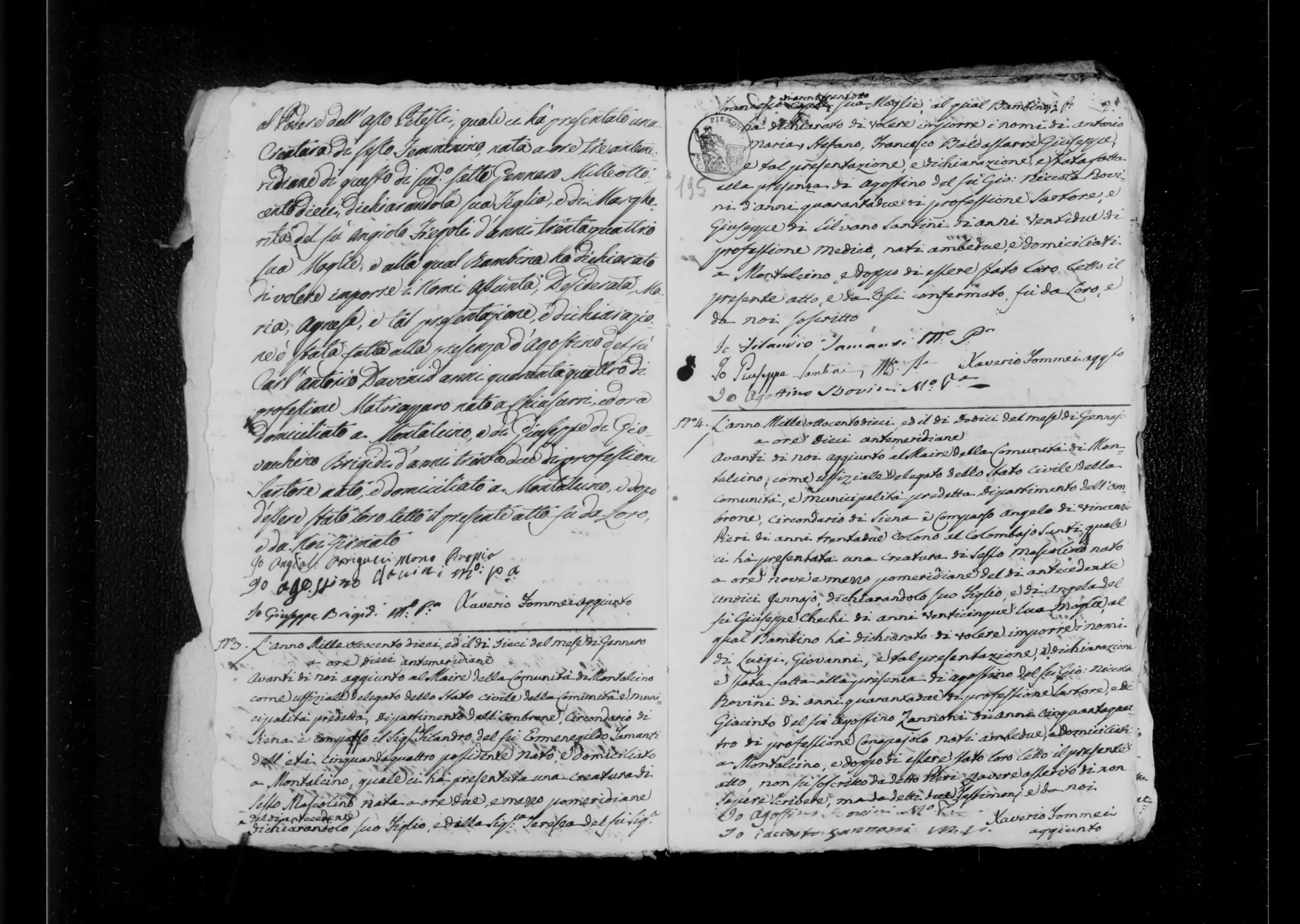
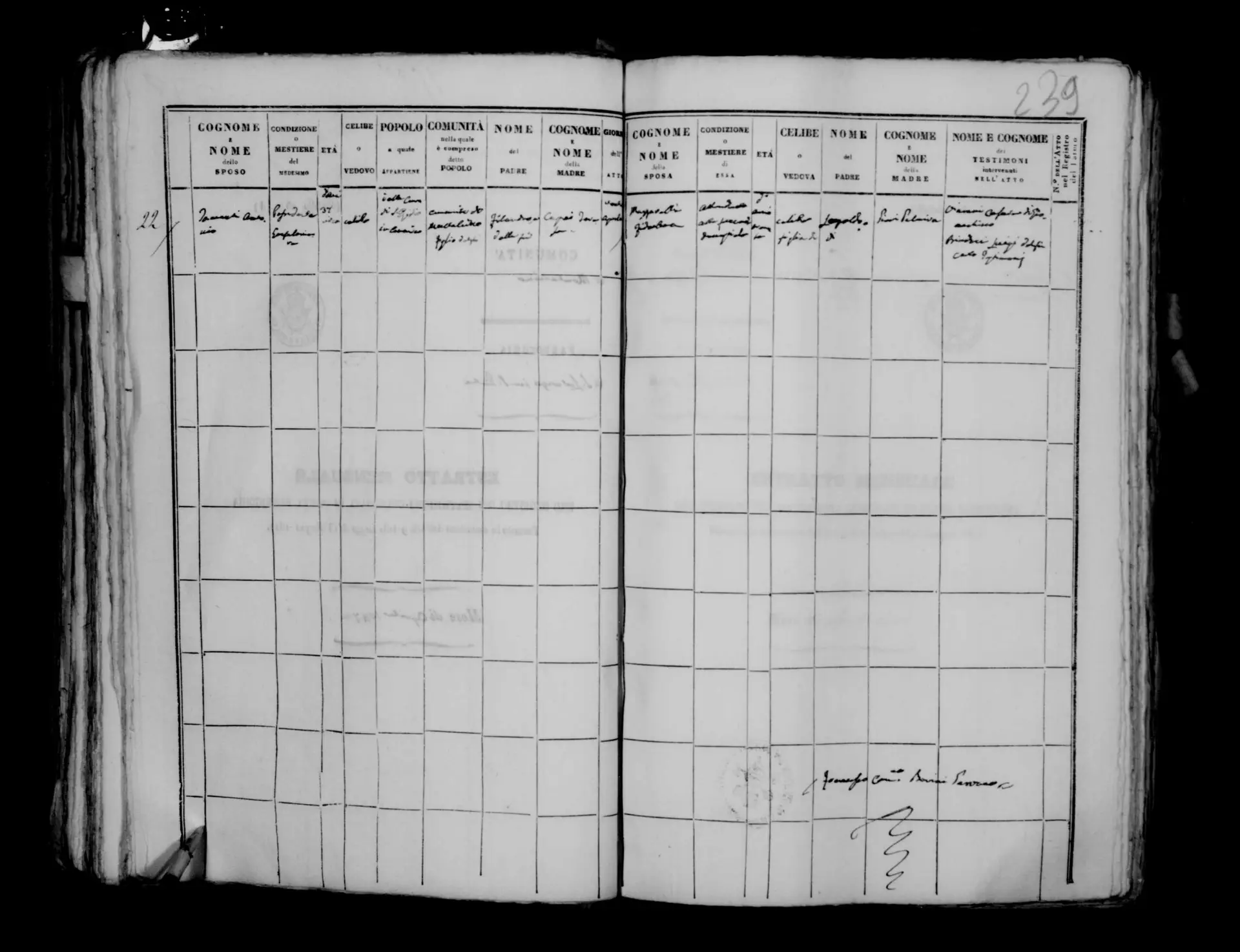
- Documented: Antonio was born on 10 January 1810, the son of Filandro and Teresa (birth act, original on Antenati). He married Fidalma Muzzarelli, daughter of Dr Leopoldo Muzzarelli and Palmira Pieri, in April 1847, very probably on the 20th, when he was “possidente e Gonfaloniere” and she was thirty; the hand of the marriage return is hard to read and her name was once read as “Giuditta”, but the later birth and death acts call her Fidalma (marriage entry, original on Antenati).
- Published genealogy and family testimony: the line continues through Antonio’s son Francesco Antonio, then Giovanni Tamanti (1881–1916), then Giuliana, who married Giovanni Colombini (Carle, La patria locale, 1996, p. 292). Both of Giuliana’s grandchildren say the same in their own family histories.
- Still open: the legal chain of title that carried Casato from the 1820 brothers down to Giuliana, and the identity of the family Donatella says owned Casato as early as 1592.
Pages in this section
- Giuliana Tamanti Colombini: the woman who joined the two families, her descent from Dr Antonio Tamanti, and what the sources do and do not prove about her parentage.
- Il Casato and Fattoria dei Barbi: the 98-parcel estate of 1820, and how Giovanni and Francesca Colombini made the family a force in modern Brunello.
For the full list of the Tamanti rural holdings in the 1820 survey, including the rest of Ermenegildo and Antonio’s lands, see Tamanti Poderi: The Family’s Lands. The Casato holding has its own page there: Il Casato (Sparampaglia).
The Padelletti side, and a visitor from Berlin
Giovanni Colombini was himself half Padelletti. His father, Prof. Pio Colombini, married Elina Padelletti in Montalcino’s town hall on 12 September 1891; she was the daughter of the notary Raffaello Padelletti and granddaughter of Dr Anacleto Padelletti, a physician of the town. The Padelletti were one of Montalcino’s professional families, linked by marriage to its doctors, the Brigidi among them. The town’s historian gives the family its first appearance as men of trade: writing in the middle of the eighteenth century, Tullio Canali noted that the making of cloth and of wax, abandoned in Montalcino for more than a century, had been brought back to life by “quel mercante Padelletti”, that merchant Padelletti, by whose work many families now lived; Canali does not give his forename. They were landowners too: by 1833 the Padelletti brothers owned the farm of Riguardo near Camigliano and built a chapel there to St Lucy (Brandi, Il Senso della Memoria, 2010, p. 107), and on 6 June 1909 Avv. Carlo Padelletti stood beside Avv. Giuseppe Tamanti as host and guide to Siena’s Society of Friends of Monuments, whose lunch the two men “washed down with exquisite wines from their own estates” (Rassegna d’arte senese, 1909, pp. 52–60). Pia Padelletti, Elina’s younger sister (born 1874, a daughter of the notary Raffaello), married Vitaliano Angelini of Murlo on 25 April 1898, with two doctors as witnesses and a reception at her father’s house (Il Progresso, 1898, no. 9).
The civil registers now take the notary’s family back two more generations. Dr Anacleto Saverio Padelletti was born in 1809 to Raffaello Padelletti, a merchant (negoziante) “del fu Giovanni”, son of the late Giovanni, and his wife Angela Valeri of Santa Fiora. In 1812, aged forty-five, Raffaello sat on the district council, according to Carle. He was very probably the Raffaello, son of Giovanni Padelletti and Agnese Grassi, who died at Montalcino on 14 May 1833 aged sixty-eight: his age, his father’s name and his parish all fit, but no single record yet names both his parents and his wife. His children included Arcangelo, Dr Anacleto, Caterina, who married the physician Dr Federigo Brigidi in 1837, and Maria Caterina Gertrude, a former oblate who never married and died in Montalcino on 19 May 1885; her death act names her parents as the late Raffaello and the late Angela Valeri. On 7 May 1818, when the image of the Madonna del Soccorso was carried to the cathedral for the hundredth anniversary of its coronation, Don Antonio Brandi’s transcription of the cathedral chapter’s memoir of the feast records Raffaello Padelletti and Pietro Begni among the men who carried the standard and the torches, and Dr Carlo Costanti and Dr Vincenzo Padelletti among the assistants of the deputies, one of whom was Filandro Tamanti: four of the families of this story walked together behind the image. Dr Vincenzo, a doctor of law and the son of the late Girolamo Padelletti, belonged to another Padelletti line; married to Violante Tommei, he had taken holy orders by 1841, very probably as a widower, and the Vincenzo Padelletti, son of the late Girolamo, who died on 19 October 1845 as archpriest of the cathedral was very probably he.
A Sienese marriage act of 1809 gives the dates this family had lacked for its eighteenth-century head. On 8 February 1809 Maria Orsola Padelletti, born at Montalcino about 1758 and living at Siena as a widow, married again there, and the act calls her the daughter of the late Giovanni Padelletti and the late Agnese Grassi, “morti ambidue in Montalcino”, both dead at Montalcino. It copies the days from the parish certificates: Giovanni died on 17 April 1801, aged eighty-five, and Agnese on what reads as 21 January 1799. Giovanni was therefore born about 1716. One of their sons, the priest Angelo Maria Padelletti, lived until 29 December 1854, when he died at Montalcino aged ninety-one.
Not every branch rose into the professions. Giovanni’s eldest son Francesco had a son, Vittorio, who became a hatter. When Vittorio registered the birth of his son Girolamo in June 1811, the clerk noted that he did not sign “per non sapere scrivere”, because he could not write; one of the witnesses was a student of twenty-three, his cousin Salvatore Padelletti. The learned and the craft branches of the family still stood side by side. Girolamo took up his father’s trade and died a hatter at his house on the Corso in 1869, and his sister Giuseppa, a day labourer, married another labourer at Montalcino in 1848. Vittorio’s sister Maria Pasitea made her living at Siena as a ribbon weaver and married a mason there in 1813, with her father Francesco, still living at Montalcino, coming to give his consent.
Dr Anacleto married twice. His first wife, Antonia Purghi, daughter of Giuseppe Purghi and Elisabetta Valli, whom he had married at Sant’Egidio on 30 April 1835, when he was a physician of twenty-six and she was not yet nineteen, died on 7 November 1869; his second, Caterina Brigidi, born on 7 February 1837, daughter of the late Dr Domenico Brigidi, a doctor of law and the elder brother of Dr Federigo, survived him and died his widow on 21 February 1907, so the Padelletti and the Brigidi intermarried in two successive generations. Domenico’s own marriage proves the kinship: in November 1826, very probably on the 2nd, “Brigidi Domenico”, a student of nineteen, son of Bernardino Brigidi and Stella Purghi, married Sofia Faneschi, a stocking-knitter (calzettaia) of twenty-two, daughter of Giuseppe Faneschi and Maria Andreini, at Sant’Egidio. Anacleto’s second wife was therefore a first cousin of Ester Brigidi, the second wife of his son. Anacleto, by then “Cav. Dott. Saverio”, died in his house at Piazza Principessa Margherita no. 8: the act was written on 4 March 1892 and says that he had died the day before, so very probably on the evening of 3 March. His son the notary Raffaello died in the same house, probably on 28 December 1900, aged sixty-four, survived by his second wife Ester Brigidi; the act names his mother as the late Antonia Purghi and, on one reading, his father as the late Saverio, that is Dr Anacleto. Raffaello had married his first wife, Elisa Gianneschi, at Siena on 16 July 1864, in the parish of Santo Spirito: he was twenty-eight, she about twenty-five, a daughter of Dr Edoardo Gianneschi, and two Sienese noblemen stood as witnesses. Their son Vieri followed ten months later; a daughter, Egle, born in June 1867, lived only two months; and their daughter Pia was born in 1874. Elisa herself died at Montalcino on 7 February 1880, as a certificate filed with her widower’s second marriage shows, and the marriage act of their son Cino in 1905 also names his late mother as Elisa.
Vieri’s wife came from a family of estate managers. Her father, Gaspare Monciatti, was born on 20 December 1829 in the parish of Bibbiano at Buonconvento, the son of Carlo Monciatti, himself a fattore, an estate manager. At forty-six, on 16 November 1875, he married Giulia Bongini, born at Siena, at the town hall of Buonconvento. Nearly all of Casale belonged to the Sienese Sergardi in the land register of the 1820s, so when their daughter Marietta was born at Casale in 1878 her father very probably managed the Sergardi estate. Marietta married Vieri at Montalcino on 18 January 1897. Vieri became a man of the farming interest: in the autumn of 1921 the town paper called him president of the Montalcino section of the Associazione Agraria Toscana, the section Gontrano Biondi Santi had first led in 1919, and in September 1928 he sat with Avv. Giuseppe Tamanti on the commission for a new school.
The Brigidi can now be followed to their end. Dr Domenico Brigidi, the father of Anacleto’s second wife, lost his wife Sofia Faneschi on 2 November 1852, married again, and died at Montalcino on 3 August 1886, aged seventy-nine. His sons were men of the law and of science. Avv. Giuseppe Brigidi, very probably another son, was the district judge of Castel del Piano on Monte Amiata when he married at Montalcino in 1857. Cav. Avv. Orazio Brigidi, lawyer and landowner, died on 14 March 1908, leaving a widow who was herself a Padelletti: a third Brigidi–Padelletti marriage. Cav. Prof. Vincenzo Brigidi, retired, died on 16 October 1908 at the same address on the Corso Vittorio Emanuele where his sister Caterina, Anacleto’s widow, had died the year before.
Vincenzo was very probably the pathologist of that name: the name, the title, his retirement and a son born at Florence all fit, though no record yet joins the two. Dr V. Brigidi of the Florentine school of pathological anatomy published in 1877 a post-mortem study of a man grown “stranamente deforme”, strangely deformed, by a long illness, and historians of medicine credit him with an early, perhaps the first, microscopic description of the enlarged pituitary gland in the disease that Pierre Marie would name acromegaly in 1886. From 1886 to 1905 he directed the Institute of Pathological Anatomy of the University of Genoa. If he is the Montalcino Vincenzo, Anacleto Padelletti’s brother-in-law has a small place in the history of medicine.
The family’s ties to the Santi and the Bucelli were older still. The elder Clemente Santi’s sister Novilia, born at Pienza about 1744 and perhaps a half-sister, followed him to Montalcino and married Romualdo Padelletti, the earliest bond between the Santi and the Padelletti. The marriage is now proved from an original record: Novilia died a widow at Montalcino, in the parish of San Pietro, at seven in the evening of 3 July 1821, aged seventy-six, and the death register names her father Livio, her mother Maria Diana Minucci and her late husband Romualdo Padelletti. When Maria Tamanti married into the Santi in 1819, her husband’s great-aunt, a Padelletti widow, was still living in the town. In the ballots for gonfaloniere of 1778 and 1792 “Caterina Padelletti ved. Buccelli” was entered in place of her late husband Giuseppe Buccelli, according to Carle, and by 1832 the tithe book of SS. Salvatore, as transcribed by Brandi, entered the farms of Canneta and Petroso as “Bucelli ora Padelletti”, formerly Bucelli, now Padelletti.
On 24 January 1824 Raffaello’s son Arcangelo married Virginia Begni; the birth act of their son the next year calls his mother “Onesta Begni”, but the rare combination of names, place and dates makes it very probable that she was the same woman. That son, Cav. Enrico Padelletti (1825–1887), became sindaco of Montalcino and, according to Nicolosi’s register of the provincial councillors, sat on the provincial council of Siena in the 1880s. A lawyer, he had signed Montalcino’s address to the departing government delegate in 1860 and by 1868 was the schools’ delegate for the district. By a royal decree of 11 December 1873 “Padelletti avv. Enrico” was appointed sindaco for the three years 1874–76, and in June 1874 he was made a knight of the Crown of Italy as mayor; notices in the official gazette of 1875 and 1876 carry his signature, “Il Sindaco: E. Padelletti”, and in January 1878 he represented Montalcino at the funeral of King Victor Emmanuel II in Rome. In June 1886, according to L’Elce, he was again acting as mayor. He died in Montalcino on 14 May 1887, and Tito Costanti printed a memorial to him, “Alla venerata e cara memoria del cav. Enrico Padelletti”. The death registers of the early 1830s fill in his mother’s family. Her sister Lavinia, widow of Pietro Angelini, died on 21 March 1833 aged fifty-five, and her brother Giuseppe on 14 June 1834 aged forty-one; both acts name their parents as Cammillo Begni and Agostina Bucelli. Their father was very probably the landowner Cammillo Begni who died on 14 November 1831 aged seventy-five, though his act leaves the spouse’s column blank. Pietro Begni, the father of Clementina who married Giacomo Tamanti in 1848, was another of their children: the 1841 census lists him beside his brother Dr Antonio Begni, and his second marriage, in 1842, names his parents as Camillo Begni and Agostina Bucelli. Clementina Begni Tamanti and Enrico Padelletti were therefore first cousins (provided Virginia and Onesta were the same woman, as is very probable), and the Tamanti of Giacomo’s line and the Padelletti of Arcangelo’s shared Begni and Bucelli grandparents. The Begni have their own page: The Begni of Montalcino.
The Padelletti also stood in the town’s year of revolution. According to Montalcino’s local historians, seven young students of the town marched with the Tuscan battalion to Curtatone and Montanara in the spring of 1848, a Pier Francesco Padelletti among them, and in the Tuscan revolution of 1848–49 Montalcino was represented in the Tuscan Parliament by two of its own: Sebastiano Brigidi, who had joined Mazzini’s Giovine Italia as early as 1833 and belonged to another Brigidi family than the doctors, and a Domenico Padelletti, very probably the canon Domenico Padelletti, who sat on the academic council of the University of Siena, served as its acting head in 1859–60, and died at Montalcino on 23 January 1884, aged eighty-six.
The name also reached further afield. Another Padelletti, the jurist Guido Padelletti (born at Livorno on 17 July 1843, son of the lawyer Pier Francesco Padelletti and Angela Piccinetti; died at Montalcino on the night of 3 July 1878), grew up between Montalcino and Florence, studied in Berlin and Heidelberg, became a historian of Roman law in Rome, and on 27 October 1870 married Hilda Zumpt in Berlin, of a family of classical scholars. In the memoir of his father-in-law, the philologist August Wilhelm Zumpt, which Guido signed in Rome in April 1878, he recalls that in October 1875 Zumpt came straight from Berlin “to visit us in my home town, in Montalcino, where we were then spending the autumn”. Town and country, Guido wrote, were still unknown to travellers, lying away from the great railway lines, and to Zumpt and the Berlin jurist Professor Bruns, who visited “unsern Steineichenberg”, our hill of holm oaks, at the same time, the landscape, the local customs and the way the land was farmed were all of great interest. The German phrase is Montalcino’s own name, the Mons Ilcinus of the holm oak, translated. Guido’s branch is distinct from the notary’s, and how the two join is not yet known (Guido Padelletti, “August Wilhelm Zumpt. Zur Erinnerung an sein Leben und seine Schriften”, Jahrbücher für classische Philologie, Supplementband 10, 1878–79, pp. 165–205, at p. 173; G. Ferri, “Padelletti, Guido”, Dizionario Biografico degli Italiani 80, 2014).
Hilda stayed in Montalcino after Guido’s death with their son Carlo Augusto (1871–1957) and daughter Sofia (1877–1889), in whose memory she founded the town’s infant school. It opened in May 1894 as the Asilo infantile “Sofia Padelletti”, under its director Giulia Ermini, and took in the children of the poor so that their mothers had time to go out to work; it still bore the dead girl’s name in January 1932, nearly forty years on (Il Progresso, 1894–1932). For Carlo’s birthday in August 1894 Hilda hung German and Italian flags over the garden terrace, and Carlo read them as his mother’s two loyalties. Carlo became a doctor, a Waldensian and one of the town’s great entrepreneurs. With his mother he built up a power plant, mill, oil press, sawmill, kiln and printing press employing about two hundred people in the early 1900s. In the First World War the son of a German mother served Italy as a doctor: through 1917 and 1918 he was a capitano medico, an army medical captain, in the military hospitals of Siena. Risky investments, his charities and his liberal opposition to the Fascists in 1923 ruined him (G. Rustici, Dizionario Biografico dei Protestanti in Italia; Il Progresso, 1917 and 1918).
The works that lit the town were not, in law, Carlo’s. The firm advertised as the “Ditta H. Padelletti-Zumpt”, announcing in 1908 the reopening of its steam mill and in 1909 its electric lighting of the town’s loggia, and the contract for the public lighting named Hilda alone. When an opponent asked the council to unseat Carlo in 1907, Carlo answered that the exclusive ownership of the works had been declared and recognised in his mother’s person alone, and owned his part in it: having pushed his mother, “inesperta, non più giovane e perfino poco pratica della nostra lingua” (inexperienced, no longer young and not even at home in Italian), into so difficult an industrial venture, it was his duty as a loving son to give her and her works all his energy. By 1907 the professor’s widow from Berlin was the owner of the steam mill and the electric works (Libertas, 1 November 1907; Libertas, 1908–1910).
A Carlo Padelletti stood beside Giuseppe Tamanti again two decades later. Carle names the partners in the cooperative olive mill of 1930–31 as Carlo Padelletti, Giovanni Costanti and Giuseppe Tamanti, with Guido Angelini as its director. This Dr Carlo was very probably Hilda’s son; whether he and the Avv. Carlo of 1909 were one man is not yet clear.
A second Padelletti marriage led back to the Tamanti: Amelia Padelletti, daughter of Cino and Giorgina Caselli, born in 1916, married Piero Mattei Gentili, son of Fidalma Tamanti, at Montalcino on 26 October 1944. Cino, the notary’s son, stood with the Tamanti and the Costanti in politics too: according to Ilio Raffaelli he was elected to the council in 1904 as a progressive liberal, served as an assessore in Mayor Giovanni Costanti’s giunta from 1907 beside Giuseppe Tamanti, and was re-elected in August 1910.
Why this branch matters
It is tempting to say that one family invented Brunello, but the evidence points elsewhere. Brunello grew out of a community of growers, landowners, experimenters and merchants, and the Tamanti belong to that community through their family ties. One branch married into the Santi and then the Biondi, and another married into the Colombini. Both went on to shape Montalcino’s wine. The Colombini side stands out for wine tourism, direct sales, exports and the founding of the Brunello Consorzio in 1967 (Stefano Cinelli Colombini, Brunello, ritratti a memoria, 2nd ed., 2021, pp. 97–103).
The Padelletti were in that community from its beginnings. A documentary history of Brunello published by the Associazione culturale Orcia states that in the first half of the nineteenth century the wine was made only “in tiny quantities” in the houses of the Angelini, Costanti, Santi and Padelletti, probably for a few friends or to show at fairs, and among its historical bottles it shows a mid-nineteenth-century Brunello label of the “Fratelli Padelletti”, the Padelletti brothers, which has not been seen at first hand. Two of the other three families were already bound to the Padelletti by marriage: Raffaello Padelletti’s daughter Agnese had married Giuseppe Angelini, and Novilia Santi had married Romualdo Padelletti.
Behind that modern story is a much older one: a farmhouse and stable at parcel 83, surrounded by fields, vines and woods, owned by two brothers who also held Casa Tamanti in town. That was the courtyard, house, garden and storehouse complex whose footprint researchers are still working to match to today’s Palazzo Tamanti.
Sources on this page
- Catasto Generale della Toscana, Comunità di Montalcino, Tavole indicative, Sparampaglia (section A′), Tomo II: p. 82, p. 83 (Regione Toscana CASTORE)
- Owner’s reconstruction of the Tamanti parcels at Il Casato (map)
- Birth of Antonio Tamanti, 10 January 1810, Nati reg. 61, act 3 (scan; Antenati)
- Marriage of Antonio Tamanti and Fidalma Muzzarelli (read earlier as “Giuditta”), April 1847, S. Lorenzo in S. Pietro no. 22 (scan; Antenati)
- Luisa Scrivani, c.1835 urban cadastral reconstruction of Casa Tamanti, parcels 568–571 (correspondence, 28 August 2026)
- Lucia Carle, La patria locale. L’identità dei Montalcinesi dal XVI al XX secolo (1996), Tamanti family tree, p. 292
- Stefano Cinelli Colombini, Brunello, ritratti a memoria, 2nd ed. (Fattoria dei Barbi, 2021), pp. 97–103
- Stefano Cinelli Colombini, correspondence with the owner, August 2026
- Tullio Canali, Notizie istoriche della città di Montalcino in Toscana (18th century), typescript transcription, Archivio della Memoria, Comune di Montalcino, scheda 62 AdM, Prefazione, p. 5 (online); printed edition, Monteriggioni: Il Leccio, 2014
- Libertas (Montalcino), 1 November 1907 (petition against Carlo Padelletti’s council seat and his reply); advertisements of the Ditta H. Padelletti-Zumpt, 1908 no. 14, 1909 no. 15, 1910 nos. 2, 3, 5 and 10 (Archivio della Memoria)
- Il Progresso (Montalcino), 1894 no. 8, 15 April (announcement of the Asilo infantile “Sofia Padelletti”); 1895 nos. 22–23; 1896 nos. 2 and 5; 1926 nos. 12–13; 1932 no. 1; 1917 annual volume and 1918 no. 20 (Dr Carlo Padelletti, capitano medico) (Archivio della Memoria)
- G. Rustici, “Padelletti, Carlo”, Dizionario Biografico dei Protestanti in Italia (online)
- Donatella Cinelli Colombini, “Donatella Talks About Her Two Wineries” (14 September 2023)
- Archivio di Stato di Firenze, Stato civile toscano, Montalcino, Morti 1821, act 130, image 5 (Novilia Santi, widow of Romualdo Padelletti, daughter of Livio and Maria Diana Minucci, died 3 July 1821, aged 76) (Antenati)
- Same series, Morti 1831, image 8 (Cammillo Begni, died 14 November 1831) (Antenati); Morti 1833, act 190, image 3 (Lavinia Begni, widow of Pietro Angelini, died 21 March 1833) and row 93 (Raffaello Padelletti, died 14 May 1833) (Antenati); Morti 1834, act 220, image 4 (Giuseppe Begni, died 14 June 1834) (Antenati); Stato civile napoleonico, Montalcino, Nati 1809, act 183 (Anacleto Saverio Padelletti, son of Raffaello, negoziante, and Angela Valeri of Santa Fiora)
- Archivio di Stato di Siena, Stato civile italiano, Montalcino: Morti 1885, act 52 (Geltrude Padelletti, ex oblate) (Antenati); Morti 1887, act 71 (Cav. Enrico Padelletti); Morti 1892, act 31 or 38 (Cav. Dott. Saverio Padelletti, registered 4 March) (Antenati); Morti 1900, act 112 (the notary Raffaello Padelletti) (Antenati); Morti 1907, act 25 (Caterina Brigidi, widow of Dr Saverio Padelletti) (Antenati)
- “The Padelletti of Montalcino and the Intertwined Families”, research summary prepared for Palazzo Tamanti, 21 October 2026
- Archivio di Stato di Firenze, Stato civile toscano, on Portale Antenati (read 21 October 2026): Montalcino, Matrimoni 1826, p. 4, no. 47 (Domenico Brigidi and Sofia Faneschi) (Antenati); Matrimoni 1835, p. 43, no. 16 (Anacleto Saverio Padelletti and Antonia Purghi, 30 April 1835) (Antenati); Matrimoni 1847, p. 32, no. 22 (Antonio Tamanti and Fidalma Muzzarelli); Siena, Matrimoni 1864, S. Spirito, p. 136, no. 124 (Raffaello Padelletti and Elisa Gianneschi, 16 July 1864) (Antenati); Archivio di Stato di Siena, Montalcino, Matrimoni 1905, act 59 (Cino Padelletti and Giorgina Caselli) (Antenati)
- Cav. Enrico Padelletti: Gazzetta Ufficiale, 20 January 1874, no. 17 (sindaci for 1874–76) (Internet Archive), 6 August 1874, no. 186, notices of 1875–76, 18 January 1878 (supplement to no. 14); L’Elce (Montalcino) 1886, no. 9; T. Costanti, Alla venerata e cara memoria del cav. Enrico Padelletti, morto in Montalcino il 14 maggio 1887 (Montalcino: Donnoli, 1887)
- Lucia Carle, La patria locale (1996): gonfaloniere ballots of 1778 and 1792 (“Caterina Padelletti ved. Buccelli”); Raffaello Padelletti on the district council, 1812; partners and director of the cooperative olive mill, 1930–31
- Don Antonio Brandi, Studi e trascrizioni (2021 edition): the cathedral chapter’s memoir of the Soccorso centenary, 7–8 May 1818; SS. Salvatore tithe book of 1832 (Canneta and Petroso, “Bucelli ora Padelletti”) (PDF)
- Gerardo Nicolosi, La Provincia di Siena in età liberale. Repertorio prosopografico dei consiglieri provinciali 1866–1923 (Siena, 2003) (Cav. Enrico Padelletti)
- Ilio Raffaelli, Montalcino (1892–1914) (Colle di Val d’Elsa: Vanzi, 2006), chapters 7 and 9 (Cino Padelletti) (Archivio della Memoria)
- Archivio di Stato di Firenze, Stato civile napoleonico, Siena, Matrimoni 1809, act 62 (Maria Orsola Padelletti, daughter of the late Giovanni Padelletti and Agnese Grassi, 8 February 1809) and Matrimoni 1813, act 213 (Maria Pasitea Cristofana Padelletti and Gaetano Tamburini); Montalcino, Nati 1811, act 63 (Girolamo Padelletti, son of Vittorio) (Portale Antenati)
- Montalcino registers of deaths 1839–1848, read page by page (Morti 1845, act 183, the archpriest Vincenzo Padelletti), and later Montalcino acts on the Portale Antenati: Matrimoni 1848 (Giuseppa Padelletti); Morti 1852 (Sofia Faneschi), 1854 (Angelo Maria Padelletti), 1867 (Egle Padelletti), 1869 (Girolamo Padelletti), 1884 (Prof. Domenico Padelletti), 1886 (Dott. Domenico Brigidi) and 1908 (Orazio and Vincenzo Brigidi); Matrimoni 1857 (Avv. Giuseppe Brigidi); Matrimoni–Morti allegati 1881, papers of the marriage of Raffaello Padelletti and Ester Brigidi (death of Elisa Gianneschi, 7 February 1880)
- Archivio di Stato di Siena, Stato civile, Buonconvento: Nati 1829 (Gaspare Monciatti), Matrimoni 1875 (Gaspare Monciatti and Giulia Bongini), Nati 1878 (Marietta Monciatti, with the marginal note of her marriage of 18 January 1897) (Portale Antenati); Il Progresso (Montalcino), 1921 and 1928, bound volumes photographed at the Biblioteca degli Intronati, Siena, 19 October 2026
- V. Brigidi, “Studii anatomo-patologici sopra un uomo divenuto stranamente deforme per cronica infermità” (Florence, 1877), as cited in “The History of Acromegaly”, Neuroendocrinology 103 (2016)
- Montalcino Ieri, “I concittadini risorgimentali” (the students of 1848; Sebastiano Brigidi and Domenico Padelletti in the Tuscan Parliament); Associazione culturale Orcia, “Brunello di Montalcino docg: la storia letta nei documenti” (the four houses; the “Fratelli Padelletti” label)