

Brunello di Montalcino took shape in the experiments of one nineteenth-century family. Part of that family’s inheritance, in land and in blood, came from the Tamanti. This section follows the thread across three generations. It runs from a young landowner named Maria Tamanti, through her daughter Caterina, to her grandson Ferruccio, the man the wine world remembers as Ferruccio Biondi Santi.
The story turns on two marriages, in 1819 and 1844. Each joined a new surname to the line, and each carried property with it. Only part of that property can yet be traced record by record.
The first marriage: Tamanti to Santi, 1819
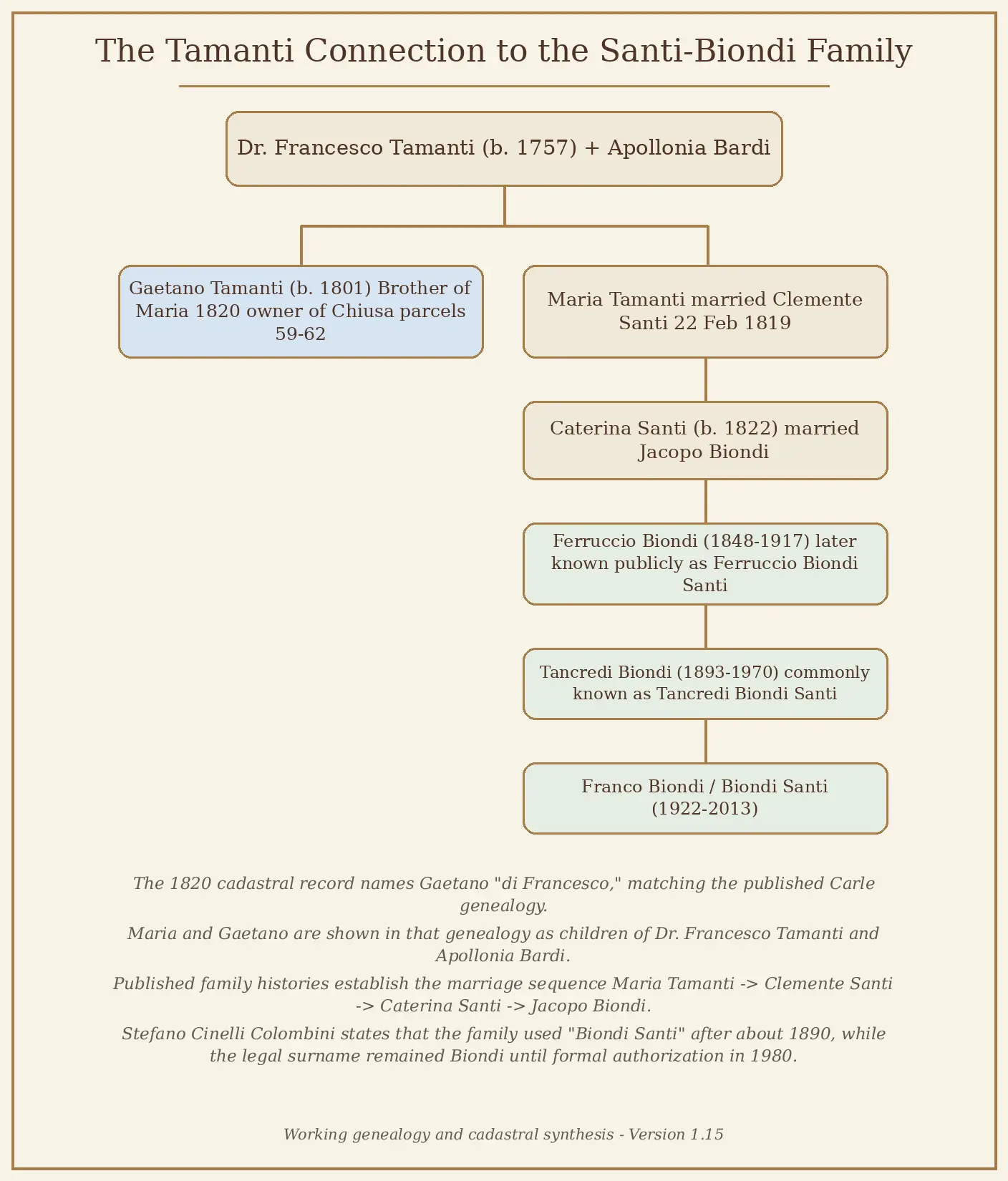
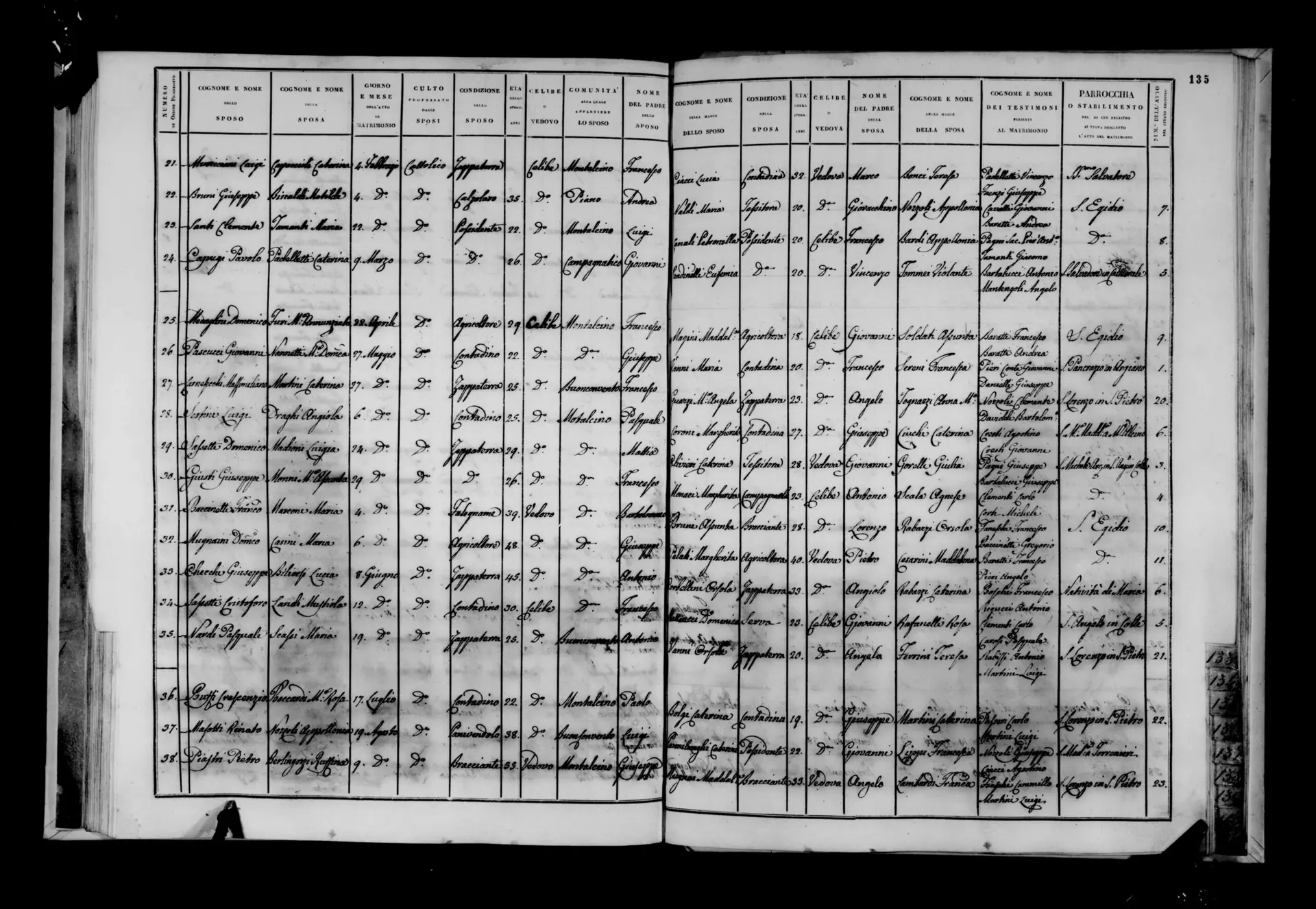
On 12 February 1819, Maria Tamanti, a landowner aged twenty, married Clemente Santi in Montalcino. The marriage act of 12 February 1819 (original on Antenati) names her parents as Francesco Tamanti and Appollonia Bardi. That places her in the branch of Dr Francesco Tamanti, alongside her brother Gaetano (Carle, La patria locale, 1996, p. 292).
Clemente was a trained pharmacist, a pupil of the naturalist Giorgio Santi, and an early experimenter with the wines of his Montalcino farms. His mother, Petronilla Canali, held one of the largest Santi-family estates in the commune. It included a farm centre with a chapel at Greppo, the name later carried by the Biondi-Santi estate. Clemente’s own fame as a wine-maker began with a sparkling sweet Moscadello, shown at Florence in 1850 and London in 1851; the name Brunello appears first for a grape, in 1865, and only by 1870 on wines of his and of other Montalcino growers. Read about Maria, Clemente and the Santi lands.
The second marriage: Santi to Biondi, 1844
On 22 January 1844 Maria and Clemente’s daughter Caterina Santi married Jacopo Biondi, a physician. The marriage entry of 22 January 1844 (original on Antenati) names her parents as Clemente Santi and Maria Tamanti. Together with the 1819 act, it anchors the whole Tamanti–Santi–Biondi connection in the civil registers.
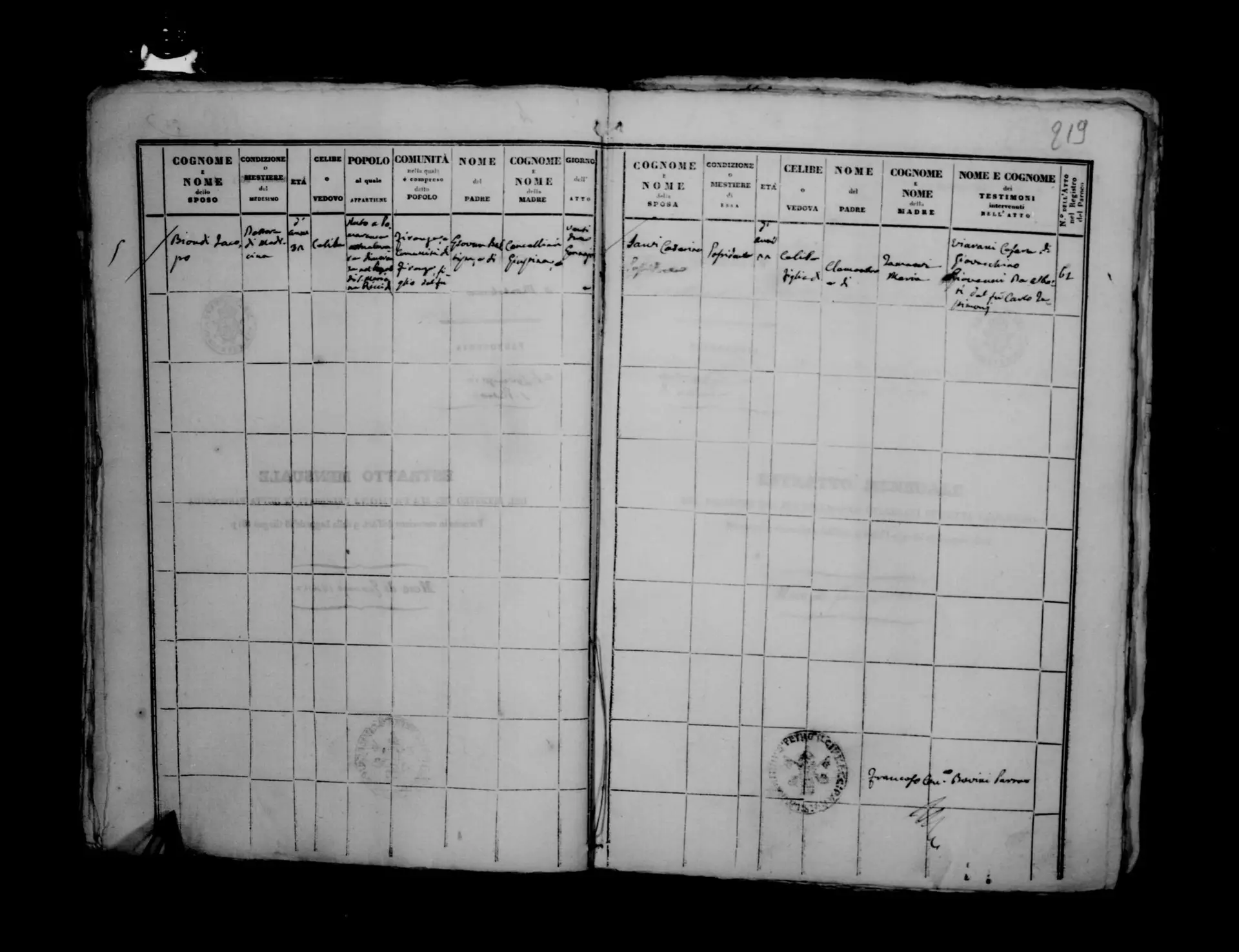
These two records also correct a long-standing error. Lucia Carle’s published Tamanti genealogy swaps the husbands’ surnames, making Maria the wife of a “Biondi” and Caterina the wife of a “Santi” (Carle, La patria locale, 1996, pp. 292, 296). The originals give the opposite order. Read about Caterina, Jacopo and the corrected record.
The grandson: Ferruccio and the birth of Brunello
Ferruccio Biondi was born in Montalcino in 1848. He added his mother’s surname to his father’s in public family use, and under the combined name he turned the family’s experiments into a recognised wine. His 1888 and 1891 Riservas are counted among the first historic Brunellos. According to Stefano Cinelli Colombini, it was through Caterina that Ferruccio inherited the Fattoria del Greppo, Le Chiuse and lands at Pienza (Cinelli Colombini, Brunello, ritratti a memoria, 2021, pp. 74–75). His son Tancredi, his grandson Franco and today’s family at Castello di Montepò carried the work forward. Read about Ferruccio, the Biondi Santi name and the generations after him.
Le Chiuse: where the Tamanti land can be seen
The clearest physical link between the Tamanti and the Biondi-Santi inheritance is Le Chiuse, a farm in the Montalcino countryside that is now a Brunello estate. In the Leopoldine cadastre of about 1820, the house at parcel 59 and the fields, vines and olives of parcels 60–62 are registered to “Tamanti Gaetano di Francesco”, Maria’s brother (CASTORE, Tavole indicative, Montalcino). In 1840 Gaetano asked the bishop’s permission to build a family burial chapel on his podere Chiusa, according to the transcriptions of Don Antonio Brandi. The estate’s own history says Le Chiuse entered the Santi family as part of Maria’s dowry, but that cannot be so: Maria and Gaetano were full sister and brother, and Gaetano still owned the Chiusa in 1840. It very probably reached her line by inheritance after Gaetano died unmarried in 1861, and by every indication came down to Ferruccio through his grandmother Maria and his mother Caterina; the will and transfers that would show the exact steps have not yet been found. Read the Le Chiuse inheritance story.
The Greppo, a Canali house
The Greppo itself came to the Santi through a woman. On 21 September 1722 “il Dott. Tullio Canali, proprietario del Greppo” asked leave to build a chapel in his villa there, dedicated to the Immaculate Conception, Saint Nicholas of Bari and Saint Francis Xavier; it later became the burial chapel of the owning family (Brandi). This was very probably the chronicler Tullio Canali, who as rector of the hospital entrusted the piazza pharmacy to the young Clemente di Livio Santi in 1745. Lucia Carle notes that some Montalcino houses, dying out in the female line, were grafted onto others, “as with the Canali, who flowed into the Santi” (La patria locale, p. 303). Petronilla Canali, daughter of the late Niccolò, carried the Canali inheritance to her son Clemente, and by about 1820 she owned the Greppo farm and chapel in her own name. How the estate passed from Tullio to Niccolò and Petronilla is not yet documented.
The Santi in fact married the Canali twice: Luigi Santi’s own death act of 1841 names his mother as Caterina Canali, and his wife Petronilla’s death act calls her “vedova del fu Sig.r Luigi Santi”, the widow of the late Luigi Santi. Petronilla died at Montalcino on the evening of 3 December 1848, aged about eighty-four, more than seven years after her husband. How the Greppo passed from her to Clemente after 1848 is not yet documented, but it was at the Greppo, “nella casa posta in Villa del Greppo”, that Clemente died on 22 April 1885, aged ninety: the villa where Ferruccio made Brunello was a woman’s inheritance before it was a man’s.
Clemente’s brother, Avv. Tullio Santi, who also used the name Santi Canali, was alive in June 1872, when he and his daughter Petronilla, married to a Palanca, asked to build the chapel of Our Lady of Sorrows on their farm of Renaio, blessed in October 1873. Printed lists and the official gazette fill in his public life. “Santi Tullio, Montalcino” took his degree in law at the University of Siena in the academic year 1819–20. In March 1851 the Almanacco Toscano lists “Santi Sig. Avv. Tullio” as gonfaloniere of Montalcino, the office Ermenegildo, Gaetano and Dr Antonio Tamanti had held before him, and on 20 February 1860 he signed sixth, and his brother Clemente twelfth, among the 120 signatories of the town’s farewell to the departing government delegate. In a united Italy a royal decree of 9 February 1868 named “Santi Canali avv. Tullio” sindaco of Montalcino for the three years 1868–70. The brothers also gave the town its library: when the Biblioteca comunale opened to the public in 1874, its 5,500 volumes had been given partly by Dr Clemente Santi and Avv. Tullio Santi Canali. Tullio did not enjoy it long. The state pension list of 1875 grants his widow, Carolina Brizzi, a pension from 29 October 1874, so he died in the autumn of 1874, very probably at the end of October. In May 1886 L’Elce reported her death and called him the founder of the town library. Her civil death act adds that she died on 19 May 1886, aged seventy-seven, a native of Bagno di Romagna, and calls her “vedova del defunto Avvocato Tullio Santi Canali”, widow of the late lawyer Tullio Santi Canali.
The women after Maria
The published histories of Brunello are a line of men: Clemente, Ferruccio, Tancredi, Franco. Yet the land came down through women, and the wives and daughters of the following generations are visible in the civil registers and, above all, in the town paper, Il Progresso.
- Caterina Santi Biondi (b. 1822). The family was legally Biondi; it took the combined form “Biondi Santi” after about 1890 and, according to Stefano Cinelli Colombini, had it legally recognised only in 1980. The most famous surname in Brunello therefore carries her maiden name. She outlived her mother, who died at the Greppo in 1864; she is not in the Tuscan death indexes for 1841–1865, so she very probably died after 1865, most likely in Florence, where her husband lived.
- Paolina Biondi Salle (1845–1929) and her daughter Bianca Salle (1873–1948) held the Santi house in Via Elisa at Pienza, and Bianca also owned Villa Casalpiano: the Pienza inheritance passed from mother to daughter.
- Clementina Caselli, Ferruccio’s wife, known in town (very probably) as Orlandina. Over more than thirty years the paper shows her as patroness of the infant school (1895), among the ladies of the hospital’s charity fair (1910), and, newly widowed in 1917, organiser of Montalcino’s collection for the refugees of Caporetto, which raised more than 1,400 lire. In 1923 she organised a theatre benefit for the poorhouse, and in 1929 sat on the town’s Red Cross committee.
- Ninì (Caterina) Biondi Santi (b. 1891). Her fiancé, Captain Umberto Brigidi, was killed in Albania in September 1916; the same front page mourned Ing. Giovanni Tamanti. On 12 July 1920 she married Dr. Renzo Simionati, a lawyer, at Siena, in the church of Sant’Andrea. In 1928 the paper singled out her gift, beside that of the Tamanti family, to Montalcino’s new committee for mothers and infants.
- Anna Tomada (Trieste 1898 – Montalcino 1983), Tancredi’s wife. Family memory, in Franco’s recollection, has them meeting in a military infirmary in the First World War, where she was a nurse; Tancredi’s wound and the hospital are known only from that recollection. In 1925 she served on a ladies’ fund-raising committee with Agnese Tamanti, and in 1929 on the Red Cross committee with her mother-in-law.
- Fiorella Biondi Santi, Tancredi’s daughter, inherited Le Chiuse in 1970. After her death in 1986 it passed to her daughters and, from 1989, to Simonetta Valiani, who runs the estate today. The farm that tradition calls Maria Tamanti’s dowry, and that very probably came to her line from her brother Gaetano, is again in a woman’s hands.
What is proven, and what is not
The marriages, the parentage and the 1820 ownership of the Chiusa core are documented. What remains open is the legal mechanism that moved land between them. Maria’s dowry settlement has not been found, and she does not appear as an owner anywhere in the cadastral owner tables. Her full brother Gaetano still owned the Chiusa core in 1820 and in 1840, after her marriage, so the Chiusa at least cannot have been her dowry: it very probably reached her line by inheritance after Gaetano died unmarried in 1861, by his will or in the division among his heirs. Which farms, if any, Maria did bring in 1819 is not yet proved. Gaetano’s will, his 1847 petition about leaving his estate to the town, and the transfers recorded against his cadastral account (Campione and volture) are the records that will settle the question.
In this section
- Maria Tamanti and Clemente Santi, 1819
- Caterina Santi and Jacopo Biondi, 1844
- Ferruccio Biondi Santi and Brunello
- Le Chiuse: the inheritance story
Sources on this page
- Marriage of Clemente Santi and Maria Tamanti, 12 February 1819, Montalcino, S. Egidio, act 8. Local scan; Portale Antenati.
- Marriage of Jacopo Biondi and Caterina Santi, 22 January 1844, Montalcino. Local scan; Portale Antenati.
- Catasto Generale della Toscana, Comunità di Montalcino, Tavole indicative (Archivio di Stato di Siena), via CASTORE.
- Lucia Carle, La patria locale. L’identità dei Montalcinesi dal XVI al XX secolo (Regione Toscana / Marsilio, 1996), pp. 292, 296.
- Don Antonio Brandi, Studi e Trascrizioni (online compilation), 1840 Cappella della Chiusa record.
- Le Chiuse, official estate history.
- Stefano Cinelli Colombini, Brunello, ritratti a memoria, 2nd ed. (Fattoria dei Barbi, 2021), pp. 74–75.
- Don Antonio Brandi, transcriptions: Cappella del Greppo (21 September 1722); Cappella di Maria Addolorata nel podere Renaio (20 June 1872).
- L’Elce (Montalcino), no. 8, 23 May 1886, “Necrologia”.
- Tullio Santi Canali: G. Mozzani, L’Università degli studi di Siena dal 1839-40 al 1900-01 (Siena, 1902), graduates of 1819–20; Almanacco Toscano per l’anno 1851, p. 698 (gonfalonieri); Gazzetta Ufficiale del Regno d’Italia, no. 54, 24 February 1868 (sindaci for 1868–70), and no. 242, supplement, 16 October 1875 (pension list); Annuario delle biblioteche italiane, vol. II, Montalcino, Biblioteca Comunale; address of the Comune of Montalcino to Avv. Carlo Cavigli, 20 February 1860 (all on the Internet Archive).
- Archivio di Stato di Siena, Stato civile italiano, Montalcino, Morti 1886, act 77 (Carolina Brizzi, died 19 May 1886) (Portale Antenati, read 21 October 2026).
- Il Progresso (Montalcino), 1895–1929, via the Archivio della Memoria, including 1916 no. 21 (Capt. Umberto Brigidi), 1917 (refugee committee), 18 July 1920 (the Siena wedding) and 1929 no. 2 (Red Cross committee).
- Archivio di Stato di Firenze, Stato civile toscano (preunitario), Montalcino: Morti 1848, parish of SS. Salvatore, death of Petronilla Canali, 3 December 1848 (Portale Antenati); Morti 1841, act 119, death of Luigi Santi, 10 April 1841; death indexes 1841–1865 (Maria Tamanti, 1864; no entry for Caterina Santi Biondi); death of Clemente Santi at Villa del Greppo, 22 April 1885.
- Exhibition records for Clemente Santi’s wines: Florence 1850 (Rapporto generale, 1851); Florence 1861, Catalogo officiale, no. 2315; A. Tassi, Cenno sulla botanica agraria … della provincia di Siena (1865), pp. 24–25.