

Builders, architects and a pioneer of Brunello
No family left more of itself in the stone of Montalcino than the Paccagnini. Their name appears in a convent chronicle, on the building site of the cathedral’s bell tower, on an inscription of 1848, beneath an engraving of a Sienese triumphal arch, in a prize list on Rome’s Capitoline Hill and on a diploma awarded to Brunello at Bordeaux. Like the Padelletti, they were builders of the town and makers of its wine, and their blood entered the Padelletti house when Silvia Paccagnini married Enrico Padelletti, the future mayor, in 1848. Through Silvia’s grandmother, Giustina Brigidi, they were also kin to the Brigidi of the Osticcio, Tullio Scrivani’s family.
One line through four generations
The records give several Paccagnini households rather than a single pedigree, but one line can now be followed step by step. Pietro the builder was the father of Angelo, born on 10 April 1776, who married Giustina Brigidi, a daughter of Giovacchino Brigidi and Silvia Grassi. Their son Felice, a mason born on 30 August 1800, married Maria Luisa Terzi on 4 August 1822, and Felice’s daughter Silvia married Enrico Padelletti. The grand-ducal parish census of 1841 shows the two households a few streets apart, still in the same trade: Angelo, “son of the late Pietro”, with Giustina, “daughter of the late Gioacchino”, in the parish of San Lorenzo, and Felice, “son of Angelo”, with Luisa and their seven children in the parish of Sant’Egidio. Giustina died a widow on 7 November 1854, aged seventy-six.
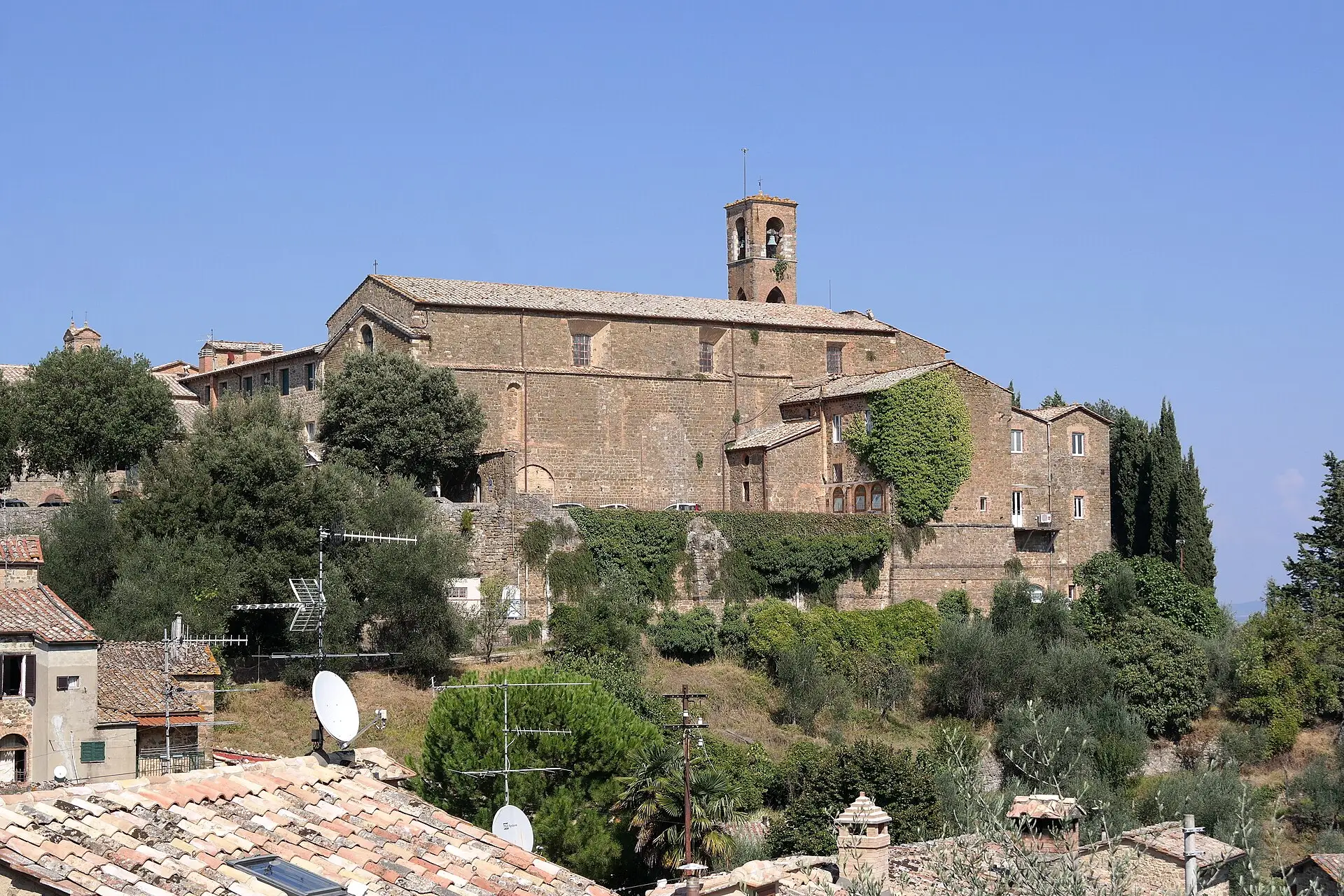
A roof for San Francesco, 1749
In the summer of 1749 the roof of San Francesco had become a danger to the church beneath it, with rotten timbers and openings that let in rain and snow. Work began on 3 July under Francesco Paccagnini, a master builder living in Montalcino who had come down from the mountains above Pistoia, and was finished by 25 September; the new roof, the chronicler noted, was painted the color of peach blossom. A workman, Carlo Signorini, fell from the church roof onto one chapel roof, then another, and finally to the ground, and got up unhurt; the friars gave the credit to Saint Anthony.
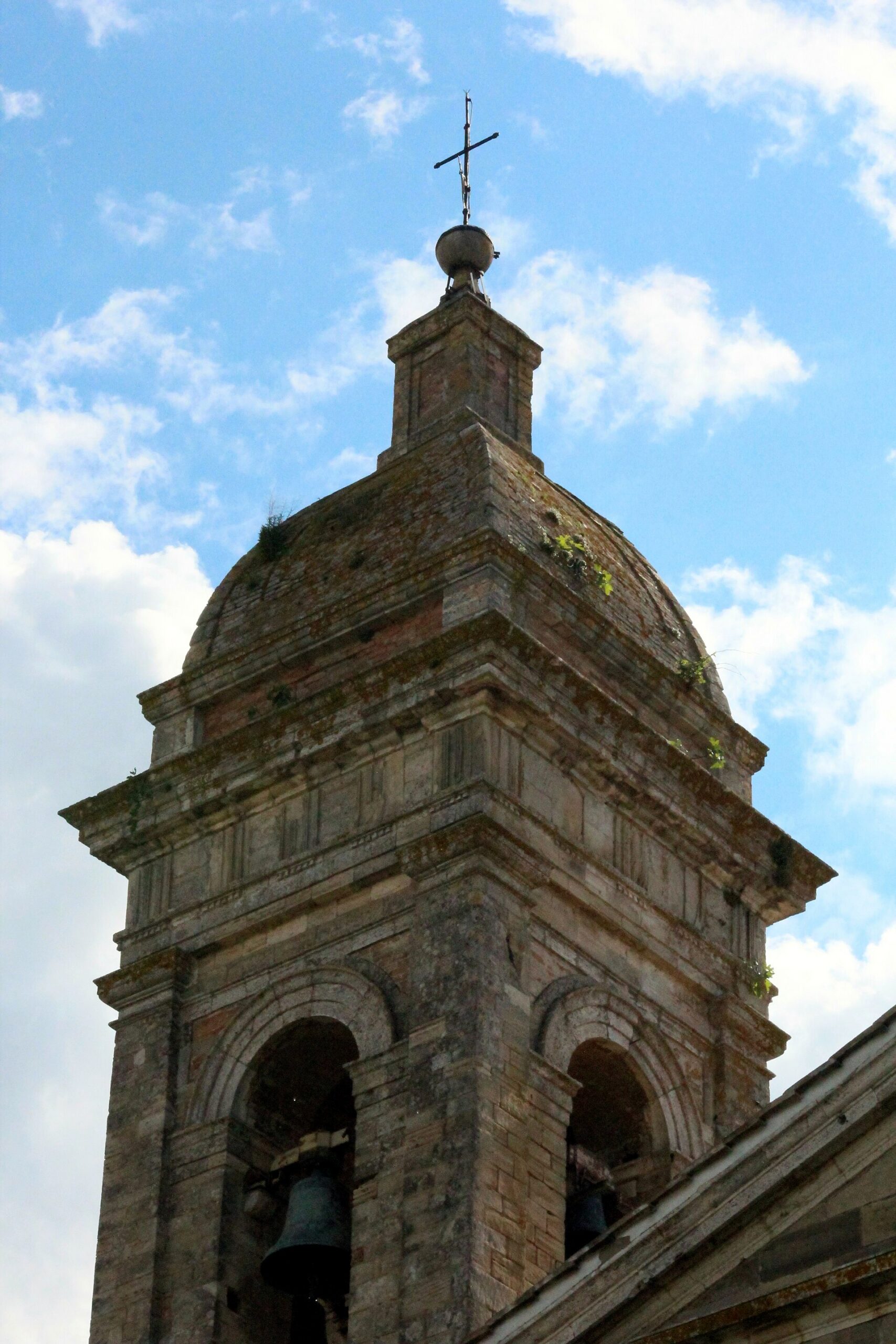
The cathedral bell tower, 1794–1797
Half a century later the Paccagnini changed the town’s skyline. Canon Vincenzo Chiarini’s description of the cathedral, written in 1817, names Tommaso Paccagnini as the designer of its new bell tower and Pietro Paccagnini and his son Angelo as its builders. The old tower began to come down in April 1794; the new one was finished on 31 August 1797 at the expense of Bishop Giuseppe Pecci, and in October 1813 four bells cast in Florence rang together for the first time. Angelo went on to work on the rebuilding of the cathedral under the architect Agostino Fantastici, who disagreed with him over the design but admired his masonry. These were the bells Filandro Tamanti and his sons heard from the palazzo.
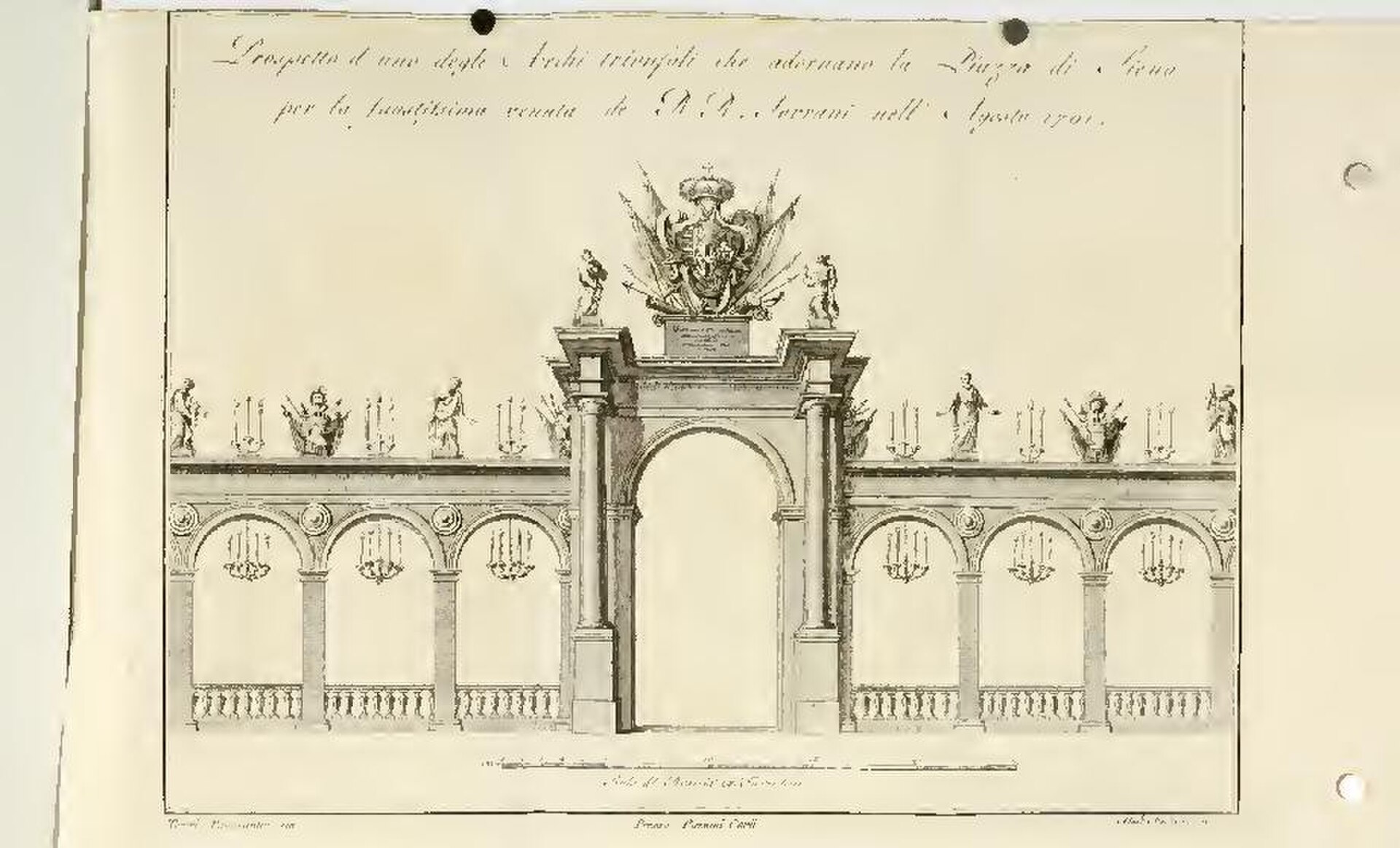
Tommaso and the architecture of celebration, 1791
Before the bell tower, Tommaso Paccagnini worked on a grander and more fleeting stage. When Siena prepared to welcome the new Grand Duke in 1791, the printed account of the festivities gave him the design of the portico raised in the Piazza Grande, today’s Campo. Its folding plate of a tall triumphal arch between arcades is architecture made of timber, canvas and paint for a single season, and the only image of his own design that has come down to us. He died at Siena in 1810.
Francesco di Tommaso: from Montalcino to Rome
Tommaso’s son Francesco was born at Montalcino in 1780. On 4 July 1805 the Accademia di San Luca gave the third prize of the second class of architecture to “Francesco Paccagnini Senese” for a design of a cemetery for a great city, which survives in the academy’s collection. He made his career in the Papal States as a government architect; after the great flood at Tivoli in 1826 he built a temporary timber bridge in a month. He died in Rome on 22 May 1832, and is very probably the architect named for the façade of the Madonna del Soccorso.
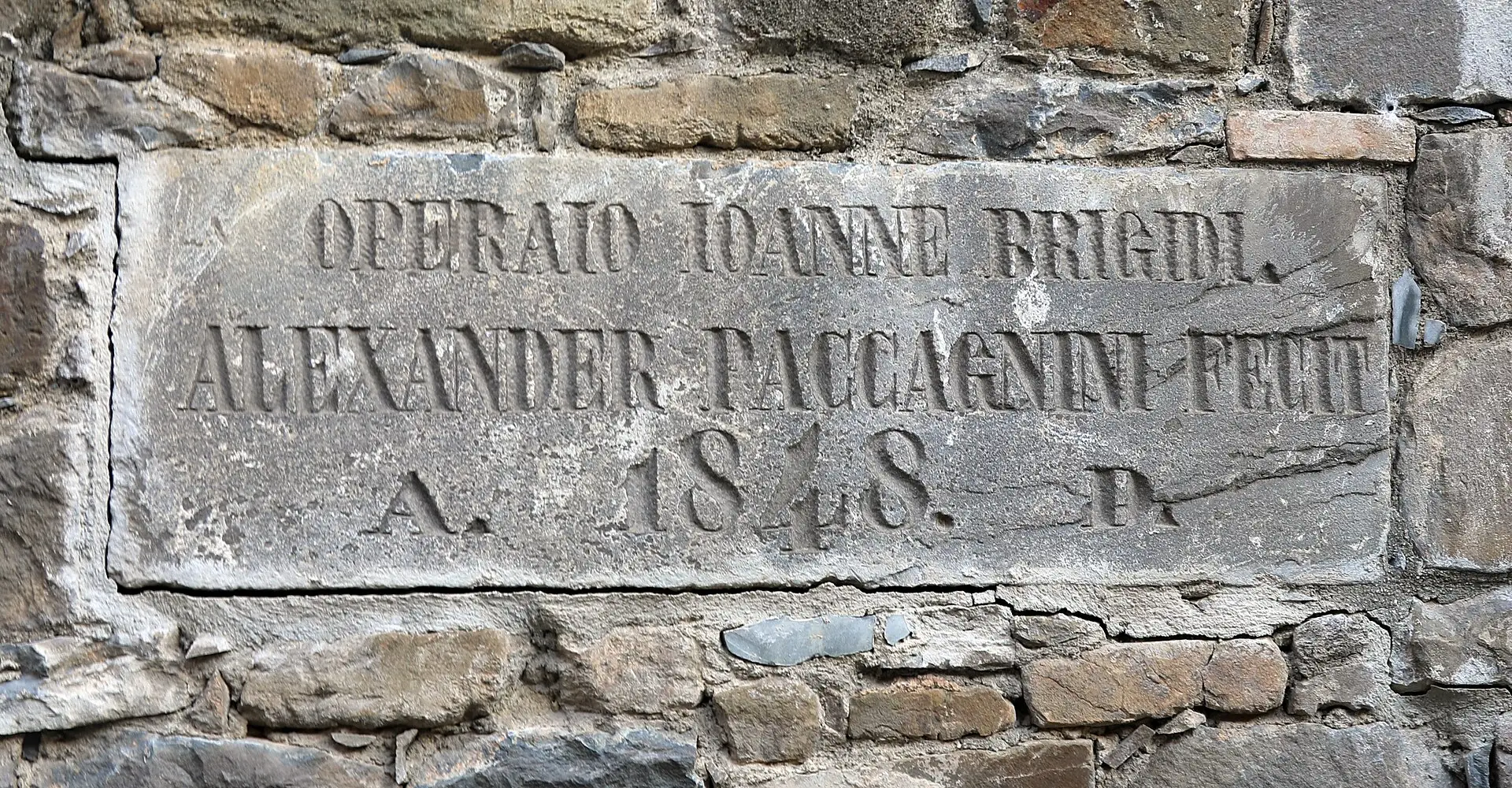
Alessandro’s inscription, 1848
An inscription of 1848 near San Pietro reads “ALEXANDER PACCAGNINI FECIT”, recording work done while Giovanni Brigidi was the operaio, the lay officer in charge of the fabric. Two men could have signed it: Alessandro, son of Cesare, born in 1830, and Angelo’s son Alessandro, born in 1819 and living in the master builder’s house in 1841, who is perhaps the likelier.
Silvia, a Paccagnini among the Padelletti
Silvia Paccagnini was born on 21 July 1826 and baptized at Sant’Egidio. On 22 July 1848 she married Enrico Padelletti, later cavaliere and mayor of Montalcino. Their first daughter, Adelina Maria, died in infancy; Adele, born on 13 July 1851, was very probably the Adele Padelletti who married Avv. Orazio Brigidi in 1872; Ida followed in 1856. Silvia died at Montalcino on 17 October 1900, aged seventy-four, “widow of the late Cav. Enrico Padelletti”. See The Padelletti of Montalcino.
Riccardo and the wine of Soccorso
Riccardo Paccagnini was born in May 1854, a twin with his sister Amabile; the parish return names their father as Serafino Paccagnini, a mason, and their mother as Angiola Padelletti (a probable reading). He became a professor and one of the first men of Montalcino to sell its wine beyond the town. A diploma from Bordeaux records that at the city’s industrial and international exhibition of 1904 he received a Grand Prix for a Brunello of the 1894 vintage, and the same year his name appears among the Montalcino wine exhibitors at the World’s Fair at St. Louis. He also wrote a practical treatise on agriculture and winemaking. His vineyard lay on the podere Soccorso, just below the sanctuary of the Madonna del Soccorso where the Tamanti had their altar; the farm was restored from 1999 by its present owners, who have revived the look of the old label.
Builders into the twentieth century
The trade outlived Felice, who died in 1861. His eldest son Romualdo, a mason, married in 1846, and their son Oreste was born on 18 February 1854. A study of Buonconvento published in 1985 records an heir’s memory that his grandfather Oreste and his father Romualdo were still at work as builders in the town in 1912. More than a century after Pietro and Angelo raised the bell tower, Montalcino still knew the Paccagnini as builders.
Other Paccagnini marriages wove the family into the houses of the storybook: Luigi Paccagnini married Giuditta Saloni (see The Fineschi, the Faenzi and the Saloni); Filippo Paccagnini married Luisa Galassi, the sister of Pietro Begni’s widow (see The Begni); and in the twentieth century Carmela Paccagnini married Giuseppe Brigidi (see The Brigidi).
Sources
- Don Antonio Brandi, Studi e trascrizioni: the San Francesco chronicle (1749), Canon Vincenzo Chiarini’s description of the cathedral (1817), the 1848 inscription
- In espettazione delle Loro Altezze Reali Ferdinando III … e Luisa Maria di Borbone (Siena: Pazzini Carli, 1791)
- Accademia di San Luca, La distribuzione dei premj (1805); Bibliotheca Hertziana; Carlo Fea, Considerazioni (1827)
- Montalcino parish census (stato delle anime), 1841; civil registers on the Portale Antenati: Matrimoni 1822 and 1846, Nati 1826 and 1854, Morti 1854, 1861 and 1900; Sant’Egidio baptism index
- Bordeaux diploma, 1904; Official Catalogue of Exhibitors, Louisiana Purchase Exposition (1904); Ilio Raffaelli, Un pioniere del vino brunello (1990)
This page is drawn from the Palazzo Tamanti storybook (version 2.48, October 2026), chapter “The Paccagnini: builders, architects and a pioneer of Brunello”, where every fact carries a full archival reference. All connected families · Back to the Tamanti family history.