

The Tamanti were not originally from Montalcino. Carle’s published genealogy traces them to Buonconvento, in the Ombrone valley. The geographer Emanuele Repetti put it six miles north of Montalcino. In Grand Duke Pietro Leopoldo’s day, travellers from Siena went as far as Buonconvento by carriage and continued to Montalcino on horseback. The family’s founder is remembered by a nickname: Cristofano, called “Il Tempesta” (“the Storm”), who died in 1590 (Carle, La patria locale, 1996, p. 292).
Arrival in the later 1500s
According to Carle, the family moved from Buonconvento to Montalcino in the later sixteenth century. They settled in the Terzo di Sant’Egidio, one of the town’s three historic districts. Their house stood in the street then called the Mattonato, today’s via Soccorso Saloni (Carle, 1996, pp. 289–300). Palazzo Tamanti itself holds older clues. Its hearth carries the date MDX (1510), earlier than any securely traced Tamanti in Montalcino. The family probably bought or incorporated an older building, but that remains a working hypothesis, not a documented fact.
The name is not new in town, though. A compilation of early Montalcino baptisms records a Marco di Cesare di Francesco Tamanti in 1570 (Brandi, Studi e Trascrizioni). No record yet connects Marco to Il Tempesta. He may belong to an earlier or side branch, and for now he is the earliest Tamanti found in Montalcino, not a proven ancestor.
Scipione’s children and the Donnoli marriages
Carle’s line runs through Scipione Barnaba Tamanti (1574–1657) and Carlo Giuseppe Tamanti (1629–1666). Marriage records show the family joining Montalcino’s established households. In 1629 Lavinia Donnoli married Carlo, son of Scipione Tamanti. On 10 September 1639 Girolamo Donnoli married Fulvia, Scipione’s daughter (Bonucci, “Per una genealogia dei Donnoli di Montalcino”, 2022, pp. 50–51). The evidence comes from a register of marriages in the town’s five parishes, compiled in the 1790s by Canon Vincenzo Chiarini.
Property and devotion went together. Christofana, another daughter of Scipione, left 100 scudi to pay for Masses. Fulvia’s estate was arranged so that its income paid dowries for female relatives in some years and Masses in the others (Brandi, Studi e Trascrizioni).
A veteran family and a Gonfaloniere
By the mid-1600s the Tamanti had a recognised civic rank. Carle records that the family was declared a “veteran” family in 1651. This was the status Montalcino gave to long-established citizen families, as distinct from newer residents, following a reform of 1644. Half a century later, in 1701, “dr. Jacomo” Tamanti became Gonfaloniere, the town’s chief magistrate (Carle, 1996, pp. 289–300). The storybook still lists the original civic registers for both points as research targets, so for now they rest on Carle.
That Jacomo is almost certainly Dr Jacomo Cosimo Tamanti (1649–1710), Carlo Giuseppe’s son. He is also probably the “Tamanti Dr.” who owned five of the six Tamanti farms in the 1692 fiscal tables, among them Chiusa, Scannaquoia and Pelagrilli (Bonelli Conenna, Il contado senese alla fine del XVII secolo, 1990, pp. 162–166). The source prints only the honorific, but his age and presence in Montalcino fit well. In 1699 a Giacomo Tamanti and his wife Anna Mechini gave the right altar of the Madonna del Soccorso, dedicated to the Virgin, Saint Gaetano and Saint Carlo Borromeo (Brandi, Studi e Trascrizioni). No source yet says whether this donor was Dr Jacomo Cosimo.
A book inscribed in 1675
The Italian book-provenance database records a volume inscribed on its title page “Jacobi Tamantij | 1675” (“of Giacomo Tamanti”). A later owner’s note by an Antonio Tamanti is on the front flyleaf (Archivio possessori, “Tamanti, Giacomo”). If the hand is Dr Jacomo Cosimo’s, he wrote it at 26, around his university years. This would fit Mario Ascheri’s observation that the Tamanti were among the Montalcinesi who reached the university and the professions, in a town with substantial private libraries. The library that holds the book and its chain of ownership are still to be verified.
The anchor and three stars
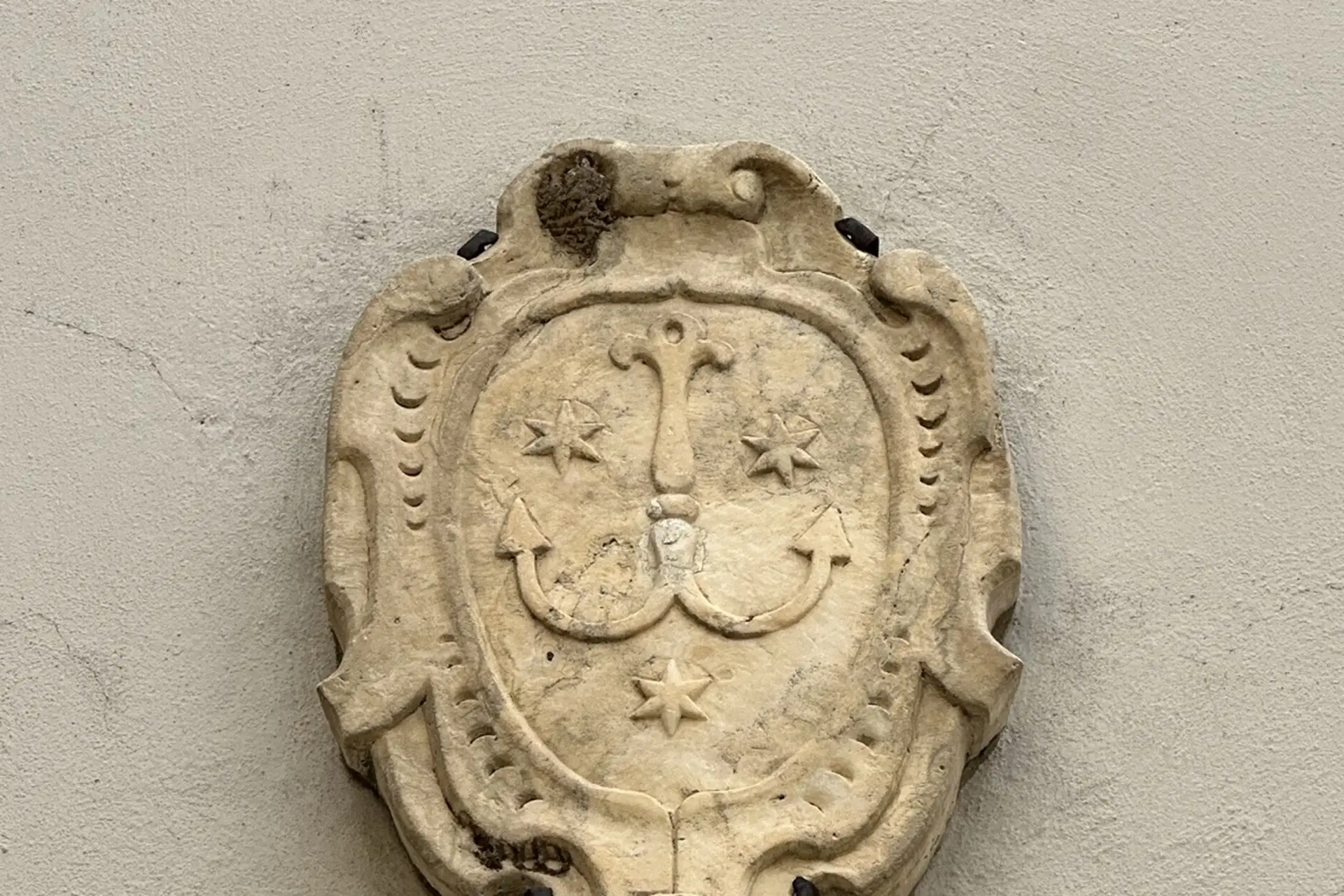
Above the palazzo’s main door is an oval shield in a scrolled stone frame. It shows an upright anchor with three eight-pointed stars, two above and one below. Metal clamps hold it to the facade, so it is a separate piece added to the older portal, and the door and the arms need not date from the same time. The anchor appears again on an iron shield in the old wine cellar, between the letters T and A. The Italian cultural-heritage catalogue gives the traditional Tamanti arms as an anchor with three gold stars on blue.
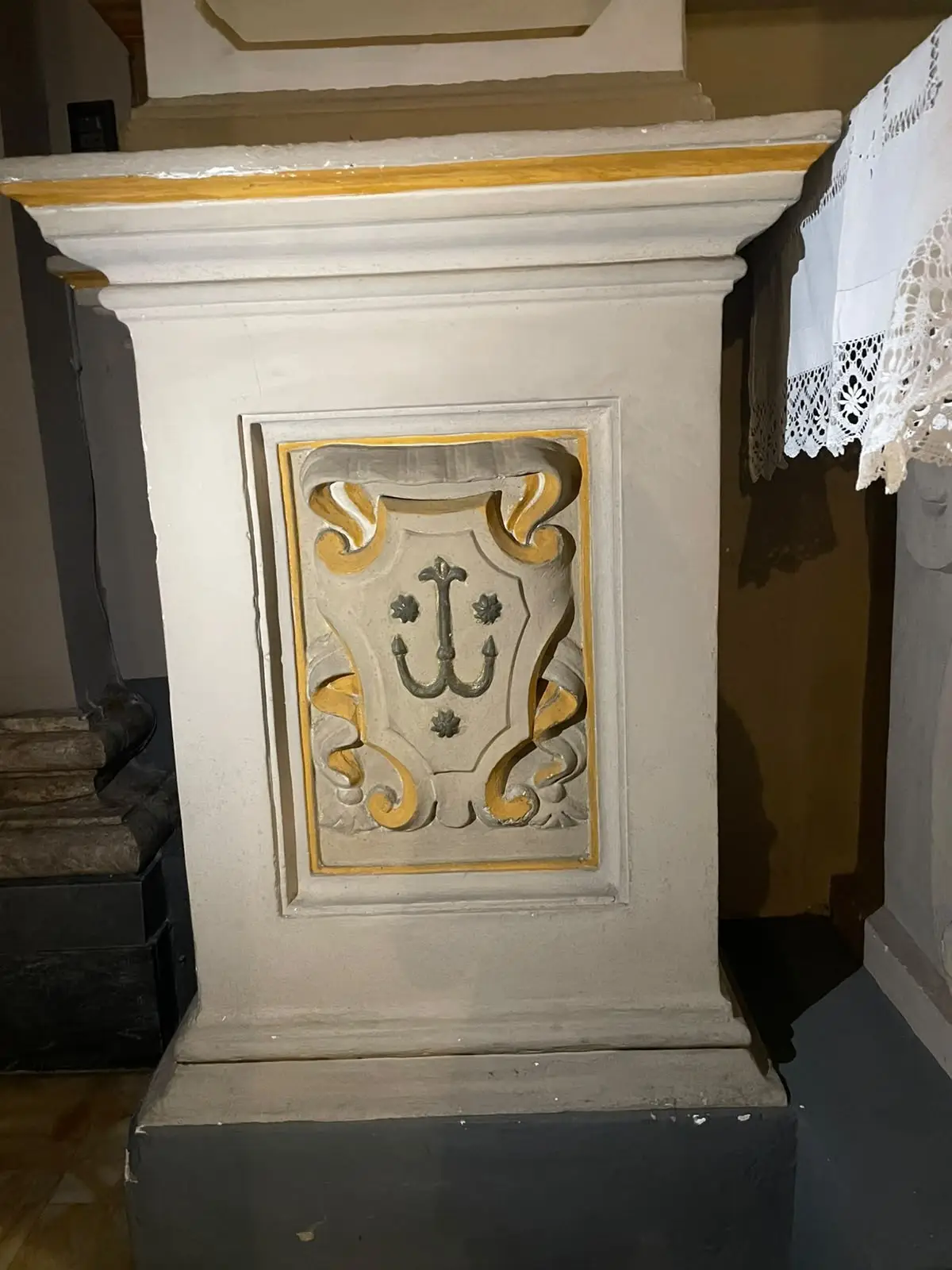
The same emblem is carved inside the Madonna del Soccorso, the church where the 1699 altar was given. That repetition strongly ties the device to the family. It is still unknown whether that relief belongs to the 1699 altar or to a later gift.
It is tempting to read the anchor as a sign of seafarers or sea merchants. The anchor is also a common heraldic figure and a Christian symbol of hope. Until an early dated seal or a merchant or maritime record connects the Tamanti with the sea, it is best read as a family emblem that may carry either meaning, or both.
Sources on this page
- Lucia Carle, La patria locale. L’identità dei Montalcinesi dal XVI al XX secolo (Regione Toscana / Marsilio, 1996), Tamanti chapter pp. 289–300; family tree p. 292
- Don Antonio Brandi, Studi e Trascrizioni (baptismal surname list, 1570; Tamanti legacies; 1699 Madonna del Soccorso altar inscription)
- Bruno Bonucci, “Per una genealogia dei Donnoli di Montalcino”, appendix to M. A. Ceppari Ridolfi, “San Donnolo martire di Ceuta (1227)”, Rivista Accademia dei Rozzi XXIX/1 (2022), no. 56, pp. 50–51; underlying repertory Archivio Vescovile di Montalcino, cart. 339
- Lucia Bonelli Conenna, Il contado senese alla fine del XVII secolo: Poderi, rendite e proprietari (Siena, 1990), pp. 162–166
- Mario Ascheri, “Montalcino nella storia: alle sorgenti del Brunello”
- Archivio possessori, record “Tamanti, Giacomo” (inscription “Jacobi Tamantij | 1675”)
- Emanuele Repetti, Dizionario geografico fisico storico della Toscana, vol. 3 (1859)
- Un granduca “popolare” sul trono di Toscana: saggi su Pietro Leopoldo d’Asburgo Lorena (travel observations, owner-supplied compilation)
- Italian cultural-heritage catalogue, description of the traditional Tamanti arms (as cited in the storybook)
- Treccani, “Àncora”, Vocabolario online (heraldic meaning of the anchor)